





| Updated:
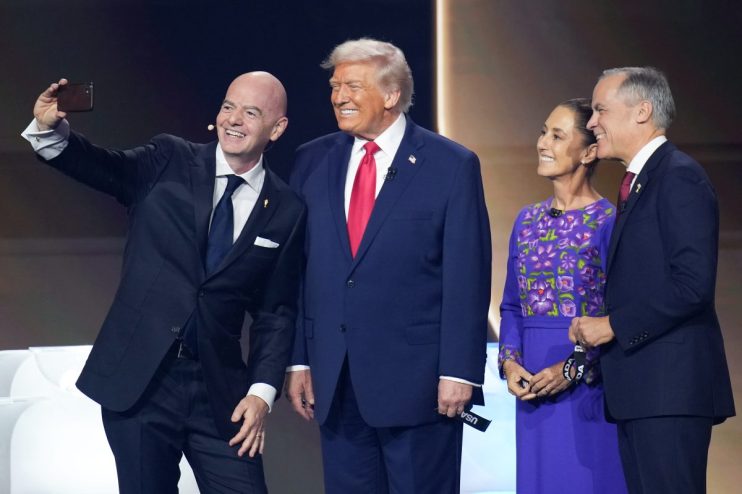
Former FCDO special adviser, Flint Global’s Alan Sendorek, discusses the sport diplomacy playing out with Fifa’s Infantino and Trump at its centre.
Gianni Infantino’s efforts to cultivate a visibly warm relationship with Donald Trump have been mocked in many quarters. From the award of the inaugural Fifa Peace Prize to hailing the President as ‘my great friend’ in Davos, the optics of the Fifa president wearing a Maga cap certainly sit uneasily with the idea of football as a unifying, apolitical force. But dismissing Infantino’s approach as grandiosity or politicisation risks missing a more important point: global sport is not insulated from geopolitics, and governing bodies ignore that reality at their peril.
The 2026 Fifa World Cup this summer will be the largest in history, with the United States as its principal host. Fifa needs to work closely with the US not just on logistics and infrastructure but on regulatory cooperation, visa policies, counterterrorism and cybersecurity. In that context, establishing and maintaining a constructive relationship with the main host government is not an indulgence, it is vital risk management.
For Fifa, the stakes are unusually high. The tournament will bring together teams and supporters from across an increasingly fragmented geopolitical landscape, with more nations involved than ever before. Iran’s qualification alone illustrates the complexity, given the state of relations with the United States, but there are three other competing countries also subject to travel bans – Senegal, Ivory Coast and Haiti. Ensuring that players, officials and, as far as possible, fans and delegations can travel, compete and engage safely will require careful coordination across political and diplomatic channels.
Trump, tarrifs and trade
Economic policy is another variable. Trade barriers, tariffs, sanctions and shifting regulatory requirements can affect everything from sponsorship arrangements to the movement of equipment and personnel. In addition, security concerns, from cyber and terrorism to civil unrest, are evolving in ways that demand close alignment with host governments. Fifa has reportedly requested a moratorium on ICE raids in World Cup host cities during the tournament to minimise disruption, using Infantino’s personal relationship with President Trump to press the case.
Critics might question whether gestures such as the Fifa Peace Prize or Infantino’s praise for the President go too far. But international diplomacy is often performative by design. Symbolism, flattery and carefully calibrated gestures are longstanding tools of statecraft. For example, a head of government ceremonially presenting a letter from a Monarch to signal goodwill, as Sir Keir Starmer did on his first visit to Trump’s White House. Or Mark Rutte, Secretary-General of NATO, hailing the President’s “truly extraordinary” action in Iran in 2025 in a private text message that didn’t stay private for long. “Something no one else dared to do. It makes us all safer,” he enthused. Such moments are less about substance than about creating the conditions for substantive cooperation.
This is not to suggest that every tactic employed by international sports organisations is beyond criticism. There is a legitimate debate about where to draw the line between pragmatic engagement and reputational risk. Nor does engagement guarantee success. Geopolitics has become more challenging to predict, and even well-managed relationships can be tested by events beyond anyone’s control.
Structural shift
However, the structural shift is clear. As global tensions rise and the intersection between politics, economics and security becomes more pronounced, international sporting bodies are being pulled, sometimes unwillingly, into that orbit. Any hope or expectation that they can remain entirely removed from geopolitical constraints is simply not realistic.
In extreme cases, governing bodies like the FIA and sports entertainment organisations like WWE must now deal with conflict and additional instability in the Middle East, making the events they host there much more complicated. The challenge for them is not to avoid political entanglement, but to navigate it effectively.
As the international political landscape becomes more volatile, delivering sports mega-events now requires geopolitical fluency as well as organisational competence. Acknowledging that reality and responding with clear-eyed pragmatism may be uncomfortable, but it is increasingly necessary.
Alan Sendorek is a director at Flint Global and former special adviser at FCDO and 10 Downing Street
