




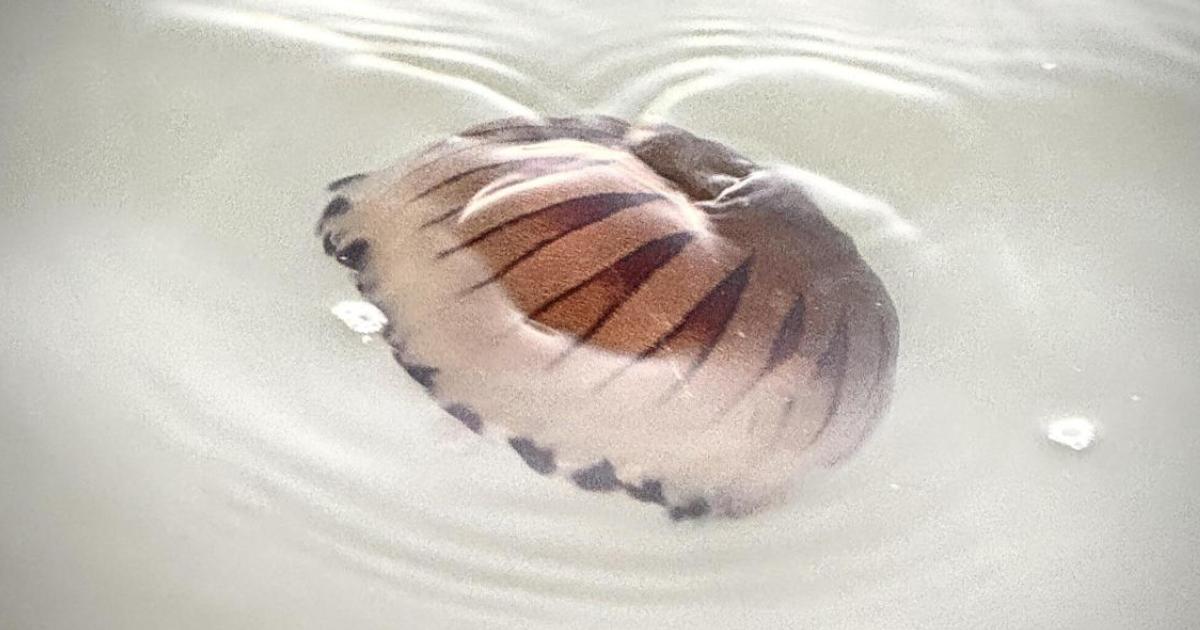
Brighton resident Piers Helm spotted the jellyfish on Hove beach near the King Alfred Leisure Centre when he was about to go for a swim on Wednesday morning, July 8.
He believes it is a compass jellyfish, which are commonly found off the southern and western coast of the UK in summer months.
Compass jellyfish are recognisable by their distinctive brown marking, reminiscent of a compass; however, the public are warned not to touch them as they have a nasty sting.

A spokesperson for the RNLI said: “They’re always a nuisance at this time of year, but with the lovely weather, more folk are noticing them as they’re enjoying the water.
“We always advice visitors to the beach to go to a lifeguarded beach wherever possible and to swim between the red and yellow flags.”
Most jellyfish found in UK and Irish waters are harmless, but some can deliver stings ranging from mild to severe.
The moon jellyfish, easily recognised by its four circular markings, is the most commonly found.
More concerning is the barrel jellyfish, which can grow up to a metre wide, with one having been spotted off the coast of Seaford in May.

Lifeguards are trained to treat jellyfish stings by carefully removing any tentacles, rinsing the affected area with cold seawater—and avoiding the use of fresh water or cold packs—and soaking the injury in very warm water for at least 30 minutes.
The RNLI stresses that anyone experiencing a serious or life-threatening reaction should call 999 or 112 immediately and request an ambulance.
Beachgoers are also advised not to touch jellyfish—dead or alive—as they can still sting.
Wearing wetsuits or rash vests can help reduce the risk of stings for those planning to enter the water.
Source link
[Featured]
[Just In]
