












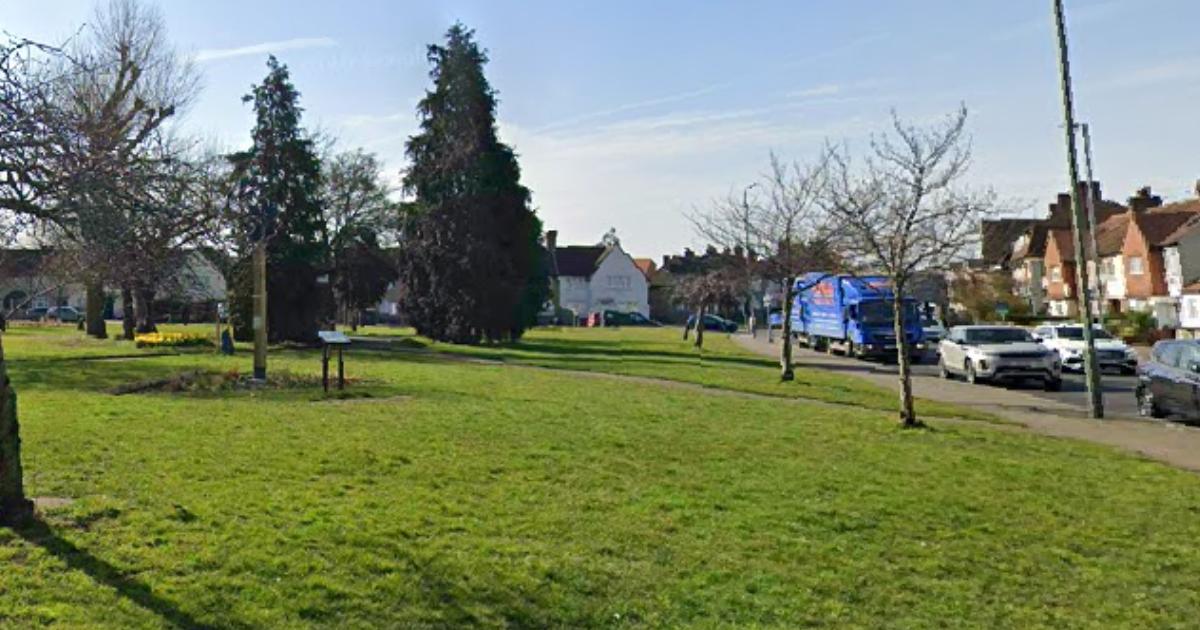
One longstanding theory claims a highwayman named Elmer was hanged at the crossroads, where Elmer met his “End”, according to Foxtons.
Wikishire suggests the name derives from an Anglo-Saxon term associated with criminals and public punishment, and that Elmers End Green, now a traffic roundabout and small public space, may once have been used for executions.
Today, the area sits within the London Borough of Bromley, bordered by Beckenham, Anerley, Eden Park, and Monks Orchard.
Local theories say that criminals were publicly executed on Elmers End Green (Image: Google Maps)
It lies around 11 miles from Charing Cross and forms part of outer south-east London’s suburban belt.
The most historically grounded explanation for the name links it to the medieval Aylmer family, wealthy landowners who held estates in the area during the reign of King Henry III.
According to Wikipedia, in old English place-name conventions, “End” referred to the edge or boundary of an estate, making Elmers End effectively “the boundary of the Aylmer lands.”
Records suggest the area was documented as early as 1226, making it one of the older recorded settlements in the borough.
For centuries, Elmers End remained a rural hamlet surrounded by farmland, woodland, and scattered estates. The arrival of the railway transformed the district during the Victorian era.
Elmers End station opened in 1864 and gradually turned the area into a commuter suburb connected directly to central London.
Elmers End station (Image: Google Maps)
The station later became one of the few places in south London where National Rail and Tramlink services terminate side by side.
Part of today’s tram route follows the former trackbed of the Woodside and South Croydon Joint Railway, a Victorian railway line that finally closed in 1983 before being repurposed for modern tram services. Elmers End Green remains one of the oldest surviving features of the district.
A triangular patch of land shown on maps as early as 1723 later became a children’s play area and even hosted air-raid shelters during the Second World War.
The railings around the Green were removed in 1941 as part of the wartime metal collection effort. One of the area’s most remarkable sites is Beckenham Crematorium and Cemetery, commonly known as Elmers End Cemetery.
Opened in 1876, it contains the graves of several nationally significant figures, including legendary cricketer W.G. Grace and plumbing pioneer Thomas Crapper.
Beckenham Crematorium and Cemetery is the resting place of Thomas Crapper (Image: Google Maps)
Crapper, often incorrectly credited with inventing the flush toilet, helped popularise major improvements to Victorian sanitation systems, including the floating ballcock and U-bend plumbing trap.
The cemetery also contains the grave of Samuel Rowbotham, better known as “Parallax,” an early and influential advocate of flat-earth theory.
South of the railway stood the vast industrial works of Muirhead & Co, a pioneering electrical engineering company established in the late 19th century.
The company specialised in submarine cable communications equipment and later developed facsimile transmission technology, helping position Elmers End as an unlikely centre of communications engineering.
The former factory site is now occupied largely by a Tesco superstore.
The Tesco Superstore is now in place of the old factory site (Image: Google Maps)
One of Elmers End’s strangest transformations can be found beside the station at South Norwood Country Park.
The 47-hectare park was formerly a Victorian sewage farm where Croydon processed waste using irrigation fields and filtration channels.
After the sewage works closed in 1967, the contaminated land was left undeveloped and gradually rewilded into wetlands, woodland and grassland.
The park officially opened in 1989 and also contains the remains of a medieval moated manor site dating to the 13th or 14th century.
Average property prices in Elmers End sit broadly in line with neighbouring parts of outer south-east London, with transport links remaining one of the district’s strongest assets.
Tram services connect the area directly to East Croydon and Wimbledon, while National Rail services provide routes into London Charing Cross and Cannon Street.
Politically, Elmers End sits within the Beckenham and Penge parliamentary constituency.


