












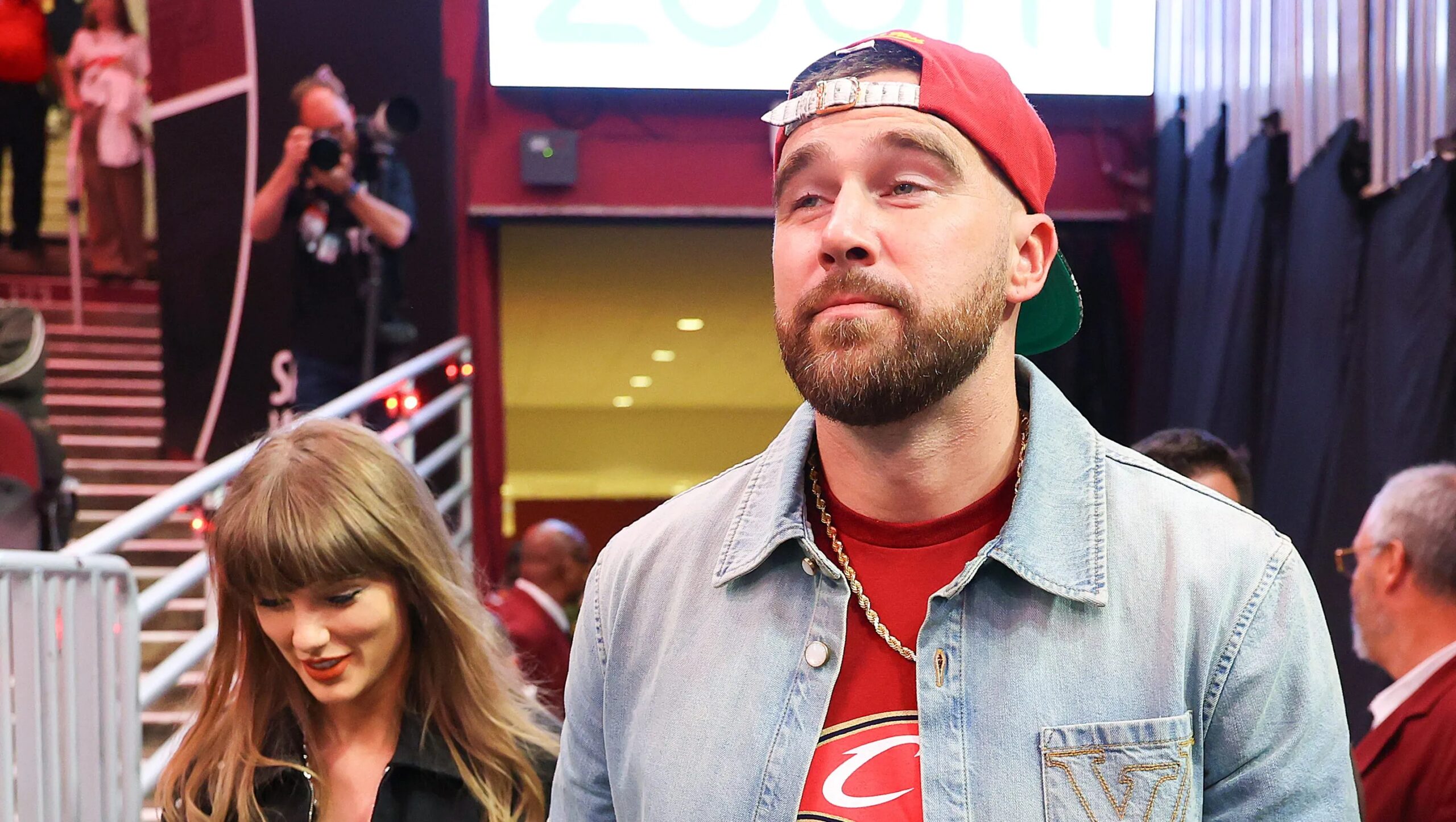
Taylor Swift and Travis Kelce showed up to the Cavaliers vs. Knicks game Saturday night in matching double denim. Courtside. Cleveland. Engaged. Glowing.
The internet did what the internet does. Screenshots. Side-by-sides. “Couple goals” with seventeen heart emojis. The fantasy was activated in milliseconds.
And honestly? I get it. They look vibrant, happy, entirely in sync. When two people mirror each other’s energy and style that flawlessly, it touches something deep. It feeds a story we all desperately want to believe is true. That if you just find the right person, love will be a seamless, effortless alignment of two souls.
I’m thrilled for them. I also have to tell you what I see when I look at that photo, because it’s not the whole movie. It’s the opening scene.
What the Honeymoon Phase Is Actually Doing to Your Nervous System
In my opinion, from cradle to grave, we are hardwired for emotional bonding. Your nervous system is constantly scanning your partner for the answer to two questions. Are you there for me? And am I enough for you?
When a relationship is brand new and the chemistry is firing, the answers are a loud, continuous, effortless yes. You dress alike. You finish each other’s sentences. Your nervous system relaxes into the absolute high of feeling completely chosen and entirely acceptable.
It’s intoxicating. It’s also temporary. And it’s the difference between infatuation versus actual love that most couples never get taught.
The pattern this celebrity moment exposes is the quiet expectation we all carry. That love is supposed to stay in the matching denim phase forever. We mistake the initial synchronization for the relationship itself. When that perfect alignment inevitably cracks, people panic.
I see this exact panic every Tuesday in my office. I work with founders, executives, creatives. People who have cracked the code of professional adulthood. Brilliant, highly competent humans. They sit on my couch devastated, and they say some version of the same thing.
“We used to be perfectly in sync. We used to be just like that couple on the courtside. Now all we do is fight.”
They have an unconscious expectation that because they are well educated and successful, they should be able to make their relationship smooth. They treat the relationship like a project to be optimized. When they hit a moment of disconnection, they treat it like a performance review they’re failing.
The Waltz Nobody Posts on Instagram
Here’s what’s actually happening when the sync breaks.
One partner feels a slight drop in attention. Their alarm bells go off. They feel like they are no longer a priority. Because the pain of feeling abandoned is biologically unbearable, they rise up to protect themselves. I call this person the Relentless Lover. They protest, they criticize, they demand. They live in the emotional penthouse, scanning for connection, and when they don’t feel it they bang on the floorboards.
The other partner feels that criticism and their own alarm bells go off. They feel like a constant disappointment. To survive the shame, they retreat. I call this person the Reluctant Lover. They shut down, rationalize, hide in their work or their phone. They live in the emotional basement.
Your protector meets your partner’s protector. You get stuck in what I call the Waltz of Pain. One, two, three. One, two, three. The Relentless Lover reaches. The Reluctant Lover retreats. The more one retreats, the harder the other reaches.
You think you’re fighting about the dishes, or the schedule, or the tone of voice. You’re never fighting about those things. You are fighting for your emotional survival. You are fighting because you mean so much to each other, and you don’t know how to reach each other through the armor.
If any of this is starting to feel uncomfortably familiar, you can take our free relationship quiz and see which role you’re playing in your own waltz.
Proof of Stake vs. Proof of Work
Most of the internet will tell you that if you’re fighting, your relationship is toxic. That your partner lacks emotional intelligence. That you need harder boundaries.
I’m going to tell you the opposite. Disconnection is not a bug in your relationship. It’s a feature. If you really believe your relationship should be a place where you get to be your full authentic self and you never scare your partner, I have no idea how you’re going to have a relationship you’re happy with. You are guaranteed to scare the living daylights out of your partner. Why? Because you love each other.
We love the matching outfits and the courtside smiles. I call that Proof of Stake. It’s the public display of connection. It’s beautiful. I’m genuinely thrilled for Taylor and Travis. But Proof of Stake is not the actual relationship. The actual relationship is what happens the first time one of them is exhausted, or overwhelmed, or preoccupied, and the perfect sync breaks.
Real love requires Proof of Work. And in relationships the work is not performance. The work is repair. When we disconnect, do I have the humility to expend the energy to fix it? To own my part? To cross the bridge to your reality? That’s energy expenditure. It’s costly. It burns calories. It hurts the ego.
Here’s the move. When you feel the panic of being out of sync, picture the letter C. The top of the C is your reactivity, your anger, your urge to criticize or shut down. Ride the curve down to the bottom, where the actual feeling lives. Usually it’s a profound sadness that you don’t matter, or a raw terror that you’re a disappointment.
Then share from the bottom of the C without attaching a single request or criticism. Look them in the eyes and say, “When we are out of sync, I get really sad and scared that I don’t matter to you, and because you are so important to me, that feels unbearable.”
They usually stop fighting you. Because they were only ever fighting your armor.
The Part the Camera Doesn’t Catch
Long-term love does not look like perfectly coordinated denim. It looks like two people on the kitchen floor at 11 p.m., ego-bruised and tired, choosing to cross the bridge one more time.
I hope Taylor and Travis get a thousand more matching denim nights. I also hope they get good at the unphotographable part. Because that’s the part that actually holds.
________________________________________________________________________________
Figs O’Sullivan, LMFT and his wife, Teale, are couples therapists in San Francisco, relationship experts to the Stars and Silicon Valley, founders of Empathi, and built Figlet, our AI relationship coach, an AI relationship coach trained on their clinical work.


