










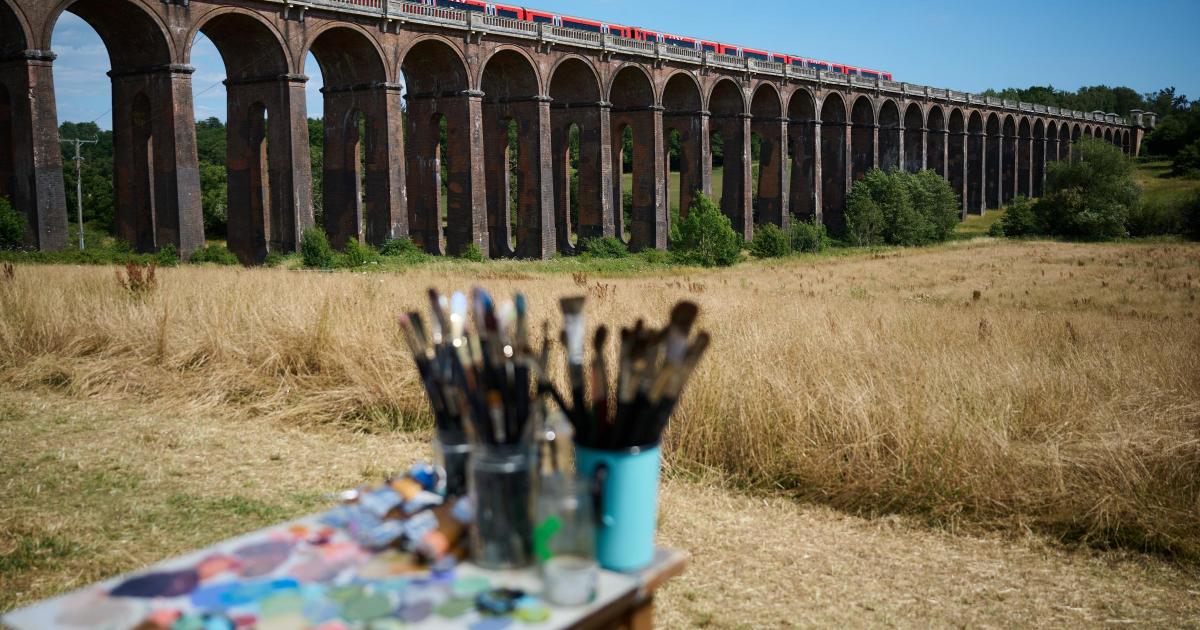
My taxi driver Alex is almost more excited than I am when I tell him where I need to go. ‘That’s one of the most beautiful buildings in England,’ he says when I ask him to take me to the Ouse Valley Viaduct. ‘In fact, you would have travelled over it on your journey here.’
The iconic red brick structure sits just north of Haywards Heath and south of Balcombe and is part of the London to Brighton railway, and as we pull up a few minutes later, he gives me the perfect introduction, pointing out the neo classical elements along the top. Against a clear blue sky, it is striking.
The day has started way before I get here – at around 6am and has been in the planning for months. Everywhere I look around this Sussex landmark is a plethora of large vehicles containing all manner of equipment including cameras, sound equipment and tripods while a catering van up on the hill provides a delicious distraction.
An army of creative-looking people are walking around, talking into walkie talkies and all appearing like they have somewhere to go fast.
Stephen Mangan presents the 11th series of the popular Sky Arts programme.Chris Lobina/Sky (Image: Chris Lobina/Sky)
And there, in the distance, are the iconic pods, created to shield their occupants – talented amateur and professional artists – from the elements so they can do their best work come rain or shine. This is the location for the semi-final of the 11th series of Sky Arts Landscape Artist of the Year where today the Ouse Valley viaduct will be the star of the show. Described as a ‘well-oiled machine’, this popular programme has a crew of around 85-90, many of whom have worked on the series from day one.
Today, instead of the usual seven, a total of eight artists have been chosen to take part, each with their own unique styles and take on the viaduct. The competition is open to all kinds of artists with the winner awarded a £10,000 commission to paint a particular location for a high-profile institution. Last year’s winner, self-taught artist Benjamin MacGregor, was commissioned to paint a landscape in the south of France by London’s Courtauld Gallery, which boasts a collection that includes Monet.
Artist Ben MacGregor was crowned the Sky Arts Landscape Artist of the Year last year (2025) (Image: Sky)
What are the challenges? As you can imagine, the main one is the good old British weather. After a downpour at Hever Castle in Kent two years ago, the crew were out with squeegees soaking up the water before the competition could start. Today the sun is already up and it’s predicted to be a hot day but it’s a challenge channelling your creativity in the heat.
I walk under the viaduct and on the hill see that the artists are already at work in their pods. Some are working from an easel and will stand back, look at the vista and study their work; others are working from a table. Fans are whirling in a bid to keep the artists cool, so they can concentrate on the task in hand. The artists arrived at 7.30am and are painting by 10am with breaks every hour. They will finish at 3.45pm and will have had four hours to create their finished piece.
Caught on camera: the judges deliberating about their favourite artist. Julie Lucas (Image: Julie Lucas)
‘It’s an extraordinary set up,’ smiles one of the artists – who we can’t name to avoid spoiling the series. ‘The crew are delightful and I love the judges. I paint all the time, but have never done anything like this before. Taking part is hugely uplifting. It brings together lots of people with different ideas all wanting to paint, all under pressure, so there is this shared experience. I try and forget anything else and think of it as a normal day painting outside with no one else around.
‘It’s proving hard today in the heat, but I have something called liquin which helps the paint drying process for the first stage otherwise you end up with a gooey mess. I am trying to keep the colours as fresh as possible.’
The schedule is tight but the crew know exactly what should be happening – and where everyone needs to be – minute by minute. Although there’s the pressure to get the right shot, everyone is remarkably calm and friendly. When I inadvertently walk in front of a camera, I don’t hear the booming voice of a director telling me to get out of the shot. It makes for a relaxed atmosphere, and, I imagine, easier for the artists to do their best work.
Staring at the different artworks in progress, I wonder how the judges select the best. ‘It can’t be personal,’ explains newcomer Eva Langret, artistic director of art fair Frieze London, who has 20 years’ experience in the art world. ‘We think about how the artist is approaching the landscapes, how it works with what we have seen of them in their submissions and look at the work that they are making on the day. We try to be as objective as possible.
The Ouse Valley Viaduct near Balcome is an architectural masterpiece and fitting muse for the artists. (Image: Getty)
‘We also understand that it is a very specific set of circumstances. There are artists who are not used to working on plein air [outside] and many of them might usually take three days or three months to produce work.
‘It’s the semi-final now and it’s really strong and also very diverse in terms of the artists’ various approaches. We have realist painters, artists that are interested in colour, abstract artists… It makes the judging even more difficult dealing with completely different visions and at this stage everybody’s good.’
For Eva working on television for the first time has also been a new experience. ‘There’s been the behind the scenes learning curve and understanding how it all works; discovering these landscapes which has been incredible and then getting to know the artists and working with [fellow judges] Tai Shan Schierenberg [award-winning portrait artist] and Kathleen Soriano [interim director of Hastings Contemporary]. I have really enjoyed it.’
Do they ever disagree on judging? ‘We do have debates,’ admits Eva. ‘I knew of Kathleen and Tai, but we didn’t know each other personally before the show. We all come with very different points of view, but even with those different viewpoints we usually come to the same conclusion in a very easy way. The path is different, but we agree on the result.’
Locations for this series have included Dover Castle, the Lake District and The Thames from HMS Wellington in London, but today’s setting has impressed both artists and judges. ‘It’s so grand,’ Eva enthuses. ‘Of all the locations, I think it’s the one that really brings together the relationship between architecture and landscape in a really interesting way.’
The Ouse Valley Viaduct near Balcome is an architectural masterpiece and fitting muse for the artists. (Image: Getty)
Built in 1839, the impressive structure was designed by John Urpeth Rastrick for the railway route between the caost and the capital, and reportedly used 11 million bricks in its construction. Look through some of the 37 arches and they appear infinite. It was a milestone in both engineering and design and its scenic setting draws both photographers, railway enthusiasts – and now artists.
As we talk it starts to cloud over, changing the light. Is that a problem? ‘Yes,’ Eva says, ‘Particularly for something that has such strong architecture. The shadows are looking completely different from when we entered this morning, and the colour of the bridge has changed. This morning there were strong shadows and now you can see the different reds in the brick.’
One of the judges’ roles is to put the painters at ease. And as well as the crew, in some of the other locations, such as St James’s Park, there’s an audience. ‘In most cases making art is a very private process, it’s our job to make the artists feel comfortable. We want them to have a nice day and a good experience,’ Eva says.
‘This is the semi-final so we are getting to know them and their work more. I think it makes the judging more insightful as we get to know their practise, but at the same time it’s harder because at this stage the standards are much higher.’
The programme is a well-oiled machine. (Image: Julie Lucas)
The programme is presented by actor Stephen Mangan who loves that it gives artists a platform. He is such a fan he has even purchased artworks from the competitors over the series. ‘Artists can find it very difficult to get their work seen by the public,’ he says. ‘But here, even if an artist might not win, people can Google them and find their website. I like something that has an interesting twist and colours are very important to me.’
Stephen, 57, describes himself as the bridge between the general public and the judges. The star of I’m Alan Partridge, Free Agents and Hang Ups chats easily to the artists, so the audience get to know a bit about the person behind the work, and he grills the judges on their decisions.. ‘I’m the one that says “what do you mean?” when they start using jargon and “why have you picked that painting?” he explains. ‘Often people will look at a piece of art and instantly like or dislike it. I think personal opinion is important but explaining why you like it is harder. It’s a lovely job.’
However, he admits that his artistic abilities are limited. ‘I’m creative in that I am an actor, writer and musician, but I can’t draw a straight line with a ruler. I know nothing more than the average person about art, although I have picked up a bit here and there. I like to think that’s my strength, if we were a group of experts talking to each other, it could easily become too inaccessible.
The judges discuss the progress of the artists plein air. (Image: Julie Lucas)
‘The artists know that we are not trying to trip them up, that I am friendly. You get a variety of personalities, some people are really happy to chat and are at ease in front of the camera and other people are shy and reserved and just want to get on with the art. It’s my job to draw them out.’
The show remains one of the most popular programmes on the channel and although it’s not possible to have members of the public today – due to the accessibility of the viaduct – other locations have hundreds of people turning up to watch.
‘This country is so beautiful and the landscape so varied, it’s a privilege to spend a few days each year going around looking at it,’ says Stephen. ‘It’s a stunning day and we have this epic viaduct in front of us. I wouldn’t know where to be begin.’
Sky Arts Landscape Artist of the Year is on Sky Arts this January.
Source link
[Featured]
[Just In]


