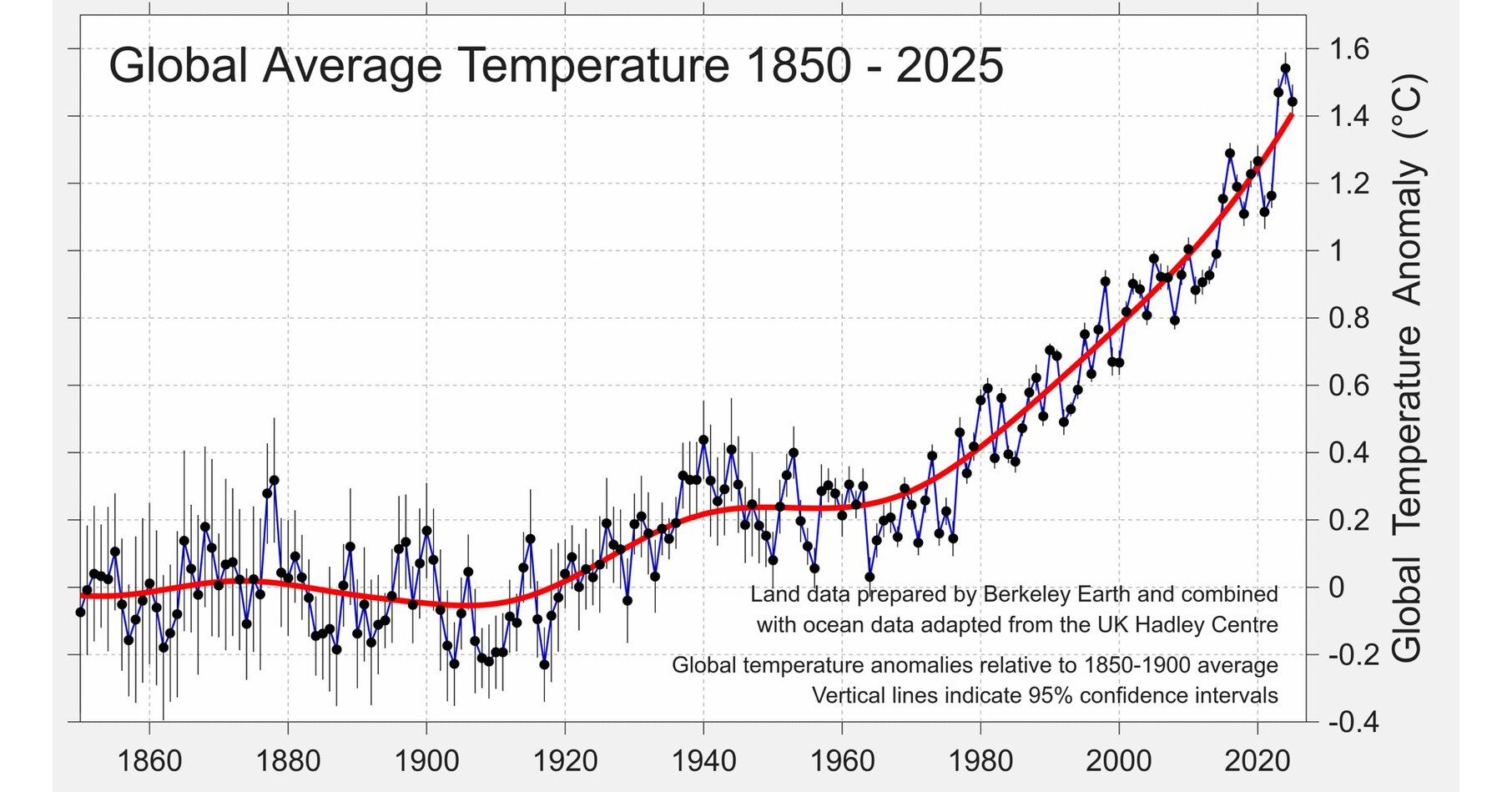
The last 11 years (2015–2025) include the 11 warmest years in the instrumental record, and the last 3 years include the top 3 warmest. Compared to the almost linear warming trend of the past 50 years, the warming spike observed from 2023-2025 has been extreme, and suggests an acceleration in the rate of the Earth’s warming.
“The warming observed from 2023 through 2025 stands out clearly from the long-term trend. While greenhouse gas emissions remain the dominant driver of global warming, the magnitude of this recent spike suggests additional factors have amplified recent warming beyond what we would expect from greenhouse gases and natural variability alone,” said Robert Rohde, Berkeley Earth Chief Scientist.
Berkeley Earth’s assessment is based on its High-Resolution Surface Temperature dataset (BEST-HR), which combines 23 million monthly-average thermometer measurements from 57,685 weather stations going back to 1750, along with ~500 million instantaneous ocean temperature observations collected by ships and buoys.
Key findings from 2025
- 2025 ranked 3rd warmest globally since 1850, behind only 2024 and 2023.
- 9.1% of Earth’s surface experienced a locally record warm annual average in 2025 (10.6% of land areas; 8.3% of ocean areas).
- Berkeley Earth estimates ~770 million people (8.5% of the global population) experienced locally record-warm annual conditions, with the largest population centers affected mostly in Asia, including ~450 million people in China.
- No region on Earth recorded a locally record cold annual average in 2025.
Interpreting the 2023–2025 warming spike
Berkeley Earth notes that the warming spike from 2023–2025 has been extreme relative to the near-linear warming trend of the prior ~50 years, suggesting that recent warming may reflect a combination of greenhouse-gas-driven warming, natural variability, and additional short-term contributions.
Recent analyses point to reductions in low cloud cover and changes in atmospheric aerosols as plausible contributors, particularly the reduction of sulfur pollution from ships following new regulations implemented in 2020, which reduced reflective aerosols and increased absorbed solar radiation.
The warming spike in 2023 to 2025 suggests that the past warming rate is no longer a reliable predictor of the future, and additional factors have created conditions for faster warming, at least in the short-term.
“The warming spike of the past three years underscores how quickly the climate system can change, and how essential sustained monitoring is to understanding those changes in real time,” said Kristen Sissener, Berkeley Earth Executive Director. “Continued investment in high-quality, resilient, and robust open climate data is critical to ensuring that governments, industry, and local communities can respond based on evidence, not assumptions.”
ENSO context and outlook for 2026
Unlike 2023 and 2024, which were El Niño years, 2025 began and ended with a modest La Niña event, which would typically be expected to modestly cool global average temperature, yet the cooling effect was limited in 2025.
Looking ahead, Berkeley Earth expects 2026 to likely be similar to 2025, with the most likely outcome being approximately the 4th warmest year since 1850, though warmer or cooler outcomes remain possible
About Berkeley Earth
Berkeley Earth is a California-based independent 501(c)(3) nonprofit founded in 2013 and dedicated to advancing open, transparent climate science. Funded through philanthropic grants, individual contributions, and commercial partnerships, Berkeley Earth produces leading high-resolution temperature datasets using advanced data science and machine learning to improve accuracy and spatial resolution, and maintains an open-access library of climate datasets, visualizations, and analysis. Berkeley Earth operates the world’s only independent, non-governmental climate monitoring system, publishing regular monthly and annual temperature reports for researchers, journalists, policymakers, and risk analysts worldwide.
Media Contact
Kristen Sissener, Berkeley Earth, 1 4158906026, [email protected], https://berkeleyearth.org/
SOURCE Berkeley Earth