













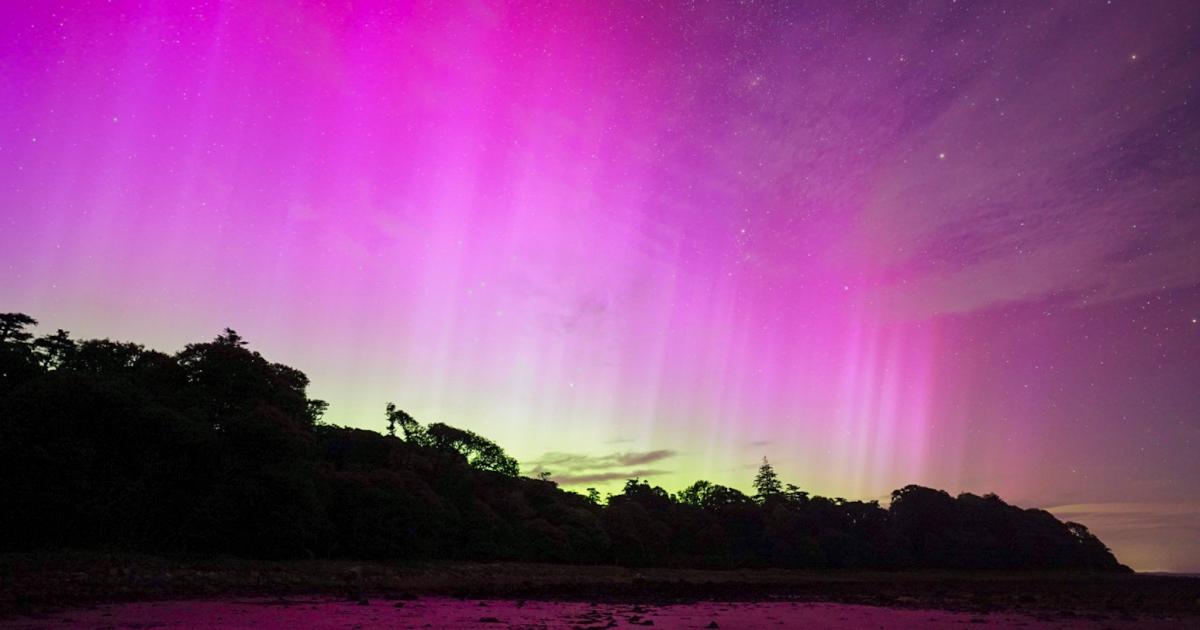


The Northern Lights, also known as the Aurora Borealis, are described as “one of the most spectacular displays in the night sky”.
The “spectacular” display was spotted numerous times across the UK in 2025, from Northern parts of Scotland and Wales, right down to Dorset in the south of England.
Best time to see the Northern Lights in the UK this weekend
The Northern Lights are now set to be visible in the UK this weekend for the first time in 2026, according to the Met Office Space Weather forecast .
The display could be visible each night from Friday (January 2), up until Sunday (January 4).
The Met Office Space Weather forecast reads: “Near background aurora conditions are expected initially on Friday 2nd January.
“Either late 2nd January, or more likely early Saturday 3rd January (UTC time zone) a Coronal Mass Ejection arrival is expected.”
It continued: “By Sunday 4th January the auroral oval is likely to return to background, or near background latitudes.”
Where to see the Northern Lights this weekend
The Northern Lights may be visible to the naked eye right across the UK this weekend, according to the Met Office forecast, from Scotland down to southern parts of Wales.
It said: “Where skies are sufficiently clear and dark, aurora may become visible by the naked-eye from Scotland as well as potentially Northern England and Northern Ireland.
“There is a slight chance that views could extend south to parts of Wales and central England should conditions be favourable.”
Cold arctic air from the north will bring snow showers for some to start the new year. What happens during the first full week of January is still uncertain.
Find out more in this week’s 10 Day Trend with Alex Burkill 👇 pic.twitter.com/Qy7WU12xjI
— Met Office (@metoffice) December 31, 2025
Weather conditions in the UK this weekend
Friday night will see frequent snow showers affecting parts of the UK, but otherwise “long clear spells” have been forecast by the Met Office .
It will be a “cold and frosty” start to Saturday, with snow to continue throughout the day.
While the forecast for Sunday to Tuesday says there will be “plenty of sunshine”, though sleet and snow showers will continue.
RECOMMENDED READING:
What are the Northern Lights?
The Northern Lights are caused by charged particles from the sun hitting gases in the Earth’s atmosphere.
The colours occur due to different gases in the Earth’s atmosphere being energised by the charged particles.
Nitrogen and oxygen are the two most common gases in the atmosphere, with nitrogen emitting purple, blue and pink colours and oxygen emitting green.


