













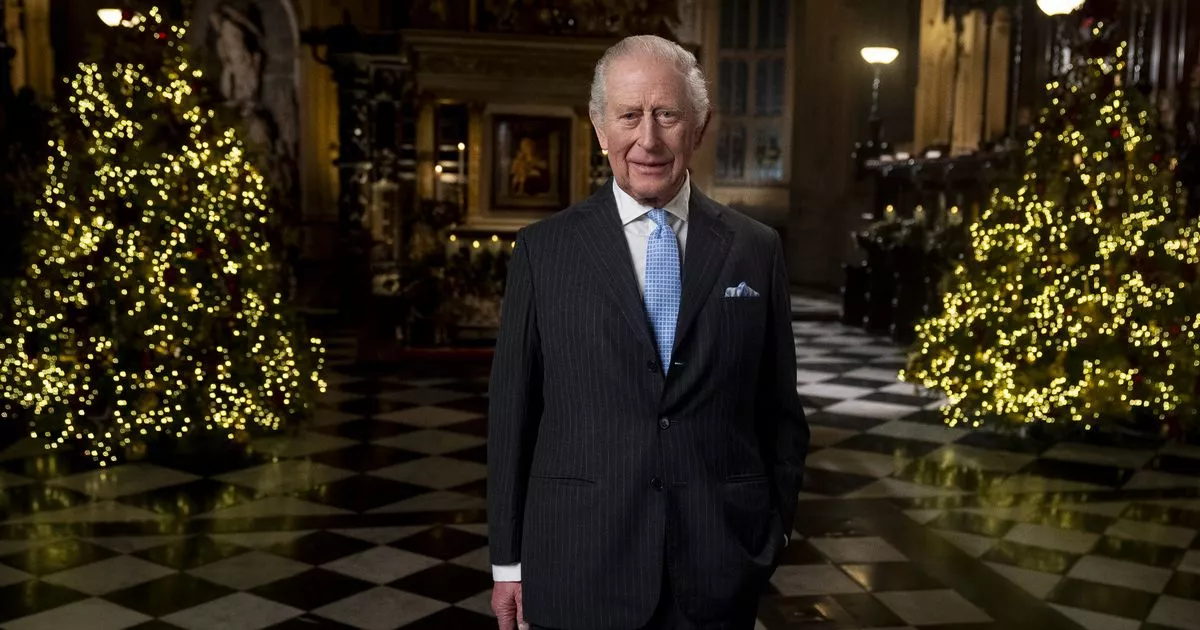
In his annual Christmas broadcast, King Charles has urged the nation to ‘never lose sight’ of the Second World War values of ‘courage and sacrifice’ and community spirit in a divisive world
In his Christmas address, the King implored the nation to “never lose sight” of the Second World War values of “courage and sacrifice” and community spirit amidst a world rife with division.
Following the tragic events at Bondi Beach and the Manchester synagogue, Charles commended the “spontaneous bravery” of individuals who risked their own safety to protect others.
The King also touched upon the influence of emerging technologies on wellbeing and community unity in an “ever faster” spinning world, suggesting that the festive season could serve as a time for rejuvenation and strengthening of communities.
The annual Christmas message, penned by the King himself without governmental input, placed communities at its core, highlighting their “diversity” and resilience in times of hardship.
Charles has long viewed his role as a bridge-builder among these diverse communities, faith groups, and others, maintaining that he is an integral part of society rather than separate from it, reports Cambridgeshire Live.
This year, the King and Queen participated in significant commemorations marking the 80th anniversaries of VE Day and VJ Day. In his broadcast, Charles noted: “The end of the Second World War is now remembered by fewer and fewer of us, as the years pass.
“But the courage and sacrifice of our servicemen and women, and the way communities came together in the face of such great challenge, carry a timeless message for us all.
“These are the values which have shaped our country and the Commonwealth. As we hear of division, both at home and abroad, they are the values of which we must never lose sight.”
The preceding year has witnessed mounting division across numerous matters, from demonstrations regarding asylum seeker accommodation to polarisation within the political sphere, alongside so-called culture wars dominating news cycles and the ongoing cost-of-living crisis deepening the chasm between wealthy and poor whilst stoking intergenerational resentment.
Charles’s departed parents, Queen Elizabeth II and the Duke of Edinburgh, hailed from the wartime era, with footage displayed of a VE Day anniversary commemoration featuring the Prince of Wales and Prince George greeting Second World War veterans at a Buckingham Palace reception, plus another recording of the King participating in a VJ Day service.
The monarch proceeded to reflect on instances of righteousness prevailing over injustice both domestically and internationally: “These stories of the triumph of courage over adversity give me hope, from our venerable military veterans to selfless humanitarian workers in this century’s most dangerous conflict zones; to the ways in which individuals and communities display spontaneous bravery, instinctively placing themselves in harm’s way to defend others.”
The programme featured Charles at Heaton Park Hebrew Congregation Synagogue in Manchester, where he encountered survivors from the October terror incident and met individuals who barricaded the entrance as a blade-carrying attacker attempted to enter.
Footage displayed an archway in Sydney, Australia, bearing the inscription Bondi Beach, followed by countless floral memorials placed following an assault by two gunmen on a Jewish celebration that claimed 15 lives.
The widely celebrated hero of the atrocity, Syrian-born immigrant Ahmed al Ahmed, was fatally wounded after grappling a weapon from one of the attackers.
Reflecting on the frenetic pace of contemporary life and the impact of modern technology on communities and individuals, particularly young people, the King observed: “Indeed, as our world seems to spin ever faster, our journeying may pause, to quieten our minds – in TS Eliot’s words ‘At the still point of the turning world’ – and allow our souls to renew.
“In this, with the great diversity of our communities, we can find the strength to ensure that right triumphs over wrong.”
A Royal aide commented: “I think His Majesty hopes that, if nothing else, Christmas might afford a moment when people could experiment with something of a ‘digital detox’ to focus more on our friendships, our families and our faith for those who practise.
“In this way the King hopes our minds may find greater peace, our souls can renew, and our communities grow stronger.”
The address, recorded on December 11 in the Lady Chapel of Westminster Abbey, made no mention of Charles’s recent positive update regarding his cancer treatment. This omission reflects his desire for his message to resonate with society’s experiences over the past year.
The King’s speech to the nation and Commonwealth was imbued with a strong religious undertone. As a devoted Anglican Christian, Charles focused on the theme of pilgrimage, highlighting the Biblical journeys undertaken by Mary and Joseph, who arrived “homeless” in Bethlehem, and the three wise men and shepherds who came to honour the newborn Jesus.
Charles’s recent state visit to the Vatican celebrated the Papal Jubilee year themed “Pilgrims of Hope”. Furthermore, Westminster Abbey, where the address was recorded, is a pilgrim church housing the shrine of the canonised Edward the Confessor, which has drawn pilgrims for centuries.
Footage also featured George alongside his father William during a private visit to The Passage, a charity for the homeless. Here, they donned aprons and assisted in food preparation.
The figures in the Christmas story relied on the “companionship and kindness of others” during their pilgrimages and discovered “inner strength” to confront physical and mental challenges.
Charles went on to say: “To this day, in times of uncertainty, these ways of living are treasured by all the great faiths and provide us with deep wells of hope: of resilience in the face of adversity; peace through forgiveness; simply getting to know our neighbours and, by showing respect to one another, creating new friendships.”
Throughout the programme, various members of the Royal family made appearances, including Camilla spotted in a classic red telephone box alongside a group of youngsters during her trip to Dulwich Picture Gallery, and William and the Duchess of Edinburgh raising paper cups of gin in a toast at the Royal Cornwall Show.
The monarch concluded by describing the Christmas message of “peace and reconciliation” delivered by angels when they announced Jesus’s arrival – “the greatest pilgrimage of all” – as a “prayer for our times and our communities”.
Charles’s ongoing backing for Ukraine since Russia’s invasion began was evident in his selection of the Songs for Ukraine Chorus, who brought the broadcast to a close with their rendition of the beloved Carol Of The Bells, which draws from a composition by Ukrainian musician Mykola Leontovych.


