













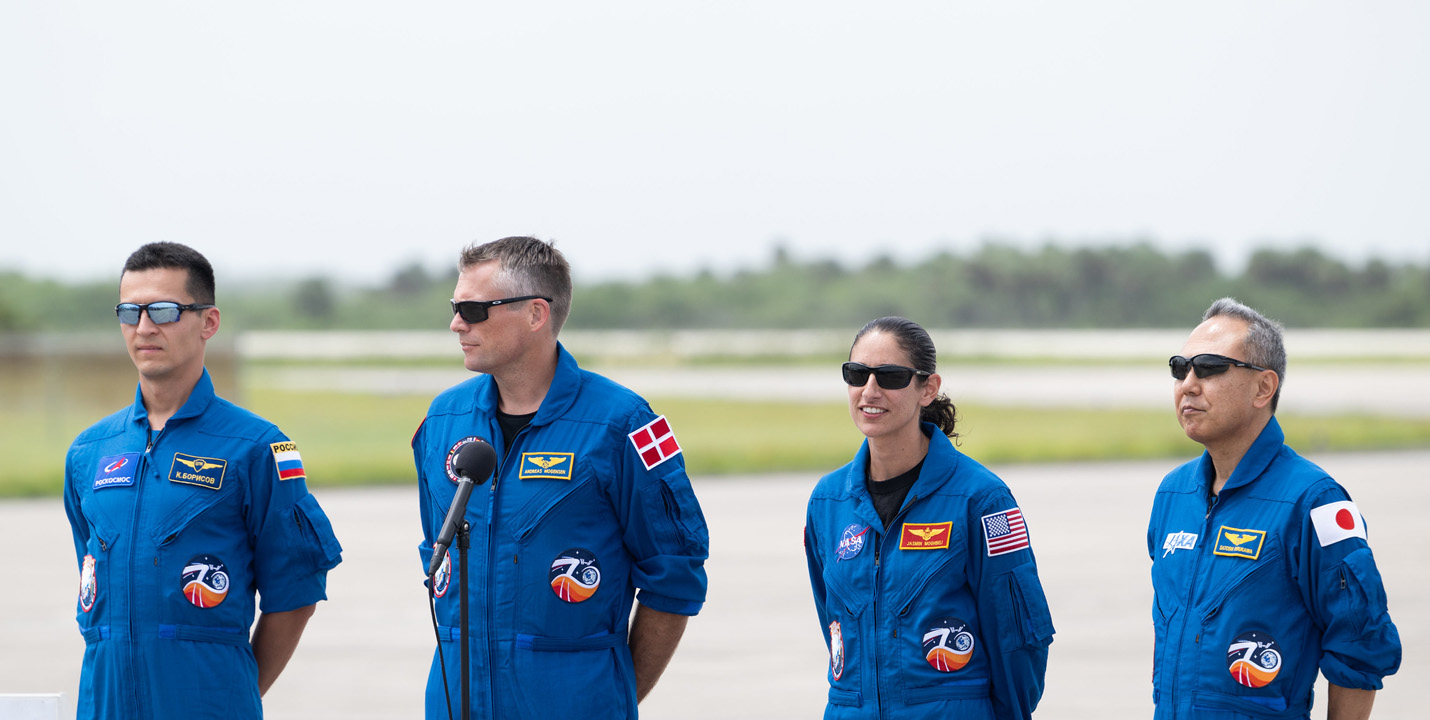


Crew-7 astronauts Konstantin Borisov, Andreas Mogensen, Jasmin Moghbeli and Satoshi Furukawa.
Image credit: NASA/Joel Kowsky.
Welcome to the Launch Roundup! In this week’s edition, crew and cargo ships are heading for the International Space Station, a Japanese spacecraft will be launched to the moon, and SpaceX reached one milestone in deploying its Starlink constellation and should reach another one later today (August 22). But, first some Flight Bytes about Virgin Galactic’s next launch, skepticism about Spaceport America, India’s new spaceport, and Rocket Lab’s latest contract.
Flight Bytes
- A Las Vegas real estate mogul named Ken Baxter says he will be flying on Virgin Galactic’s next SpaceShipTwo flight on September 7. Baxter has a countdown clock running on his website, which says he was the first person to buy a ticket from Richard Branson’s space company back in 2004. Virgin Galactic has yet to officially announce the flight.
- New Mexico residents are questioning the value of the more than $220 million that taxpayers spent to build Spaceport America, even as anchor tenant Virgin Galactic begins monthly commercial flights from the facility.
- India’s government has approved the construction of a new spaceport for launching Small Satellite Launching Vehicles in Kulasekarapattinam, located in the state of Tamil Nadu.
- Rocket Lab will launch iQPS’s QPS-SAR-5 Earth observation satellite on a dedicated Electron mission from New Zealand. The satellite was previously scheduled to be launched by Virgin Orbit, which went out of business in May.

Upcoming Launches
SpaceX is scheduled to launch its seventh operational mission to the International Space Station on August 25 with astronauts from four different nations aboard. Crew-7 includes NASA astronaut Jasmin Moghbeli, Russian cosmonaut Konstantin Borisov, European Space Agency (ESA) astronaut Andreas Mogensen of Denmark, and Japanese astronaut Satoshi Furukawa.
The Crew-7 launch is scheduled for 3:49 AM EDT (07:49 UTC). NASA will begin its launch coverage at 11:45 PM EDT on August 24.

Japan is set to become the third nation to launch a lunar lander this year, with a scheduled launch on August 26. The Smart Lander for Investigating Moon (SLIM) is a technology demonstrator designed to test the ability to perform pin-point landings while detecting and avoiding obstacles on the lunar surface.
SLIM will use technology adapted from facial recognition systems to identify lunar craters, and utilize images collected by the SELENE (Kaguya) orbiter to determine its position. The goal is for SLIM to land with an accuracy of 100 meters (328 feet).
Upcoming Launches
| Date | Launcher – Organization | Payloads – Organization | Purpose(s) | Launch Site |
|---|---|---|---|---|
| Aug. 23 | Falcon 9 – SpaceX | 22 Starlink – SpaceX | Communications | Cape Canaveral |
| Aug. 23 | Soyuz-2.1a – Roscosmos | Progress MS-24 – Roscosmos | ISS resupply | Baikonur |
| Aug. 23/24 | Electron – Rocket Lab | Acadia 1 – Capella Space | Earth observation | Mahia |
| Aug. 24-31 | Chollima-1 – NADA* | TBA | TBA | Sohae |
| Aug. 25 | Falcon 9 – SpaceX | Crew Dragon – SpaceX | ISS crew | Kennedy |
| Aug. 25 | Ceres-1 – Galactic Energy | 4 Qinling Xiaoweixing – X’ian Aviation Investment | Earth observation | Jiuquan |
| Aug. 26 | H-IIA — MHI+ | XRISM – JAXA/NASA | X-ray astronomy | Tanegashima |
| SLIM – JAXA | Lunar lander | |||
| LEV-1 – JAXA | Lunar hopper | |||
| LEV-2 – JAXA, Tomy, Doshishma University | Lunar rover | |||
| Aug. 29 | Atlas V – ULA | Silent Barker — NRO^ | Space domain awareness | Cape Canaveral |
| Aug. 30 | Falcon 9 – SpaceX | 11 Transport Layer Tranche 0 – SDA** | Military communications | Vandenberg |
| 2 Tracking Layer Tranche 0 – SDA** | Missile tracking |
+ Mitsubishi Heavy Industries
^ National Reconnaissance Office
** Space Development Agency
Source: Wikipedia
If successful, SLIM will be the first Japanese spacecraft to land on the Moon. The country previously attempted to do so with the Hakuto-R lander, launched by the private Japanese company ispace, which crashed on the Moon during descent on April 25, 2023.
SLIM will deploy the Lunar Excursion Vehicle 1 (LEV-1), which is a 2.1 kg (4.6 pound) lunar hopper measuring 26 x 40 x 30 cm (10.2 x 15.7 x 11.8 in) that will transmit data directly to Earth as it moves across the surface.

SLIM is also carrying the Lunar Excursion Vehicle 2 (LEV-2), a tiny ball-shaped rover with a diameter of 8 cm (3.1 in) and a mass of 250 g (8.8 ounces). LEV-2 is equipped with two cameras and will change its shape in order to move across the surface. The rover was designed by JAXA in cooperation with the Tomy Company, Sony Group Corporation and Doshisha University.
Rocket Lab is set to launch Capella Space’s Acadia 1 Earth observation satellite from New Zealand. The launch window opens at:
- 7:30 PM EDT on August 23
- 23:30 UTC on August 23
- 11:30 AM NZST on August 24.
Recent Launches
The world’s two leading launch companies – SpaceX and China Aerospace Science and Technology Corporation – conducted a combined three flights over the past week.
Recent Launches
| Date | Launcher – Organization | Payloads – Organization | Purpose(s) | Launch Site |
|---|---|---|---|---|
| Aug. 16 | Falcon 9 – SpaceX | 22 Starlink – SpaceX | Communications | Cape Canaveral |
| Aug. 20 | Long March 4C – CASC* | Gaofen 12-04 – CNSA+ | Earth observation | Jiuquan |
| Aug. 22 | Falcon 9 – SpaceX | 21 Starlink – SpaceX | Communications | Vandenberg |
+ China National Space Administration
Source: Wikipedia
SpaceX conducted its 100th Falcon 9 launch, primarily dedicated to deploying Starlink satellites, on August 22. The Elon Musk-led company is nearing its 5,000th Starlink satellite since the first deployment in February 2018. The next launch of 22 Starlink satellites is scheduled for tonight (August 22) at 8:47 PM EDT (00:47 UTC on August 23).
Starlink Launches
| Year | Launches | Satellites |
|---|---|---|
| 2023 | 33 | 1,318+ |
| 2018-2023 | 103^ | 4,984* |
^ Includes 100 dedicated launches, two Transporter missions, and the launch of two test satellites as secondary payloads.
* Does not include 16 secondary payloads from other companies.
Launches by Nation

The United States leads the world with 69 launches, 65 of which have been successful. US launch providers have attempted more than half of the 130 launches conducted this year.
Chinese companies have launched 37 times without fail. Russia, which long led the world in this category, has conducted only 11 launches this year.

Launches by Company/Agency
SpaceX continues to lead the world with 57 launches that carried 1,710 payloads into orbit. The company is closing in on its own record of 61 launches set last year. That total tied a record set by the Soviet Union in 1980.
Launches by Company/Agency
| Company/Agency | Successes | Failures | Total | Payloads Orbited |
Payloads Lost |
|---|---|---|---|---|---|
| SpaceX (USA) | 56 | 1 | 57 | 1,698 | 12* |
| China Aerospace Science and Technology Corporation (CASC) | 26 | 0 | 26 | 98 | 0 |
| Roscosmos (Russia) | 7 | 0 | 7 | 49 | 0 |
| Indian Space Research Organisation (ISRO) | 6 | 0 | 6 | 50 | 0 |
| Rocket Lab (USA) | 6 | 0 | 6 | 18 | 0 |
| ExPace (China) | 4 | 0 | 4 | 14 | 0 |
| Galactic Energy (China) | 3 | 0 | 3 | 14 | 0 |
| Strategic Rocket Forces (Russia) | 3 | 0 | 3 | 3 | 0 |
| Arianespace (Europe) | 2 | 0 | 2 | 3 | 0 |
| CAS Space (China) | 1 | 0 | 1 | 26 | 0 |
| Korea Aerospace Research Institute (South Korea) | 1 | 0 | 0 | 7 | 1^ |
| Northrop Grumman (USA) | 1 | 0 | 1 | 4 | 0 |
| Mitsubishi Heavy Industries (Japan) | 1 | 0 | 1 | 1 | 0 |
| Israel Aerospace Industries | 1 | 0 | 1 | 1 | 0 |
| Space Pioneer (China) | 1 | 0 | 1 | 1 | 0 |
| United Launch Alliance (USA) | 1 | 0 | 1 | 1 | 0 |
| i-space (China) | 1 | 0 | 1 | 0 | 0 |
| LandSpace (China) | 1 | 0 | 1 | 0 | 0 |
| Virgin Orbit+ (USA) | 0 | 1 | 1 | 0 | 9 |
| ABL Space Systems (USA) | 0 | 1 | 1 | 0 | 2 |
| Japan Aerospace Exploration Agency | 0 | 1 | 1 | 0 | 1 |
| National Aerospace Development Administration (North Korea) | 0 | 1 | 1 | 0 | 1 |
| Relativity Space (USA) | 0 | 1 | 1 | 0 | 0 |
| Total | 124 | 6 | 130 | 1,989 | 26 |
^ Deployment failure
+ Company defunct
Launches by Booster
SpaceX leads the world with 54 Falcon 9 launches. The company also launched three Falcon Heavy rockets and one Starship/Super Heavy booster.
China’s Long March 2C and Long March 2D rockets have launched a combined 12 times. Russia’s Soyuz-2.1a and Soyuz-2.1b boosters have been launched eight times, followed by the six flights of Rocket Lab’s Electron rocket.
Launches by Booster
| Launch Vehicle | Company/Agency | Successes | Failures | Total |
|---|---|---|---|---|
| Falcon 9 | SpaceX | 54 | 0 | 54 |
| Long March 2C, 2D | China Aerospace Science and Technology Corp. | 12 | 0 | 12 |
| Soyuz-2.1a, 2.1b | Roscosmos, Russia Strategic Rocket Forces | 8 | 0 | 8 |
| Electron | Rocket Lab | 6 | 0 | 6 |
| Long March 3B/E | China Aerospace Science and Technology Corp. | 4 | 0 | 4 |
| Kuaizhou 1A | ExPace | 4 | 0 | 4 |
| Long March 4C | China Aerospace Science and Technology Corp. | 4 | 0 | 4 |
| Falcon Heavy | SpaceX | 3 | 0 | 3 |
| Ceres-1 | Galactic Energy | 3 | 0 | 3 |
| Long March 7, 7A | China Aerospace Science and Technology Corp. | 2 | 0 | 2 |
| Proton | Roscosmos | 2 | 0 | 2 |
| Ariane 5 | Arianespace | 2 | 0 | 2 |
| LVM III | Indian Space Research Organisation | 2 | 0 | 2 |
| PSLV | Indian Space Research Organisation | 2 | 0 | 2 |
| Antares | Northrop Grumman | 1 | 0 | 1 |
| Delta IV Heavy | United Launch Alliance | 1 | 0 | 1 |
| GSLV Mk II | Indian Space Research Organisation | 1 | 0 | 1 |
| H-IIA | Mitsubishi Heavy Industries | 1 | 0 | 1 |
| Hyperbola 1 | i-space | 1 | 0 | 1 |
| Long March 2F | China Aerospace Science and Technology Corp. | 1 | 0 | 1 |
| Long March 4B | China Aerospace Science and Technology Corp. | 1 | 0 | 1 |
| Long March 6 | China Aerospace Science and Technology Corp. | 1 | 0 | 1 |
| Long March 11 | China Aerospace Science and Technology Corp. | 1 | 0 | 1 |
| Nuri | Korea Aerospace Research Institute | 1 | 0 | 1 |
| Shavit 2 | Israel Defense Forces | 1 | 0 | 1 |
| SSLV | Indian Space Research Organisation | 1 | 0 | 1 |
| Soyuz-2.1v | Russia Strategic Rocket Forces | 1 | 0 | 1 |
| Tianlong-2^ | Space Pioneer | 1 | 0 | 1 |
| Zhuque-2 | LandSpace | 1 | 0 | 1 |
| Chollima-1^ | National Aerospace Development Administration | 0 | 1 | 1 |
| H3^ | Japan Aerospace Exploration Agency | 0 | 1 | 1 |
| LauncherOne* | Virgin Orbit+ | 0 | 1 | 1 |
| RS1^ | ABL Space Systems | 0 | 1 | 1 |
| Starship/Super Heavy^ | SpaceX | 0 | 1 | 1 |
| Terran 1*^ | Relativity Space | 0 | 1 | 1 |
| Total | 124 | 6 | 130 |
* Launch vehicle retired
+ Company defunct
Launches by Spaceport
Florida has hosted 43 launches from the Cape Canaveral Space Force Station and NASA’s Kennedy Space Center. Vandenberg Space Force Base in California has hosted 16 launches.
Launches by Spaceport
| Launch Sites | Successes | Failures | Total |
|---|---|---|---|
| UNITED STATES | |||
| Cape Canaveral | 34 | 1 | 35 |
| Vandenberg | 17 | 0 | 16 |
| Kennedy | 8 | 0 | 8 |
| Mid-Atlantic Regional Spaceport | 3 | 0 | 3 |
| Pacific Spaceport Complex – Alaska | 0 | 1 | 1 |
| Starbase | 0 | 1 | 1 |
| CHINA | |||
| Jiuquan | 21 | 0 | 21 |
| Taiyuan | 7 | 0 | 7 |
| Xichang | 7 | 0 | 7 |
| Wenchang | 2 | 0 | 2 |
| RUSSIA | |||
| Plesetsk | 3 | 0 | 3 |
| Vostochny | 3 | 0 | 3 |
| INDIA | |||
| Satish Dhawan | 6 | 0 | 6 |
| EUROPE | |||
| Guiana Space Centre (French Guiana) | 2 | 0 | 2 |
| JAPAN | |||
| Tanegashima | 1 | 1 | 2 |
| OTHER NATIONS | |||
| Baikonur* (Kazakhstan) | 5 | 0 | 5 |
| Mahia+ (New Zealand) | 4 | 0 | 4 |
| Naro (South Korea) | 1 | 0 | 1 |
| Palmchim (Israel) | 1 | 0 | 1 |
| Cornwall^ (UK) | 0 | 1 | 1 |
| Sohae (North Korea) | 0 | 1 | 1 |
| 124 | 6 | 130 |
+ Rocket Lab Electron launches
^ Virgin Orbit launch
The Jiuquan Satellite Launch Center leads all Chinese spaceports with 21 launches. The nation’s other three spaceports have 16 launches combined among them.


