




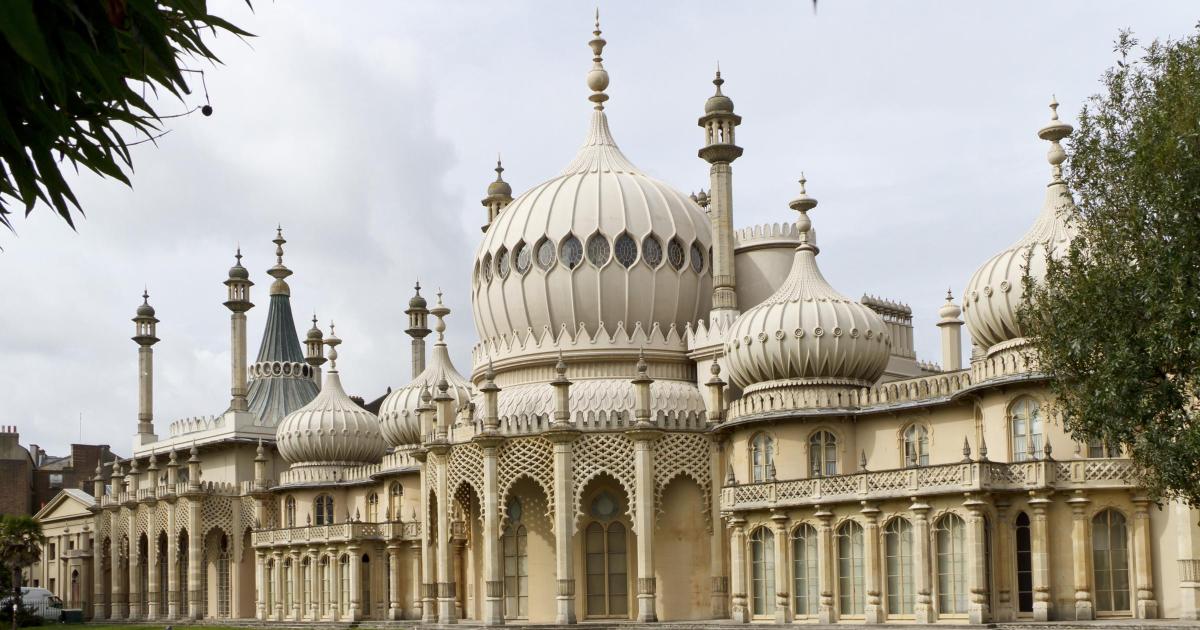
One of the most startling episodes in the history of Brighton’s Royal Pavilion occurred during the First World War, 1914-18, and was one that the pleasure palace’s creator, the extravagant King George IV, would never have dreamed possible. It became a military hospital for Indian soldiers.
That’s because they were sent to the Western Front when Belgium was over-run and the German army advanced towards France. The British Empire was then at its height, resulting in soldiers of the Indian Army being offered for service, as India was one of many countries then ruled by Britain. The first arrived during October 1914 – some 1,800 within a month.

Due to its proximity with northern France, many hospitals along the south coast of Britain were used to take wounded men from the battlefield hospitals, via Dover, Southampton and Eastbourne. As places in conventional institutions were limited, a large number of other buildings were requisitioned by the authorities, such as schools, town halls and public buildings. The King, George V, suggested that the Royal Pavilion estate at Brighton, with its Indian-inspired minarets and domes, would be an ideal place to house wounded Indians. He felt that they, more than anyone, would ‘appreciate’ the unique decor. Royal suggestions were always taken up, so 724 beds were installed in the Dome, Corn Exchange and Royal Pavilion itself, soon supplemented, due to demand, by 2,000 more at the town’s workhouse in Elm Grove, and 550 at schools in Pelham Street.
The first intake was in December 1914. The main wounds the Indians had received were gunshots, which had to be X-rayed on arrival, then drained under anaesthetic, to assess levels of infection, dressings often being pads of sphagnum moss enclosed in muslin.
Many of the soldiers had received extremely severe wounds – leading to immediate amputations before being brought to Britain, so their stay at the Pavilion was more a matter of monitoring and convalescence. While medical provision was state-of-the-art, sanitary and catering provisions were very problematic. There had to be separate water taps, wash houses and latrines for Hindus and Muslims, and nine different kitchens were provided to accommodate all the various caste diets. Animals for meat dishes were ritually killed at butcher’s premises in nearby St James’s Street. A gurdwara – Sikh temple – was erected on one of the lawns, with an area in front of the Dome set aside for Muslims to pray, facing Mecca.
Not all Indians survived. The bodies of any Hindus or Sikhs that died had to be cremated with full ritualistic ceremony on ghats, set up on the Downs above Patcham.

There was also of course, the ‘novelty factor’ of having a large number of Indians in the town and an extremely curious public were desperate to see these ‘men of the Empire.’ A high wall was built round the Pavilion and the best glimpse of the Indians was for a 2d ride from the top of a passing tram!
As the Brighton Herald wrote in December 1914: ‘There can be few stranger chapters in the history of England than that which is being written in Brighton now.’
Politically, the authorities had much to gain from the Indians’ stay at Brighton and the hospital was widely publicised. The security of British rule in India depended to a large extent on the loyalty of the native troops. To let everyone know, both at home and abroad, that its men were being well cared for and all caste groups were being respected and fully accommodated, was paramount.
The Germans were also spreading misinformation that the Indians were badly treated by the British, again something the authorities were keen to counter.
Stories of men arriving at the Pavilion unconscious, then reviving, and believing they had arrived in heaven, because of the Pavilion’s sumptuous interiors (particularly the music room), are quite genuine, and come from letters sent to their families back home. Letters also reveal the huge patriotism and loyalty amongst the inmates. ‘If we die on the battlefields for our King, this is equal to entering heaven’ – one soldier wrote.
King George V visited the Pavilion twice in 1915, the second time to decorate 11 of the wounded with military honours. This was a huge event, with more than 1,000 patients gathered on the western lawn to witness the ceremony, with Queen Mary, Lord Kitchener and many other dignitaries also attending.

The highlight was the award of the Victoria Cross to Subedar Mir Dast, for bravery at Ypres, commemorated on a blue plaque on the wall of the present-day Pavilion shop.
‘How did you like your treatment from your British comrades?’ Mir Dast was asked. ‘Splendid,’ he replied. ‘They treated us like brothers, even more than brothers.
‘For it is a fact – to which the whole Indian Army in the field can testify most gratefully – that whenever soldiers fell wounded on the field, the British soldiers first removed Indian wounded soldiers to our hospital and then the British soldiers. They are really noble and chivalrous fellows. Our British officers too, were very kind. They made no distinction between the British, the Mahometan or the Hindu soldiers – all were treated alike.’
The ceremony was filmed and can be found on YouTube: 1915 Royal Visit to Royal Pavilion Hospital Brighton.
It’s extraordinary to see the shaky, black and white images of the familiar lawns opposite the Pavilion crowded with Indian patients, many of who had lost limbs, playing games, being pushed around in wheelchairs, then proudly receiving their medals. The King, a tiny man, seems to salute and shake hands with everyone, and he even lights up a cigarette at one point.

Again, such a film would serve propaganda purposes, showing all was well with the ‘sons of the Empire.’
The Indian army was withdrawn from the Western Front in late 1915 and reassigned to the eastern Mediterranean. This meant that from January 1916, the hospital lost its host of Indian facilities and was then used to treat severely injured British soldiers until 1920.
The departure of the Indians saw the authorities finally give in to the public’s intense curiosity about the occupation of the Pavilion, Dome and Corn Exchange buildings and opened them all up for public inspection – initially at 2/6d a time – the money raised going to the Mayor of Brighton’s War Charities. By early February, there had been 10,000 visitors, many buying the shilling official souvenir publication on sale, which ran for 120 pages and contained 35 illustrations.
This singular episode in Brighton’s history has two lasting memorials. A new southern gateway to the Pavilion estate was built in 1921, a gift from ‘the princes and people of India,’ to commemorate the unique role of the building in accommodating its fighting men during the Great War. It was unveiled in October that year by Bhupinder Singh, the Maharaja of Patiala, and designed by Thomas Tyrwhitt in the style of 16th-century structures in Ahmedabad, the principal city of Gujarat. The Maharaja unlocked the double gates with a golden key and in his speech revealed he had sent 28,000 troops from his own state to fight in the war. Again, old Pathé News film of this can be found on YouTube. Huge flags hiding the gateway are pulled away, the gates unlocked and the Mayor of Brighton, Bertram Southall, and the Maharaja shake hands vigorously, before passing through.

Another structure in memory of the Indians at Brighton is the Chattri, built over the ceremonial ghats near Patcham, where 53 Indians were eventually cremated, their ashes scattered on the sea. This was designed by EC Henriques, a young Hindu architect, the Chattri (meaning umbrella) taking the form of a white dome supported by pillars, which had been used in numerous Indian memorials to the dead. It was not unveiled until February, 1921, by Edward, Prince of Wales (later Edward VIII), the inscription reading: ‘To the memory of all the Indian soldiers who gave their lives in the service of their King-Emperor this monument erected on the site where the Hindus and Sikhs who died in hospital in Brighton passed through the fire is in grateful and brotherly affection dedicated.’ YouTube once more has a short, one and a half-minute piece of film, showing the impressive inauguration ceremony.
In all, 2,300 patients were treated in the Pavilion estate during the Great War. A startling fact is that it’s now reckoned 1.4 million Indians were involved overall, some in non-combatant roles, with over 74,000 casualties amongst the military troops.
Source link
[Featured]
[Just In]
