




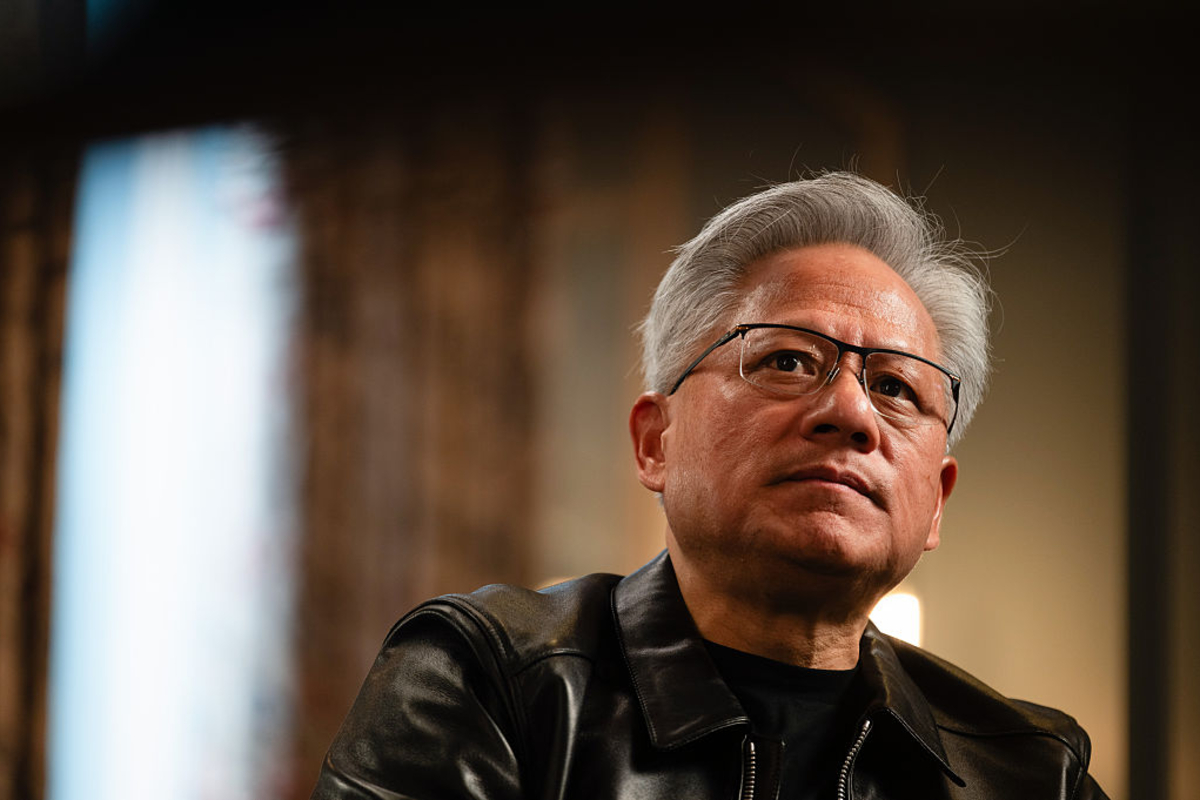

Nvidia’s dependence on its “totemic” founder Jensen Huang has become a growing concern for investors, analysts have said, after an alleged Chinese espionage scandal raised questions over who could replace the man credited with building the world’s most valuable AI chipmaker.
The company’s board has launched an independent investigation following reports that Huang was targeted by a suspected Chinese intelligence operative, exposing a leadership structure built around the billionaire tech founder.
“Given his totemic status as the genius that has driven Nvidia to where it is now, his [eventual] departure does cast a major shadow over the stock”, Chris Beauchamp, chief market analyst at IG, told City AM.
Nvidia shares fell around five per cent in pre-market trading on Monday, threatening to derail a tentative recovery in technology stocks after last week’s sharp sell-off.
Nvidia’s ‘key man’ problem
Huang has led Nvidia since co-founding the business in 1993, overseeing its transformation from a graphics chipmaker into the dominant supplier of processors underpinning the global AI boom.
Under his leadership, Nvidia reached a record valuation of nearly $5.8 trillion in October, although its market capitalisation has since slipped below $5 trillion amid mounting concerns over the sustainability of AI infrastructure spending.
But the company’s extraordinary growth has come with an unusually concentrated leadership structure.
Unlike many of its Silicon Valley peers, Nvidia operates with a deliberately flat management hierarchy, with dozens of senior executives reporting directly to Huang rather than through conventional layers of management.
The structure allows decisions to be implemented quickly, but has left the company without a publicly identified successor or an obvious executive ready to assume Huang’s responsibilities.
Huang, who has repeatedly said he intends to remain chief executive for decades, is also central to Nvidia’s relationships with its biggest customers and policymakers in Washington.
According to Nvidia’s 2026 proxy filing, Huang held approximately 3.58 per cent of the company, compared with roughly 9.1 per cent held by Vanguard and 8.1 per cent by Blackrock.
That structure leaves major institutional investors exposed to a business whose strategic direction remains closely tied to one individual.
Gary Black, managing partner at the Future Fund, warned that Nvidia has “no natural successor”, suggesting uncertainty over Huang’s future could prompt portfolio managers to reduce their holdings.
The scrutiny follows reports that Huang had a relationship with Alice Huang, a former executive at Singapore-based Megaspeed International whom US intelligence agencies reportedly suspected of being recruited by China’s intelligence services.
Huang affair
Huang admitted to an extramarital affair in a memo to employees on Sunday, apologising to his family and colleagues.
“I was unfaithful to my wife,” he wrote. “My actions hurt her and our children. There is no excuse for what I did.”
Nvidia’s board said it had no reason to believe company secrets or national security information had been compromised, but confirmed an independent committee, supported by external legal counsel, would examine the allegations.
Megaspeed has recently faced allegations of circumventing US export restrictions on advanced chips, while Huang has been an influential voice in Washington’s debate over semiconductor sales to China.
“Things are unlikely to stop at an internal investigation,” Beauchamp said. “Huang now faces the prospect of being hauled in front of US lawmakers and grilled over his relationship, which is likely to put his position at severe risk.”
A wider threat to the AI trade
The uncertainty comes at a rocky moment for global tech markets, with investors already questioning whether the enormous sums being committed to AI infrastructure will generate sufficient returns.
Nvidia sits at the centre of that spending, supplying the processors used by Microsoft, Amazon, Google and Meta to train and operate advanced AI systems.
Its position makes the chipmaker a bellwether for the wider sector, meaning any prolonged uncertainty over its leadership risks weighing on companies throughout the AI supply chain.
The Nasdaq-100 recovered 1.35 per cent on Friday after its worst session in 19 months, following a sharp sell-off that spread across Asian and European markets.
But Monday’s allegations threatened to undermine that rebound, with Nvidia’s Frankfurt-listed shares falling around six per cent and Nasdaq futures coming under pressure.
“Nvidia is huge and at the heart of the AI supply chain, so what happens to this stock matters to the rest of the market”, Neil Wilson, markets analyst at Saxo, said.
“If Huang is forced to leave, what happens to Nvidia? As others have said, Huang is kind of irreplaceable for US leadership in AI.”
The wider semiconductor industry has so far proved more resilient. Taiwan’s TSMC, which manufactures Nvidia’s advanced processors, gained around 4.7 per cent, while South Korea’s SK Hynix and Samsung also recovered ground.
Nvidia did not respond to request for comment.
