




Months of design work can go into the colours covering an F1 car, with teams testing everything from shades and patterns to the materials used to apply them. Some of the sport’s most memorable liveries have involved custom software, specialist colour-shifting films and printing technology designed to keep weight down.
Taking those designs from initial concepts to finished cars involves plenty of teams, from creative designers and materials specialists to the engineers responsible for the car’s aerodynamic performance.
Fifty Designs In, One Comes Out
According to Mercedes, designing the livery for its 2018 car took around six months, starting in July at the Austrian Grand Prix and working through approximately 60 proposals that were cut to 30, then 10 and finally one. Toto Wolff saw the options from early on, with the designers also bringing in a few deliberately crazy ideas to find out whether he thought any of them were worth following.
Once a design starts taking shape, it needs to be tested against the actual contours of the car. McLaren’s designers have explained how they develop concepts as flat designs before applying them to 3D models, where they can see how lines and shapes behave across the bodywork. Designers have to account for the car’s changing contours, adjusting the placement and proportions of graphics so they follow the bodywork as intended.
Paint Weighs Something And F1 Has Noticed
Mercedes went back to black for 2023, leaving large sections of the carbon fibre exposed rather than covering them with opaque paint. Some sections were still finished in matte black. Toto Wolff explained that the team had been looking for ways to remove every possible gram after its previous car exceeded the weight target; leaving parts of the W14 in their natural carbon finish was one way to do that.
Ferrari and HP approached the same problem from the wrap side for the 2025 Miami Grand Prix. Their engineering teams in Barcelona and Maranello developed a film using HP’s latex printing technology, which they said was up to 14% lighter and 17% thinner than the material used the previous year, with improved thermal resistance. The film was also PVC-free and fully recyclable, with the companies highlighting that the new technology reduced application time.
Motor Sport Magazine took quite a different view of the finished design, joking that the blocks of HP blue on the rear of the car and front wings looked as if Ferrari had run short of engine covers and raided a scrapyard; the engineering improvements were clearly easier to appreciate than the colour scheme, apparently.
Colour-Shifting Film Does Not Do Gradients
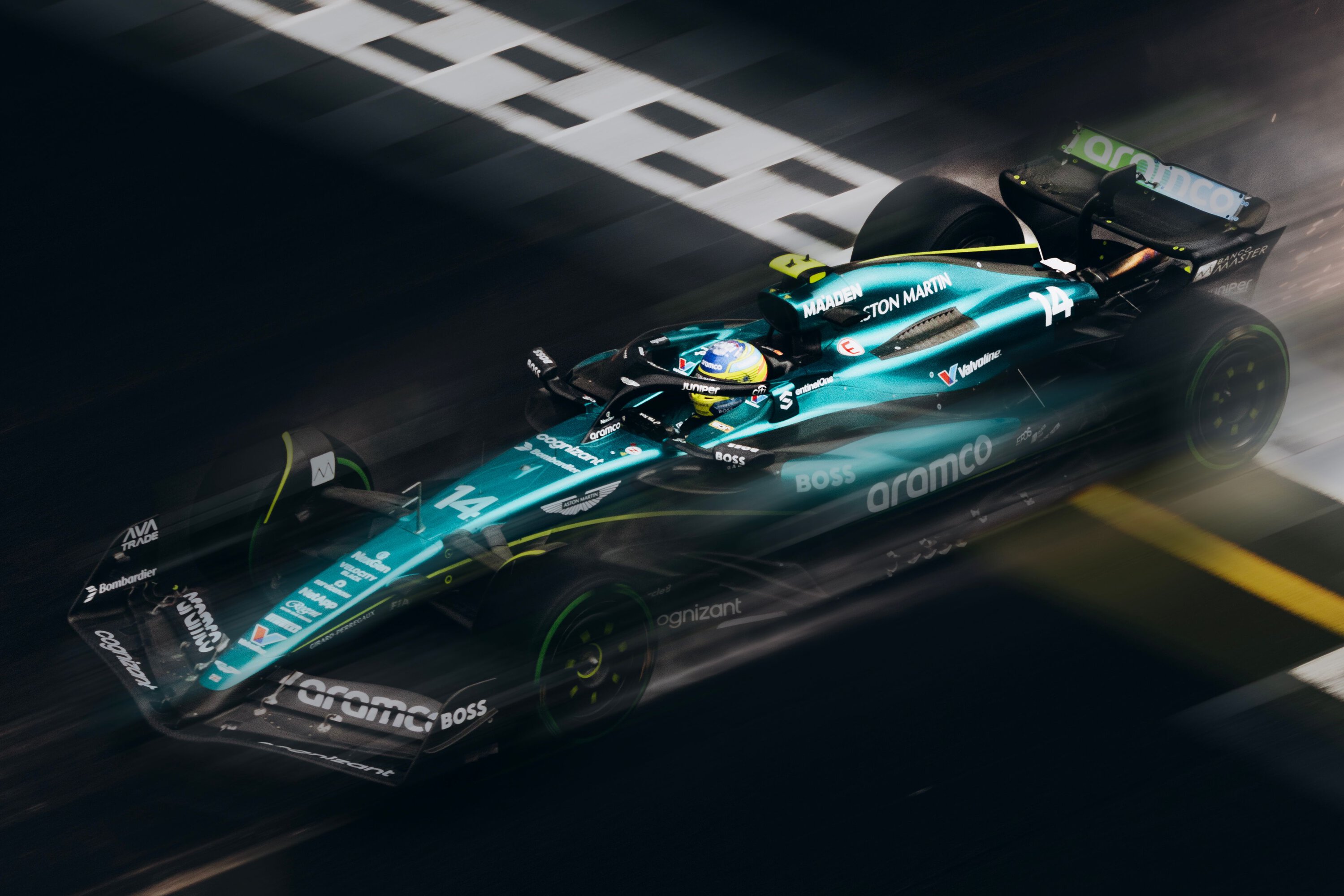
Aston Martin’s Monaco livery in 2026 used a colour-shifting wrap, which appears to change shade depending on the light and the angle from which it is viewed. The front of the AMR26 featured an iridescent finish that blended from copper and other metallic tones into the team’s familiar green.
According to Aston Martin, every additional layer adds weight and thickness, while raised edges can affect aerodynamic performance. The iridescent material therefore had to be used selectively on parts of the car where its impact would be less critical.
The film also came with an unusual design limitation, as traditional gradients could not be printed onto the colour-shifting wrap, so the designers built the fade using hexagons inspired by sponsor Maaden’s logo.
The team developed custom software to generate and position the hexagonal pattern across the bodywork, alongside virtual Monaco simulations to study how the material would appear under real-world lighting conditions. A colour scheme designed for a single Grand Prix practically ended up requiring its own piece of software.
Fitting Three Historic Cars Onto One Modern One
McLaren says its 2023 Triple Crown livery was around a year in the making. It brought together the designs of three race-winning cars: the papaya orange of the 1974 Indianapolis 500 winner, the white of the 1984 Monaco Grand Prix winner and the black of the 1995 Le Mans-winning McLaren F1 GTR.
The challenge was fitting all three into one design without making the car look like a collection of mismatched pieces. The final MCL60 featured papaya across the rear, an ice-white centre section and a black front end, with each colour representing one of the historic victories.
The shape of the car made the design harder to execute than it might look. McLaren’s designers explained that getting lines to appear completely straight across curved bodywork is difficult, so they had to create the illusion that they were. The rounded shape of the 1984 Monaco car was especially tricky to translate onto the modern 3D models, which required loads of adjustments before the finished design came together.
Grams, Millimetres And Raised Edges
A livery gets judged twice, once by fans on launch day and again by engineers who have a weight target and data on how air behaves around every surface. Teams now use 3D modelling, specialist films and printing methods to keep both groups happy; the aim is a design that looks great while adding as little as possible to the car.
The next time a new livery appears and the internet decides it is either a masterpiece or a disaster, just know that somebody at the team has already spent months worrying about its weight, thickness and what it could mean for the car’s performance.
