












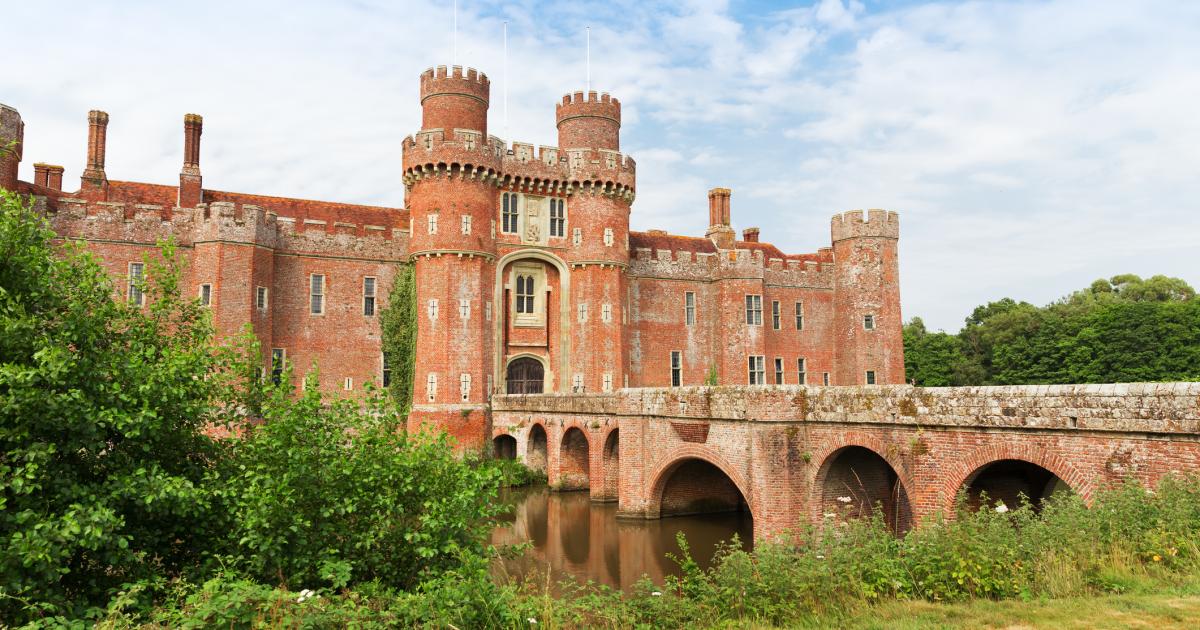
Herstmonceaux, near Hailsham in East Sussex, has often been labelled pretty, attracting walkers and day-trippers coming to visit its stunning castle, which is one of England’s oldest brick buildings.
However, many residents, both local and visitors to the area, can find the pronunciation of the village’s name tricky.
How to pronounce Herstmonceux in Sussex which is famous for its historic castle
Unlike some more difficult Sussex places, such as Glynde or Felpham, Herstmonceux is not too tricky to say once you know how.
The village is pronounced: “HUHST-MUHN-ZOO”.
The first part rhymes with “first”, the second with “done”, with the ending being like an animal zoo.
One of the most common mistakes visitors make is pronouncing the final bit as ‘so’.
Its name comes from Anglo-Saxon hyrst, meaning “wooded hill”, plus the name of the Monceux family who were lords of the manor in the 12th century.
The village itself sits in pretty Sussex countryside, and has a wealth of history.
The Herstmonceux area is known for the making of trugs, baskets made from split willow boards set in an ash or chestnut frame.
Archaeological finds suggest that the area around the modern-day village of Herstmonceux may have been inhabited as far back as the Neolithic period, about 5,000 years ago, the 1066 country website explains.
However, the first written evidence of a settlement at ‘Herste’ appears in the Domesday Book of 1086.
The main feature and visiting point of the village is, however, Herstmonceux Castle.
Herstmonceux Castle is the oldest brick building of note in the country (Image: Herstmonceux Castle)
It was originally built as a country home in the mid-15th century, to replace the existing manor house and was commissioned by Sir Roger Fiennes, who was treasurer to the household of Henry VI.
But by 1740, the castle was virtually uninhabited, and it began to fall into disrepair.
The castle was dismantled internally in 1776 and was later fully restored as a private home in the first half of the 20th century.
This work was first started by Colonel Claude Lowther and by June 1912, most of the castle’s south front had been restored, but the work had to be halted with the onset of the First World War.
Colonel Lowther died in 1929 and so the work to the castle was picked up again by Sir Paul Latham, baronet, MP.
Latham changed the design of the castle restoration, going against Lowther’s intended mediaeval castle with flat roofs and battlements.
Instead, he created high-pitched roofs above the crenellations.
The moated castle was purchased and then gifted to Queen’s University, Canada, by industrialist and philanthropist Alfred Bader, a former student at Queen’s, and his wife Isabel in 1992.
The castle and estate were also once home to the Royal Greenwich Observatory, which relocated from the light and smoke pollution of London to the clearer skies of Sussex.
A group of green copper-domed buildings were built to house the telescopes that moved to the village, which now form part of The Observatory Science Centre.
The parks and gardens of Herstmonceux Castle and Place are Grade II* listed on the Register of Historic Parks and Gardens.
Other listed structures on the Herstmonceux estate include the Grade II listed walled garden to the north of the castle and the Grade II* listed telescopes and workshops of the Herstmonceux Science Centre.
Have you visited Herstmonceux before? Let us know in the comments.
Source link
[Featured]
[Just In]


