












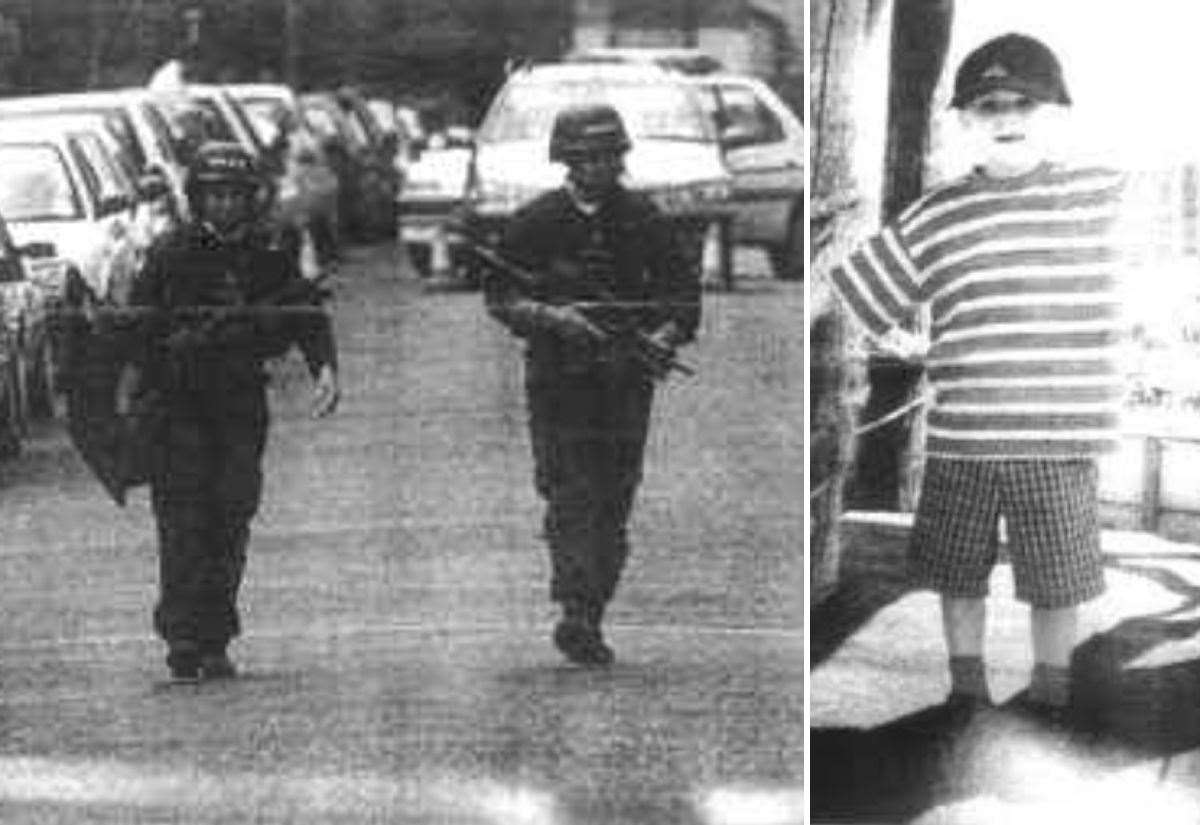
It is 25 years since Dover and the rest of Kent were stunned by the death of a little boy called Jamie McCarvill. What made it shocking and tragic was that he was shot by his mother, who turned the gun on herself.
For Simon Finlay, who was working on a local paper at the time, it is a story that will stay with him forever…


The phone rang at about lunchtime on June 11, 2001, in the rickety upstairs newsroom of the Dover Express.
A man with a foreign accent said that he had heard gunshots earlier at an address in Albert Road, on the outskirts of Dover town centre.
This was a highly unusual “ring-in” from a member of the public.
I called a police contact.
“Have you heard anything about shots in Albert Road in Dover?”
“No. Are you sure? Not heard anything.”
“No, I’m not sure, that’s why I am calling.”
“Give me 20 minutes, I’ll have an ask around.”
The contact rang back five minutes later.


With the sort of understated calmness one comes to associate with detective officers who have seen it all, he whispered: “It’s a bad one, Fin.”
The initial police reports suggested a woman was believed to have shot her young son – deliberately – with a shotgun and turned the weapon on herself. As we spoke, she was on her way to hospital but it was unclear if she would make it there alive.
It was a Monday. I was news editor of the paper but back then, a quarter of a century ago, there was no news website to break the story on and we weren’t due to go to press for days.
I visited the scene, a five-minute walk from the office, and spoke to locals, who seemed to know even less than we did and, as is often the way, gave entirely contradictory accounts.
Knowing that the Fleet Street papers would be able to publish the next day, I knew I had to find something different for the Express that week.


The editor decided to run a front page with the headline: “WHY?” It summed up perfectly what everyone was thinking.
Underneath was a ‘comment’ piece, trying to sum up the genuine numbness and sheer disbelief that people were feeling in the town that week.
On an inside page, the best I could come up with was: “A mother who shot her four-year-old son dead in Dover on Monday morning before turning the shotgun on herself, may not face murder charges.”
At that stage, what everyone knew was the assailant was Patrica McCarvill, a French woman, who lived with her Scottish-born husband Frank in the smart Albert Road townhouse with their children Peter, 15, and Jamie, aged four.
She had been suffering from depression and mental health episodes, on occasions quite extreme, for some time, and something had snapped that day. She used her husband’s legally-owned shotgun to kill her son and then attempted to take her own life but survived.


Far from wanting to demonise Patricia, local people felt sorrow for her, Frank and especially Peter, who was close to his much younger brother Jamie. Even hard-as-nails coppers on the case were very upset and knew they would have to tread very lightly for all concerned.
It was unusual for the Press to deviate from the basic facts but since Patricia had not been arrested, reporting what we knew was not technically sub judice.
And Patricia, far from being at death’s door, was improving physically but nowhere near mentally well enough to be interviewed by police. This would last for many months.
What was striking was just how quickly Kent Police had garnered not just the essentials of the case but an incredible depth of knowledge of their suspect.
The following month, the funeral service was held at St Peter’s church in River, Dover. It was a bright, warm day but there were puddles on the ground after a summer shower.
The Press were asked to keep a discreet distance on the other side of the road from the church entrance. Even from there, there were murmured sounds of the service inside, floating across the graveyard – Lord of All Hopefulness and to mark Jamie’s support of Liverpool FC, You’ll Never Walk Alone.


As the little white coffin borne by Jamie’s father, uncle and two close friends emerged from the church and through a guard of honour by the lads from Dover Athletic’s under-15s squad, it was impossible not to be moved by the sheer piteousness of the next two or three minutes.
So I wrote what I saw: “To those waiting outside, Rev Dr Kirby’s wind-blown surplice announced the enormous shoal that was to follow the coffin from the door of St Peter’s.
“Each head was bowed, many in tears and some wearing the hollow, dark-eyed look that only grief brings.
“The quiet walkers moved three-abreast at an equal, shuffling pace down the narrow pathway through the graveyard to the respectful purr of the hearse.
“Here, in the dappled July sunlight, the living were among the dead.”
A few days after the centre-page spread was published, I spotted Frank and Peter standing outside a shop in Dover’s High Street.
Should I go over and introduce myself? Wasn’t sure, to be honest. But I did it anyway.
We shook hands and Frank said: “I wanted a word with you.”

I shuddered inwardly, ready for a rebuke about journalistic inaccuracy or tabloid sensationalism; that I was “scum” or a “vulture” or something. It wouldn’t have been the first time.
“I wanted to say thank you for what you wrote. It meant a lot,” he said.
It was about 4.30pm and I was heading back to the office.
“Can we have a chat, Frank?”
“Of course,” he said.
“What about 6pm?”, I said, not wanting to give him the chance to sleep on it, reflect and change his mind.
He agreed. And so we met at the family home, which had been thoroughly torn asunder by police and shorn of most of its furniture and sat on a pair of quite uncomfortable chairs.
Above our heads, part of the ceiling cornice had been crudely plastered over, the result of one of Patricia’s shotgun discharges in the room directly upstairs.
Frank gave me a tour of the house. A pair of little wellies at the back door. Jamie’s toys in the garden. It was the wellies that nearly made me burst into tears.
My wife was heavily pregnant at the time, so perhaps some primal urges had overtaken me.

Frank went through the events of the day Jamie died in some detail; a photographer turned up and took some pictures. I remember how open and frank he was, almost disarmingly matter-of-fact. He did not dodge a question or skim over his wife’s mental health struggles and the pressures they placed on the family. It was fairly exhaustive.
He said that Patricia was convinced for most of Jamie’s short life that he “wasn’t right”, that the child was not developing as he should.
Frank said he visited his wife every day in the secure hospital unit she was being held in.
When I was finished, I made to leave, slipping my notebook into my suit pocket. Then Frank, out of the blue, told me he had been having an affair with a woman from work, that he had told Patricia about it the previous January and blamed the confession for his wife’s downward spiral, leading to Jamie’s death. She had also taken an overdose in March, he said.
“That dalliance,” he said, “probably cost the life of my son. I have to live with that.”
I shivered. The notebook appeared again and I asked if I could write that down.
And then he uttered the words that have remained with me ever since: “Those that care don’t matter; those that matter don’t care.”


I warned him that when the paper published the line about the affair, it would be followed up by the nationals. He opened the palms of his hands as if to say: “So be it.”
Why on earth did he tell me all that? Perhaps he wanted to get it all into the open as, one way or the other, it would come out in the end. We duly published the piece and got an encore from the national dailies the following day.
We kept in touch fairly regularly over the next couple of years. He passed on what he could about the case and how Patricia was faring in psychiatric care.
Patricia’s mental state was such that she could not stand trial or be placed in front of a court.
Detectives on the case would provide off-the-record updates. Few had worked on anything so tragic or so unusual.


But eventually, in mid-March 2003, she was due to appear at Maidstone Crown Court.
A couple of days before, Frank rang to ask if I was going. When I said I wasn’t sure, he asked: “Can you be there, please?”
Patricia, by then aged 46, pleaded guilty to manslaughter and was detained indefinitely under the Mental Health Act.
Judge Andrew Patience heard prosecuting counsel Jeremy Gompertz tell the court how Patricia had been suffering from a severe mental illness with “psychotic implications” that led her to believe that the only solution was to kill herself and her son.
The details of what happened to Jamie were spelt out in graphic, upsetting detail. Sitting directly behind me on the press bench, I could hear Frank’s uncontrollable sobs as he was comforted by his new partner.


I can’t recall Patricia’s demeanour in court, other than she cut a rather dishevelled, pathetic figure in the dock.
At the end, Judge Patience said to the defendant as kindly as he could: “You may go down.”
That was it.
For the McCarvills, they would try to rebuild their lives after a tragedy few can truly comprehend and which was played out in public view.
When Frank remarried, he invited my wife Lesley and me to the evening reception. It was a gesture of friendship; a nod to what we had shared uniquely together.
He looked content, relaxed and at peace that night. But is also felt like a a full stop. We haven’t spoken since.


