













The European Union’s Markets in Crypto Assets Regulation hits a hard deadline on July 1 when the transitional period ends and in-scope crypto asset service providers operating under national regimes must either hold a MiCA licence or stop serving EU clients.
A spokesperson from the European Securities and Markets Authority (ESMA) told Cointelegraph that from that date, non-authorized entities “will not be allowed to operate within the EU” and should implement wind-down and client migration plans rather than rely on open-ended transitional status while awaiting a decision.
The deadline could force some crypto firms to suspend EU operations while their applications remain under review, potentially affecting millions of users who continue to engage with platforms that are not yet authorized under MiCA.
In France, 19 crypto asset service providers (CASPs) have been authorized so far, and roughly 25 applications remain under review, a spokesperson for the Autorité des marchés financiers (AMF) told Cointelegraph.
From July 1, providers that are not MiCA-authorized “must cease their activities,” the spokesperson said, pointing to a February AMF warning that unauthorized crypto asset services are a criminal offence punishable by up to two years in prison and a 30,000 euro (roughly $35,000) fine.
The watchdog says it can also add firms to a blacklist, issue public warnings and seek court orders to block access to the websites of unauthorized providers targeting French users.

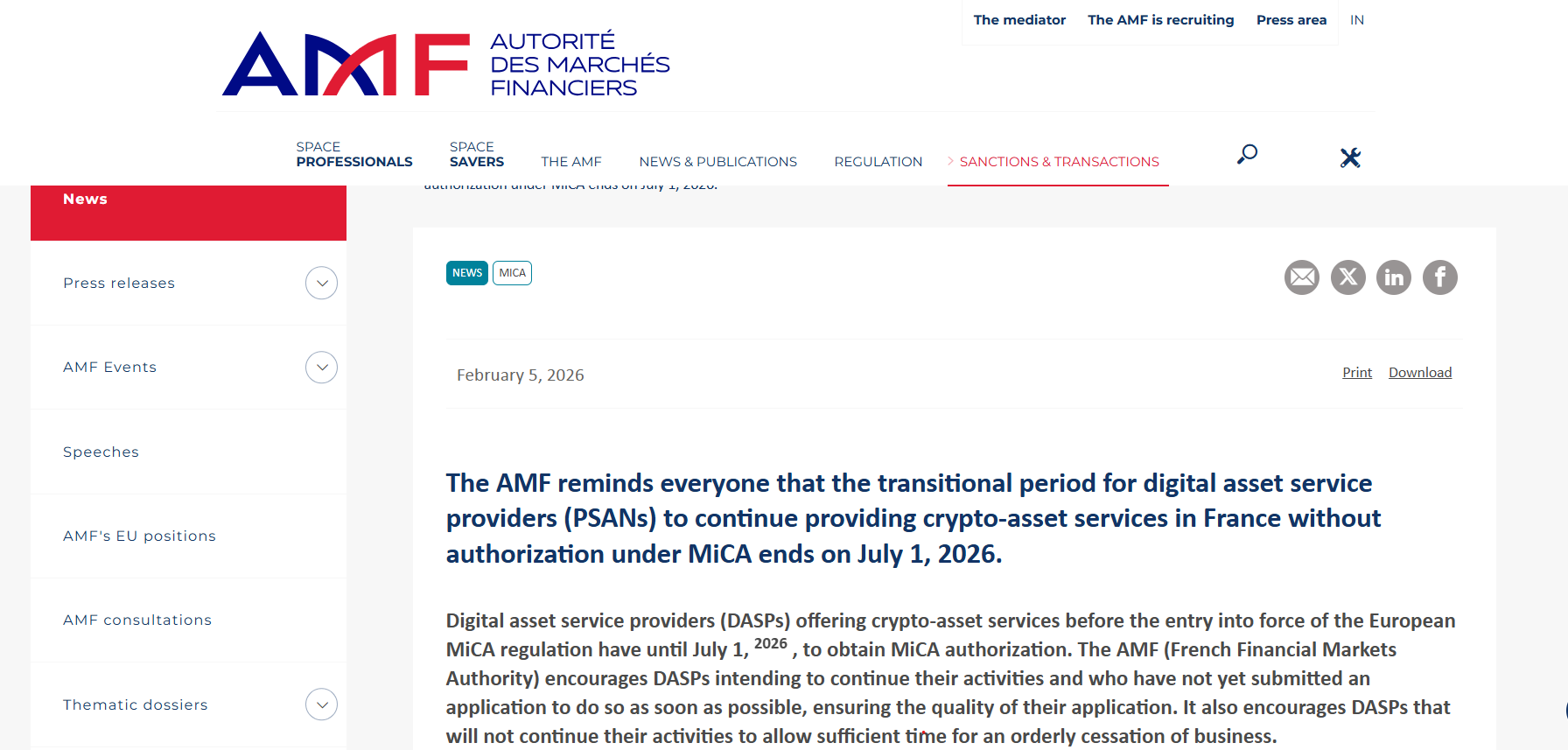
AMF warning to unregulated crypto asset platforms. Source: AMF
Germany has set a licensing requirement under its national implementation of MiCA, requiring crypto asset service providers that were operating under prior exemptions to obtain authorization by June 30, a spokesperson from German regulator BaFin told Cointelegraph.
The country generally follows EU and national deadlines, the spokesperson said, and may apply enforcement measures “where possible and appropriate,” adding that some applications remain under review.
In contrast, Austria chose not to extend grandfathering for virtual asset service providers under its pre-MiCA regime, which ended on Dec. 31, 2025, so no exchanges are still operating without a license in the country.
A spokesperson from the Finanzmarktaufsicht (FMA) told Cointelegraph it has licensed nine CASPs so far and that MiCA application volume is “significant,” although it does not disclose how many applications are pending.
Related: France’s AMF regulator sets June 30 deadline for MiCA licensing
Lawyers warn pending applications offer no protection
Having an application in the queue will not shield CASPs from the deadline, Niall Esler, head of the regulatory and risk advisory practice at law firm Walkers, told Cointelegraph. He said that companies still serving EU clients without authorization after the transition ends will be operating unlawfully and cannot expect to continue business as usual.
MiCA requires member states to give national authorities powers to order an immediate halt to services, compel client offboarding, name firms publicly and impose administrative fines for unauthorized activity.

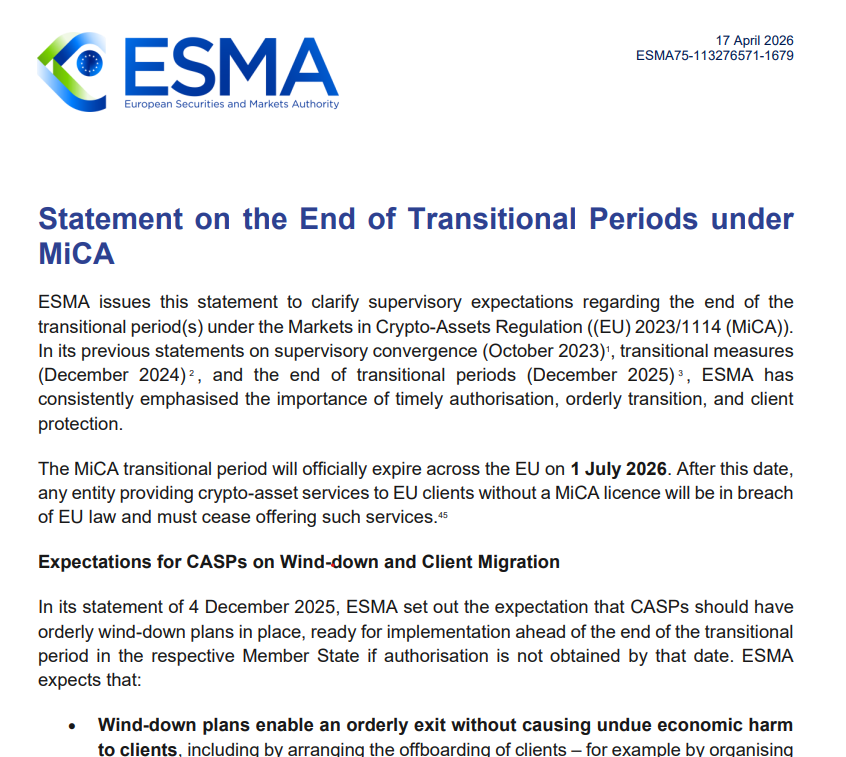
Statement on the end of transitional periods. Source: ESMA
That could affect a substantial number of European crypto users. According to analysis shared with Cointelegraph by OKX Europe, of 18.5 million crypto app downloads in Europe between May 2025 and May 2026, about 7.6 million (41%) were to exchanges that do not appear on the independent register of MiCA-authorized providers compiled from ESMA and national data.
ESMA declined to provide an estimate of how many EU users remain on non-authorized platforms, saying it cannot share non-public information.
OKX Europe CEO Erald Ghoos said app download figures understate the issue because they miss users who access exchanges via web browsers or installed apps earlier and remain active.
To bridge that gap, OKX says it combined App Store data with web traffic estimates and search trends to approximate active usage. Ghoos said the company believes “approximately 60% of European crypto users are actively engaging with platforms that hold no MiCA authorization,” including some of the world’s largest exchanges by trading volume.
Related: Europe’s MiCA regime puts smaller crypto firms under pressure
Some exchanges still seeking MiCA approval
Several major exchanges are still awaiting MiCA authorization as national regulators review their applications.
Bitget, for example, applied for a MiCA license in Austria in 2025. The company’s chief legal officer told Cointelegraph it expects regulatory approval in the second quarter of 2026 and will not offer services in the European Economic Area until authorization is granted.
Binance, meanwhile, applied for a MiCA licence in Greece in January through the country’s Hellenic Capital Market Commission and is not currently listed among MiCA-authorized providers in the EU. The company did not respond to a request for comment on its application status.
Magazine: Singapore isn’t a ‘crypto hub’ — it’s something better: StraitsX CEO


