




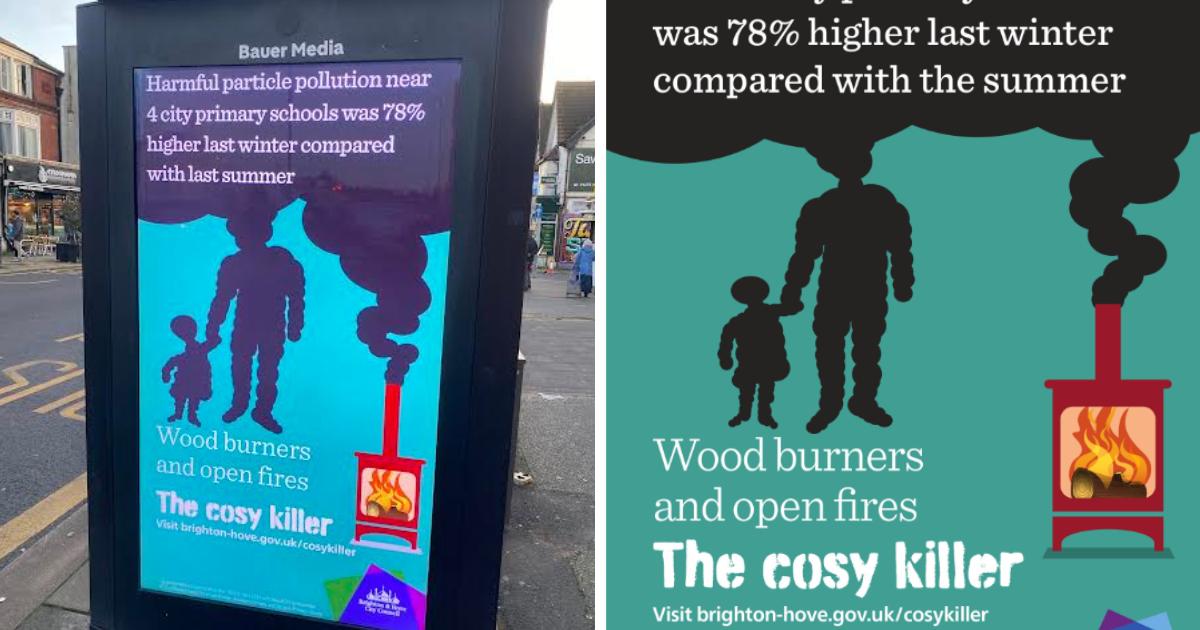

The ASA announced today that they have banned an advert which was created by Brighton and Hove City Council as part of their controversial “Cosy Killer” campaign.
The advert distributed by the council read: “Harmful particle pollution near 4 city primary schools was 78% higher last winter compared with last summer […] Wood burners and open fires. The cosy killer”.
The ASA’s investigation found that the advert implied that wood burners and open fires were the cause of a claimed increase in particulate pollution around four city primary schools, but ASA did not find any evidence to back up this claim.
The poster, which was seen in December 2025, included a graphic of a wood burning stove which was emitting smoke in the shape of an adult and child.
Small text at the bottom of the advert stated: “City sensor data comparing December 2024 to April 2025 with May 2025 to November 2025 at Middle Street, Elm Grove Primary, Adlington Primary and Saltdean Primary schools”.
The complainants, one of whom owned a chimney sweeping business, challenged whether the advert misleadingly implied the use of wood burners and open fires was the cause of the claimed increase in particle pollution.
The advert was part of the council’s Cosy Killer campaign which was devised to raise awareness of the “damaging impact of particulate matter (PM) pollution from domestic wood burning, including open fires and wood burners, on public health, and its contribution to deaths”.
The advert also raised awareness of the increase in particle pollution during the “heating season” – a period which runs from October until March/April – which they said was attributable to domestic burning.
In defence of the advert, the council said it had used data from a city-wide network of air quality sensors which analysed air pollution levels from eight places across the city, which included main roads and the primary schools mentioned in the advert.
They compared pollution levels in two parts of the year: the winter months when wood burners and open fires were used more often (December 2024 to April 2025), and the warmer months (April 2025 to October 2025).
Across all eight monitoring sites, the council said PM2.5 pollution was 91% higher in period one than period two. The same results showed a 79% increase across the four primary schools between the two periods. They provided a memorandum of scientific support from an academic who specialised in air pollution.
The council said its monitoring data strongly suggested that spikes in PM2.5 pollution were primarily caused by solid fuel burning rather than other sources.
It found no meaningful differences between roadside and suburban detectors, indicating year-round traffic emissions were not responsible for seasonal peaks and pollution levels were highest late at night, when traffic had subsided.
The city also lacks major pollution sources such as motorways, heavy industry or nearby airports, while cleaner energy use is widespread, such as at Shoreham Port. Remote sensors in the South Downs showed extremely low pollution, which suggested winter peaks came from local, urban activity
In a statement, a spokeswoman for ASA said: “We acknowledged Brighton and Hove’s comments that the surrounding circumstances at the time of the winter data collection – such as PM peaks after commuting rush hours, lack of proximity to motorways and heavy industry, and local renewable energy generation – suggested the increase in measured ambient PM2.5 concentrations was unlikely to be attributable to those sources.
“We also acknowledged the memorandum of scientific support from an academic who specialised in air pollution, which stated agreement with the messaging in the ad campaign, and that the results were consistent with the burning of wood and solid fuel.
“However, the ad implied there was a direct causal link between the use of wood burners and open fires and the claimed increase in particulate pollution, and that those heat sources were the sole cause of the increase. While we understood domestic wood burning was a significant contributor to urban PM2.5 emissions, we had not seen evidence in support of the direct link claimed in the ad.”
The spokeswoman added: “The ad implied that wood burners and open fires were the cause of the claimed increase in particulate pollution around four city primary schools. However, we had not seen evidence to substantiate the claim. We therefore concluded the ad was likely to mislead.
“The ad breached CAP Code (Edition 12) rules 3.1 (Misleading advertising) and 3.7 (Substantiation).
“The ad must not appear again in the form complained of. We told Brighton and Hove City Council to ensure that robust evidence was held to substantiate any claims where a direct causal link between the use of wood burners and open fires and an increase in particle pollution was stated or implied.”
Brighton chimney sweep Rob Whittingdon, who trades as The Purple Sweep, has previously accused the council of “scaremongering” and was one of the complainants who reported the advert in question.
He said: “There are lots of contributing factors to winter rises in pollution, and councils shouldn’t make claims without the right evidence. Air pollution from solid fuel heating has declined significantly over recent years, and much of this has been achieved through guidance in how to use stoves and fires correctly.
“The message I’m keen to get out is that using solid fuel is perfectly legal, including in smoke control areas, provided people are using authorised smokeless fuels or approved appliances designed to burn more cleanly.
“As a chimney sweep in the city, I meet many people who are relieved to have a resilient alternative to the price rises they’re seeing in gas and electricity. Most of these people are doing the right thing, but some benefit from guidance on how to use solid fuel effectively. This is where the focus should be: on helping people do things properly and improving standards where needed, not stigmatising people who are acting lawfully.”
Councillor Tim Rowkins, Cabinet Member for Net Zero and Environmental Services at Brighton and Hove City Council, said: “We have clear and detailed local data that shows the impact that burning solid fuels has on air quality in our densely populated urban areas.
“The health implications of PM2.5 exposure are well-documented and we have a duty to protect the health of our residents.
“We are committed to ensuring our messages are accurate and reliable. The ASA has ruled that, in one of the campaign graphics we used, there was an insufficiently clear link to the evidence. We accept that ruling and will be taking time to review it to ensure any learning for the future.
“There was no ruling against the campaign as a whole or the other materials that were used. The campaign ended in February, and we have no plans to run it again in its original form.
“Later this year we’ll be introducing a new Smoke Control Area covering most of the city, accompanied by information and clear guidance on what can be burned and how.
“We’re working towards cleaner air in Brighton & Hove and will always act to protect the health of people in our city.”
Source link
[Featured]
[Just In]
