












In May 2026, the Global Volcanism Program reported nine actively erupting volcanoes in Indonesia—more than any other country at the time. Such activity is typical for the Southeast Asian archipelago, where eruptions have occurred at 55 volcanoes since the 1960s—the highest total for any country. Japan ranks second with eruptions at 40 volcanoes over that time period, followed by the United States with 39, according to Global Volcanism Program data.
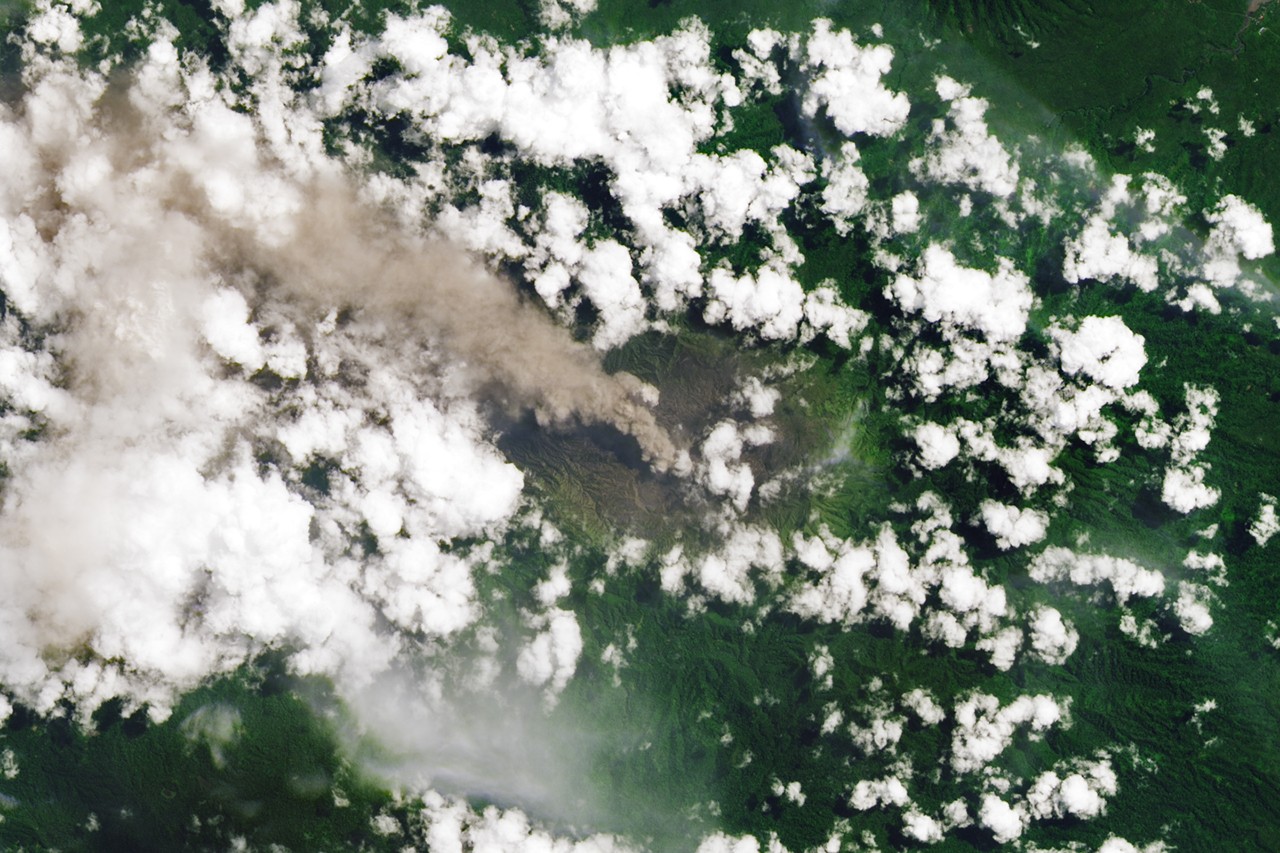
Even for such an eruption-prone country, the persistence of activity at Mount Dukono stands out. The remote stratovolcano, located at the northern end of Halmahera Island, has been erupting nearly continuously since 1933, with near-daily rumbles and frequent emissions of ash and volcanic gases. The volcano routinely flings hunks of semi-molten rock, known as volcanic bombs, hundreds of meters from its vent.
This sort of activity at Dukono turned deadly on May 8, 2026, when ash and volcanic bombs rained down on a group of hikers. In the days following the tragedy, the mountain remained highly active. Indonesia’s volcanological survey reported an average of 52 eruptive events per day between May 9 and 16, with ash plumes rising 400 to 4,300 meters (1,300 feet to 14,000 feet) above the summit.
NASA and other U.S. government satellites detected thermal anomalies, ash plumes, and sulfur dioxide emissions in recent days. Indonesian authorities have set the alert level at 2 (on a scale of 4) and warned the public to stay at least 4 kilometers (2 miles) from the crater.
NASA Earth Observatory image by Lauren Dauphin, using Landsat data from the U.S. Geological Survey. Story by Adam Voiland.


- Center for Volcanology and Geological Hazard Mitigation (2026) MAGMA Indonesia. Accessed May 26, 2026.
- CNN (2026, May 9) Multiple hikers killed, others rescued after volcano erupts in Indonesia. Accessed May 26, 2026.
- Global Volcanism Program (2026, May 14) Weekly Volcanic Activity Report. Accessed May 26, 2026.
- Global Volcanism Program (2026, March 31) Which countries have the most volcanoes? Accessed May 26, 2026.
- The Ministry of Energy and Mineral Resources (2026) Gunung Dukono Kembali Erupsi, Masyarakat Diminta Waspadai Sebaran Abu Vulkanik. Accessed May 26, 2026.
- Mirova (2026, May 26) Dukono. Accessed May 26, 2026.
- Mounts (2026, May 26) Dukono. Accessed May 26, 2026.
- Oregon State University (2026) Dukono. Accessed May 26, 2026.


