











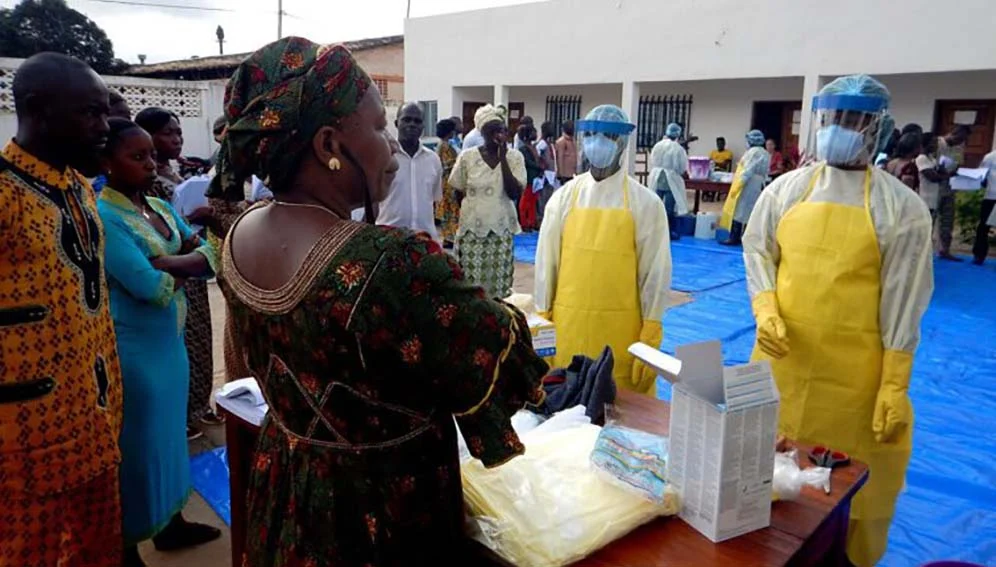
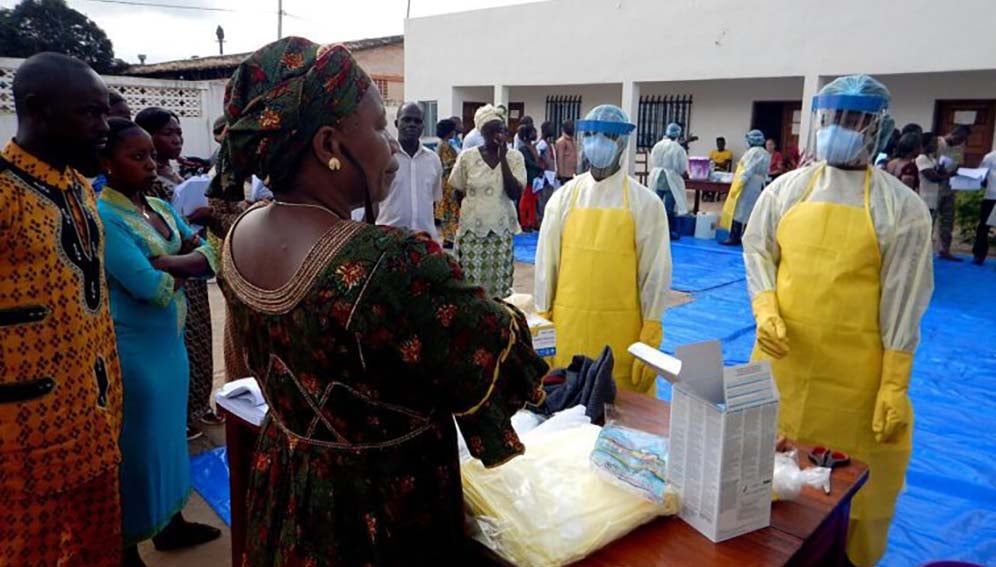

[KINSHASA, SciDev.Net] Health workers battling an Ebola epidemic believed to have affected hundreds of people in the Democratic Republic of Congo (DRC) say they have been working without medical supplies and personal protective equipment as international agencies scramble to respond to the crisis.
Medics are putting their own lives at risk helping patients who may have been infected with the rare Bundibugyo species of the virus, for which there are no licensed vaccines or treatments, a leading doctor told SciDev.Net.
“The situation on the ground is truly alarming,” said Ruben Dedja, chief medical officer of the Mongbwalu health zone in Ituri province, the epicentre of the epidemic.
“As yet, we do not have the rapid intervention kits at the health zone level. We’ve been told they are on their way,” he told SciDev.Net on Tuesday (19 May), adding that the lack of kits meant there was “no way to limit the spread”.
“What we are doing is making do locally with the resources we have,” he said.
This lack of resources revives a “dark” memory from previous epidemics when many healthcare workers were infected and died, Dedja explained.
At a time when affected communities need health workers not only to treat them but also to support them, he said many medics feared that the lack of equipment could prove fatal.
“There is anxiety among healthcare staff as they do not have all the protective equipment,” said Dedja.
“There are many doctors who are afraid for their own lives and are wondering whether to intervene with such limited means,” he added, clarifying that “nevertheless, we have no choice, it is our oath. We do things with the means at hand”.
The WHO announced the outbreak on 15 May and declared it a Public Health Emergency of International Concern two days later.
In an update Friday (22 May), WHO director-general Tedros Adhanom Ghebreyesus said the number of suspected cases was close to 750, with 177 suspected deaths. He said the national risk assessment had been revised up from “high” to “very high”, with a high regional risk but low global risk.
The WHO has shipped 18 tonnes of emergency supplies to the DRC, including personal protective equipment, clinical management and lab supplies, medicines and tents. It has also deployed 20 experts and set up mobile laboratories across affected areas to speed up testing and diagnostics, according to a WHO spokesman who declined to comment on the absence of equipment in Mongbwalu.
The response also includes help to strengthen surveillance, lab testing, contact tracing, and case management, as well as engaging neighbouring countries to improve cross-border preparedness, he said.
For Lokana Moro, a resident of Mongbwalu, this comes too late. He lost his 16-year-old daughter after hospital doctors were unable to cure her of an illness that presented all the symptoms of Ebola.
He told SciDev.Net by phone: “After her death, we were left as a family of seven […] We don’t know if we are infected or not, but we continue to live all together. Nobody has told us anything, we haven’t even been quarantined.”
Emily Lebughe, a doctor at the Renaissance University Hospital in Kinshasa, says adhering to strict hygiene standards will be critical for local communities.
“We know that the virus takes advantage of hygiene gaps to infect medical staff and populations,” she said.
Mulangu Sabue, a virologist and lecturer-researcher at the University of Kinshasa, warned: “We know from previous responses that the level of hygiene in most of our hospitals and health centres is inadequate and has often played an amplifying role in the spread of epidemics. Therefore, we need to have strict infection control protocols at the hospital level.”
‘Chronic underfunding’
For Dedja, this situation reveals the vulnerability of DRC’s health system.
“Our system suffers from chronic underfunding, to the point where resources, whether human or material, are deficient in both quality and quantity,” he said.
Sabue also highlighted the limitations of surveillance systems, noting that “the index case was reported on 24 April, and almost three weeks later, there were already more than 300 infected cases and more than 90 deaths”.
“Our authorities really need to focus on making our health system strong and putting in place a health monitoring system,” added Lebughe, who also called for psychological support and better equipment for healthcare workers fighting the ongoing epidemic.
Tedros noted that the provinces of Ituri and North Kivu where the outbreak is occurring are highly insecure, with around 4 million people needing urgent humanitarian assistance, 2 million displaced, and 10 million facing acute hunger.
The outbreak has also spread to neighbouring Uganda, with two cases confirmed in people who had travelled from the DRC, including one who died.
Tedros said the situation there was “stable” after authorities ramped up disease surveillance and postponed a religious pilgrimage expected to attract a million people.
“The measures taken in Uganda, including intense contact tracing and cancelling the Martyrs’ Day commemoration, appear to have been effective in preventing the further spread of the virus,” he said.
This article was produced by SciDev.Net’s Sub-Saharan Africa French edition, with additional reporting by the Global desk.