










Experts were quizzed about whether it was ‘reasonably foreseeable’ the underground tunnel could pose a risk to the public


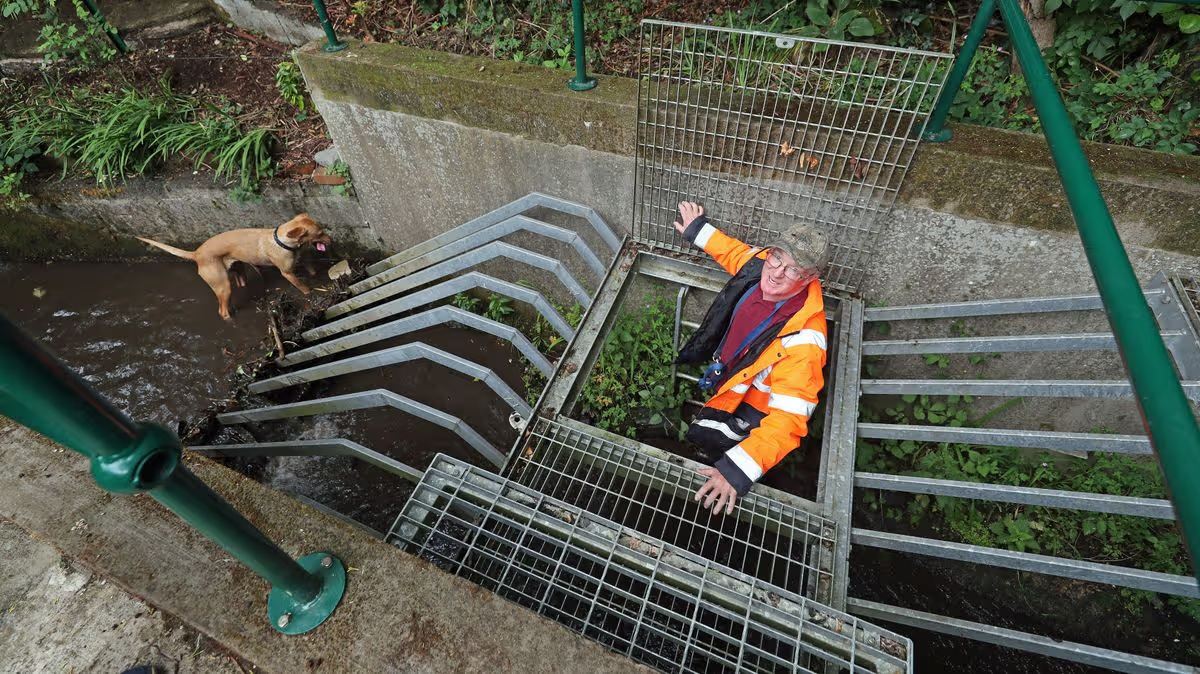
A man and a dog inspect a culvert in Seaview Park during the search for missing Noah Donohoe in June 2020(Image: PA)
The Noah Donohue inquest has heard that there may have been “missed” opportunities to assess the public risk of a water tunnel entrance as part of refurbishments carried out three years before the boy died.
Experts were quizzed at the inquest today, about whether it was “reasonably foreseeable” that the underground tunnel could pose a risk to the public.
Noah, a pupil at St Malachy’s College, was 14 when his naked body was found in the underground water tunnel in north Belfast on June 27 2020, six days after he left home on his bike to meet two friends in the Cavehill area of the city.
READ MORE: Omagh crash victim locally named as father-of-two Adrian SlevinREAD MORE: Major delays expected across Belfast this weekend as parades planned
He was found more than 600 metres downstream from where he had last been seen close to the culvert inlet behind houses at Northwood Road in north Belfast.
The long-running inquest, which has entered its 16th week, heard further evidence on Monday from from civil engineer Brian Pope and risk assessment expert Dr Mark Cooper. They were among a group of four experts who had provided joint responses to a series of questions about the culvert, for which the Department of Infrastructure (DfI) is responsible.
The inquest has previously heard that the department carried out refurbishment work at the culvert entrance in 2017, building new access steps and adding a new debris screen.
On Monday, the experts were shown photos of the debris screen replaced in 2017 and an earlier debris screen in an undated photo.
Brenda Campbell KC, who represents Fiona Donohoe, said there were 11 bars in the earlier debris screen, and if it is assumed they are evenly spaced out, there would be a gap of 131-132mm between the bars.
She told the inquest that 144mm is the recommended gap for a security screen and asked Dr Cooper if the screen were being changed to make the bars wider apart, “enabling children to pass”, would it have prompted a risk assessment.
Dr Cooper, who has 35 years of experience and specialises in serious and fatal accidents in the workplace, replied that any change would have called for a risk assessment. The experts were also asked about evidence given to the inquest by Jonathan McKee, a DfI official, who described the new 2017 debris grille as a “like-for-like” replacement.
Both experts said they disagreed it was a “like-for-like” replacement, with Dr Cooper stating it was “obviously” an improvement but was “primarily aimed at workers”.
Dr Cooper said there were “missed” opportunities in relation to the risk posed by the culvert – most notably during the 2017 refurbishment to consider wider health and safety issues – and said there was no consideration given in 2017 to the risk of unauthorised access.
He said there was an “absence of a risk assessment and an absence of a consideration of the public safety concern, which is my area of interest, and nobody seemed terribly concerned that there wasn’t a risk assessment in place”.
“That is how you ensure occupational health and safety,” he added.
On June 12 2023, Dr Cooper walked the boundary of where the culvert land adjoins a nearby residential area and saw access points for residents, as well as objects that indicated it was being used, such as tools, a washing line, a frizbee, and bird feeders.
Dr Cooper said: “It was foreseeable to me that the land was being used as a playground for individuals.
“It is bounded, it’s a green area where children might play and – more than that – it might be seen by parents as a safe place for children to invite their friends. Indeed, they may think it’s safe but the point that I would like to make is that parents would not be aware of the hidden dangers once you go beyond that (debris) screen.”
Mr Pope said that while the risk of unauthorised access to the culvert would have been of a low probability, the consequences of any potential incident would have been severe.
He said that while there was “no evidence of graffiti” or “written-down information about unauthorised access” to the culvert, this did not “diminish the risk to zero” of unauthorised access.
Barrister Neasa Murnaghan KC, representing the DfI, questioned the experts on what is reasonably foreseeable in a risk assessment and whether there is variation in different experts’ assessment of risk.
Mr Pope said if both engineers had the same information in 2017, “then they should come to the same conclusion given the information available”.
“So it’s either right or it’s wrong?” said Ms Murnaghan.
“Generally speaking, one would think you’d arrive at the same information,” Mr Pope replied.
Ms Murnaghan asked that it “wasn’t foreseeable” that a member of the public would gain access to the site, to which Mr Pope said it was his view that it would have been a relatively low but foreseeable risk.
He added the risk arose from the possibility of members of the public gaining access to the culvert, and because of its proximity to a residential area.
When Dr Cooper was asked by Ms Murnaghan whether health and safety legislation does not require the elimination of risk, he said this was “an obvious thing to say because in life you can’t eliminate all risk”.
Asked by Ms Murnaghan about whether a risk assessment would have “absolutely led to a different conclusion as to a choice of screen”, Dr Cooper said he did not agree.
“It’s as plain as can be, a culvert is a confined space,” he said. “After control measures it’s still a high category, all culverts, as confined spaces, should be (deemed a) very high (risk).”
Ms Murnaghan said it was a medium risk according to another risk assessment.
“My job is to ask you questions rather than to argue with you,” Ms Murnaghan said.
Later, Dr Cooper told the inquest that he is “very suspicious of risk assessments that say there are no actions required”, adding that a risk assessment is to be used a tool to assess actions to bring risks under control.
“If you’d have done a proper risk assessment at the time, we wouldn’t be having this conversation now. That’s the problem, it wasn’t done,” Dr Cooper said.
For all the latest news, visit the Belfast Live homepage here and sign up to our daily newsletter here.


