










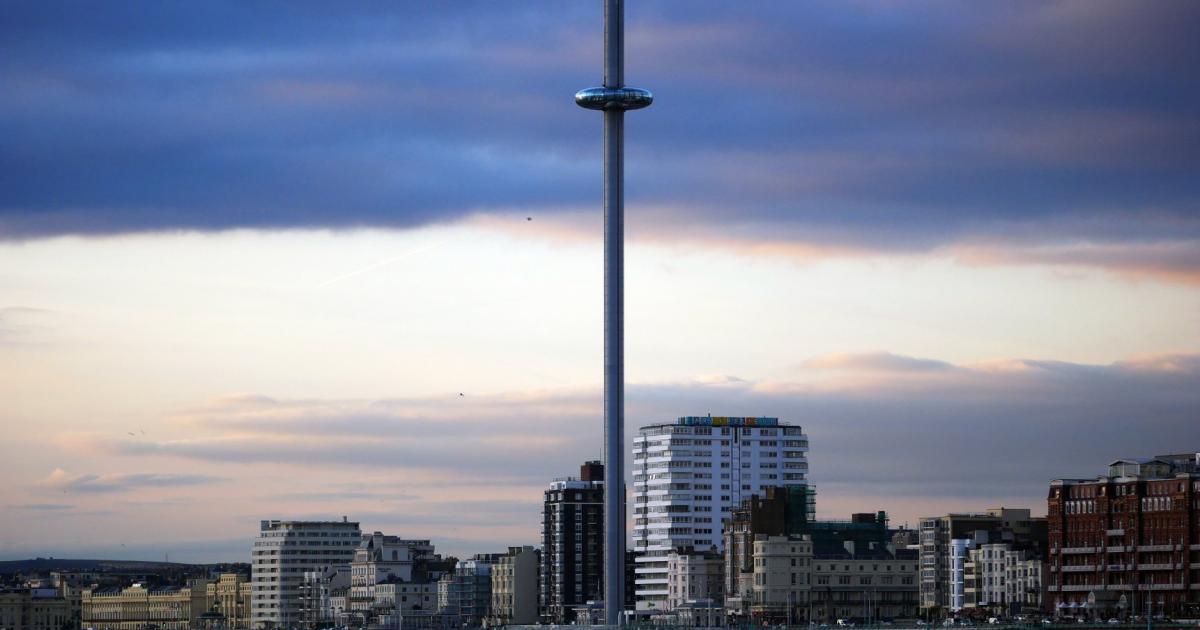


Brighton and Hove City Council has today published an independent report from the Chartered Institute of Public Finance and Accountancy on lessons learnt from the original decision to extend a loan to the i360. The report confirmed visitor numbers were significantly overestimated and that “optimism bias” was evident throughout the business plan.
The report confirms what The Argus revealed in 2022 when the business case that helped convince politicians to approve a £36 million taxpayer-backed loan to build the i360 was accidentally handed to The Argus by council officials.
And this new report states the business plan was “naive”.
It states: “The original business plan for the Brighton i360, developed in 2012, projected annual visitor numbers of between 700,000 and 800,000, with the first year expected to attract 798,374 paying visitors. D & J Consulting Ltd worked alongside Marks Barfield Architect and provided a review of these projections in 2014. They produced projected opening year attendance figures with a high, medium and low range of 982,922, 822,584 and 599,242 respectively, and recommended using the medium projection of 822,584. These forecasts proved to be naïve and fell far short of these expectations. This projection of visitor numbers was one of the most significant factors that led to an over-anticipation of income and was based on unrealistic assumptions about tourist and residential market penetration and the attraction’s appeal as a landmark destination.”
The attraction was designed and developed by Marks Barfield Architects, the London‑based practice founded by David Marks and Julia Barfield, who also created the London Eye.
It opened in August 2016 after the loan was agreed by the city council under a minority Green Party administration led by Jason Kitcat.
But the predicted visitor numbers and income did not prove sufficient for the loan repayments and it closed in December 2024. To secure the sale to new owners the city council wrote off its £51 million debt. The council will now need to repay £2.2 million a year every year until the 2040/41 financial year.
The Brighton i360 reopened on March 8, 2025, under new management following a two-month closure due to financial insolvency. Nightcap Limited CEO and former Dragon’s Den star Sarah Willingham secured a lease after the council wiped out £51m in debt.
Now this new report has reflected on “what went well, what could have been done differently, and how similar projects might be better designed and delivered in the future”.
One of the key findings is that the i360 suffered from optimism bias from the outset and that in many instances, “decision-making was driven by ambition rather than robust financial analysis”.
Optimism bias refers to the systematic tendency to overestimate benefits and underestimate costs, risks, and timelines. It has been particularly prevalent in public infrastructure and regeneration projects.
The original business plan for the Brighton i360, developed in 2012, projected annual visitor numbers of between 700,000 and 800,000, with the first year expected to attract 798,374 paying visitors.
These forecasts “proved to be naïve”, the report states and in reality, the attraction averaged around 270,000 visitors per year.
The report states: “This discrepancy stemmed from an overestimation of market penetration – assumed to be 3.6–4% of the local and tourist population, as well as unforeseen global shocks for which there was no mitigation.”
Financial projections also proved “overly ambitious”. The plan anticipated £11.7 million in revenue and £6.7million in EBITDA (Earnings Before Interest, Taxes, Depreciation, and Amortisation) in the first year, rising modestly over the following years.
“The attraction was expected to be highly cash generative, with sufficient income to cover operating costs and service the £36 million loan provided by Brighton and Hove City Council. However, the i360 struggled to break even and eventually defaulted on its loans.”
As well as visitor numbers, a further key issue was the “overestimation of revenue per visitor and secondary spending”, such as purchases at the Sky Bar and merchandise sales.
The report states that applying an optimism bias adjustment would have changed projections.
The original plan “relied heavily on a single scenario” and “failed to account for a number of potential downside risks”.
There was “no detailed assessment of the risk that Brighton i360 Ltd might fail to meet its debt obligations, nor of the council’s exposure as the lender”.
“This oversight is significant, as the council remained liable for repayments to central government even after the operating company defaulted,” the report reads.
The report found that while the plan “referenced and benchmarked against a number of regional UK attractions”, it also considered “iconic global landmarks” such as the London Eye, Eiffel Tower, CN Tower, Empire State Building, Berlin TV Tower, Willis Tower, and the Auckland Sky Tower and used some of the information on these attractions to determine market penetration.
“These international comparators operate at a scale and within destination markets that bear little resemblance to the local regional context,” the report reads.
“The approach should have primarily focused on benchmarking against domestic attractions such as the Spinnaker Tower in Portsmouth, Blackpool Tower, and SEA LIFE Brighton.”
The plan “lacked evidence of independent scrutiny of the underlying financial assumptions” and would have benefited from “incorporating further feedback from local stakeholders”.
There appears to have been “gaps in financial acumen” in the i360 leadership team with no mention of a CFO or financial controller with “deep expertise in financial modelling, investment analysis, or debt management” as part of the senior team.
The report argues that many local authorities suffer from “limited commercial acumen” and that while councils were encouraged to behave “more like private sector entities”, they were often “not equipped with the necessary skills, experience, or governance frameworks to manage complex commercial investments”.
Councillor Jacob Taylor, deputy leader of the council, said former councillor Warren Morgan had warned of his misgivings about borrowing the money and that was why Labour councillors voted against the loan.
Cllr Taylor said: “It’s really important that the city learns the lessons from this independent report, given how much public money was lost. I think one lesson is abundantly clear: we should never again trust the Greens with Brighton and Hove taxpayer’s money.”
He added: “It’s fantastic that Nightcap and Sarah Willingham are now managing the attraction, and the city needs to move forward and keep promoting tourism. But as a council, we need to properly understand the mistakes that were made – and avoid similar decisions in the future.”
Source link
[Featured]
[Just In]


