












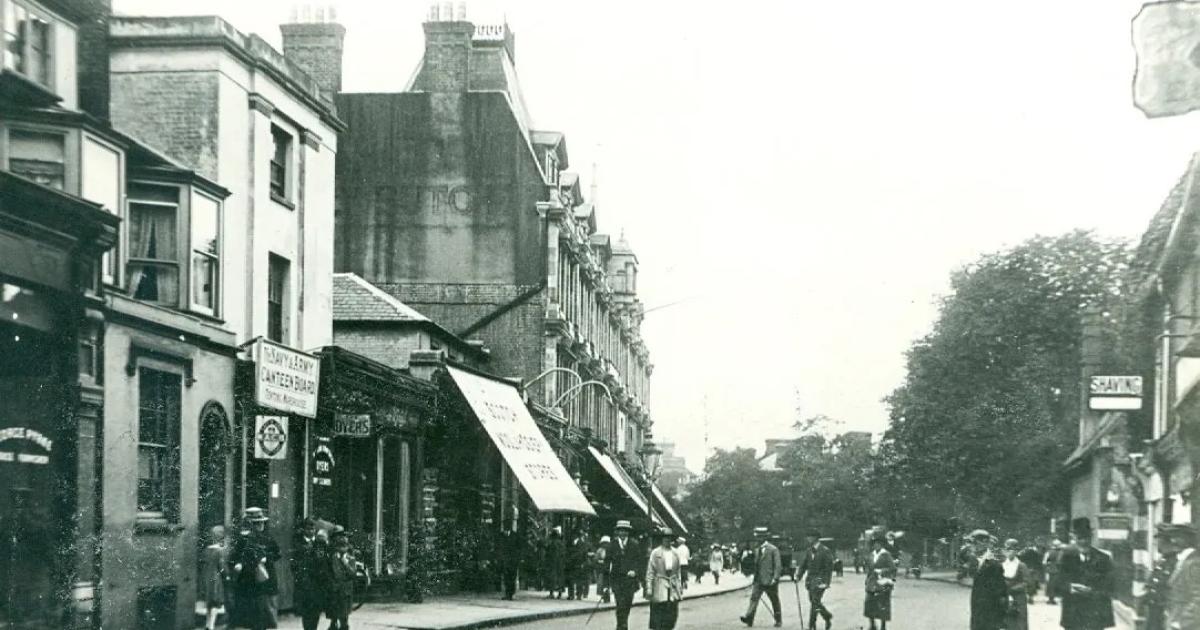
It has been part of Bromley since the 13th century, when the market was first established in 1205. At the time, High Street would have been a single road leading to Market Square.
Bromley developed around the market over the centuries, with coaching inns popping up around the area due to its position on the London to Hastings turnpike.
One of these inns that is still part of Bromley today is The Royal Bell, a 19th-century former coaching inn which was reopened earlier this year following a major restoration.
However, it was in the late 1850s, when the railway arrived in Bromley in 1858, that the town truly began to transform from a quiet country settlement into a busy commercial centre with shops and larger buildings.
High Street expanded with the creation of the railway in the 1850s. (Image: Bromley Borough Local History Society)
The 19th century also saw the prominence of notable civic buildings such as Bromley College, founded in 1666, and Sheppard’s College, established in 1840, while streams running beneath the town were diverted to make way for new developments.
Like much of London, High Street was affected during the Second World War, with parts of it — including Church House and the parish church — sustaining significant damage during a bombing raid in 1941.
Over the years, Bromley High Street has housed and hosted a number of famous figures, including science-fiction writer H.G. Wells, who was born at 47 High Street in 1866. The site is now occupied by Primark, with a plaque outside commemorating the writer and his ties to Bromley.
Historic photo of Bromley South railway station. (Image: Bromley Borough Local History Society)
The Royal Bell hosted guests of high society and even appeared in Jane Austen’s Pride and Prejudice, when Lady Catherine de Bourgh advises Elizabeth Bennet to change horses there.
Throughout the years, Bromley has lost some of its historic buildings, while others have survived as reminders of its past. Ravensfell House, a mid-19th-century villa, was demolished in the 1920s to make way for Ravensfell Parade, a row of shops including Russell & Bromley.
The Gaumont Cinema, which opened in 1936, was converted into a Debenhams department store in the 1960s and has since been subdivided into multiple retail units.
The high street once housed famous science-fiction author H.G Wells. (Image: Bromley Borough Local History Society)
While some buildings are long gone, others — such as The Royal Bell, the Swan & Mitre coaching inn, and the Star & Garter Inn — remain standing as a testament to Bromley’s coaching inn heritage.
The late 20th century brought a new era of change to High Street with the construction of The Churchill Theatre in 1977, which was opened by the then Prince Charles.
The Glades Shopping Centre opened in 1991, significantly reshaping the retail landscape. Its development replaced houses, a church, and several smaller shops with a multi-level shopping centre containing more than 130 stores.
Bromley High Street in 2008 (Image: Google)
Bromley was formerly home to two major department stores that once anchored its shopping scene, including Army & Navy, which closed in 2004.
The store, originally known as Harrison Gibson before becoming part of the House of Fraser group, stood at 64 High Street, where Primark is now located.
The second was Debenhams in The Glades, which closed in May 2021 when the national chain went into liquidation.
The large unit has since remained vacant, but plans have been approved to subdivide the space into a mix of leisure and retail units, giving the multi-level site a new lease of life.
In the last 15 years, High Street has also seen the loss of several well-known retailers, including Maplin, which closed in 2018, and Topshop, which closed in 2020.


