












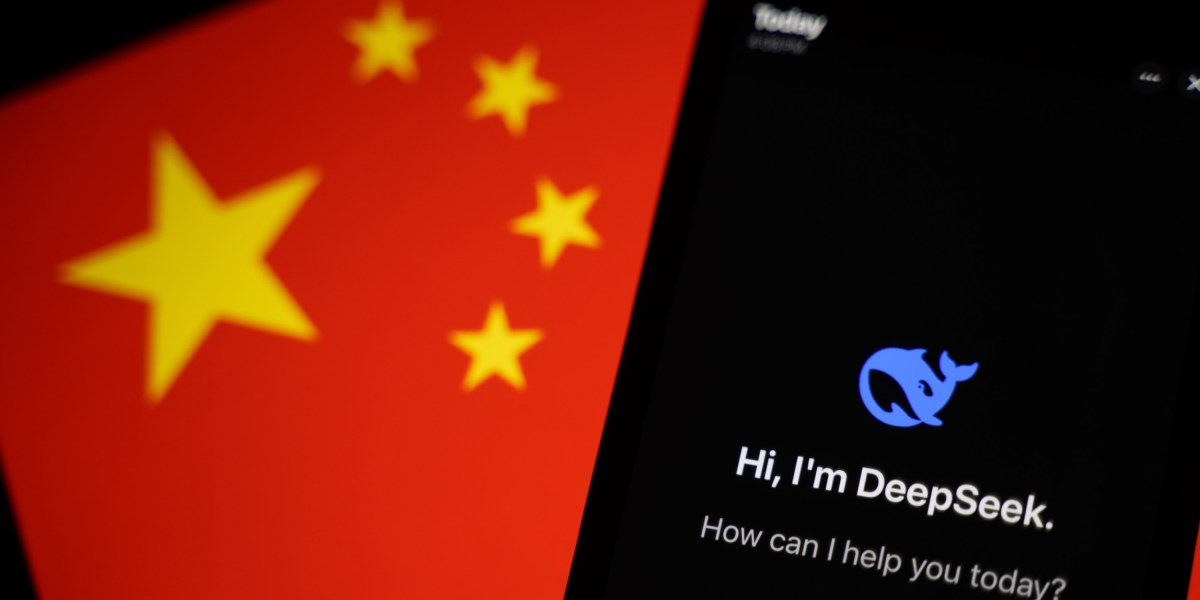
DeepSeek’s breakout moment wasn’t China’s first open-source success. Alibaba’s Qwen Lab had been releasing open-weight models for years. By September 2024, well before DeepSeek’s V3 launch, Alibaba was saying that global downloads had exceeded 600 million. On Hugging Face, Qwen accounted for more than 30% of all model downloads in 2024. Other institutions, including the Beijing Academy of Artificial Intelligence and the AI firm Baichuan, were also releasing open models as early as 2023.
But since the success of DeepSeek, the field has widened rapidly. Companies such as Z.ai (formerly Zhipu), MiniMax, Tencent, and a growing number of smaller labs have released models that are competitive on reasoning, coding, and agent-style tasks. The growing number of capable models has sped up progress. Capabilities that once took months to make it to the open-source world now emerge within weeks, even days.
“Chinese AI firms have seen real gains from the open-source playbook,” says Liu Zhiyuan, a professor of computer science at Tsinghua University and chief scientist at the AI startup ModelBest. “By releasing strong research, they build reputation and gain free publicity.”
Beyond commercial incentives, Liu says, open source has taken on cultural and strategic weight. “In the Chinese programmer community, open source has become politically correct,” he says, framing it as a response to US.dominance in proprietary AI systems.
That shift is also reflected at the institutional level. Universities including Tsinghua have begun encouraging AI development and open-source contributions, while policymakers have moved to formalize those incentives. In August, China’s State Council released a draft policy encouraging universities to reward open-source work, proposing that students’ contributions on platforms such as GitHub or Gitee could eventually be counted toward academic credit.
With growing momentum and a reinforcing feedback loop, China’s push for open-source models is likely to continue in the near term, though its long-term sustainability still hinges on financial results, says Tiezhen Wang, who helps lead work on global AI at Hugging Face. In January, the model labs Z.ai and MiniMax went public in Hong Kong. “Right now, the focus is on making the cake bigger,” says Wang. “The next challenge is figuring out how each company secures its share.”
The next wave of models will be narrower—and better
Chinese open-source models are leading not just in download volume but also in variety. Alibaba’s Qwen has become one of the most diversified open model families in circulation, offering a wide range of variants optimized for different uses. The lineup ranges from lightweight models that can run on a single laptop to large, multi-hundred-billion-parameter systems designed for data-center deployment. Qwen features many task-optimized variants created by the community: the “instruct” models are good at following orders, and “code” variants specialize in coding.
Although this strategy isn’t unique to Chinese labs, Qwen was the first open model family to roll out so many high-quality options that it started to feel like a full product line—one that’s free to use.


