













Known for its bidding-based approach to fares, inDrive is deepening its push beyond ride-hailing by rolling out advertising across its top 20 markets and expanding grocery delivery to Pakistan, executing on a “super app” strategy outlined last year to build new revenue streams and boost engagement while sustaining growth in price-sensitive markets.
The latest move by the Mountain View, California–headquartered firm comes as ride-hailing platforms face intensifying competition and tighter margins across emerging markets, pushing companies to look beyond transport for growth. Advertising offers a high-margin revenue stream that scales with usage, while grocery delivery increases how frequently users open the app. The combination could help inDrive reduce reliance on ride commissions while reinforcing its core mobility business.
InDrive has built its position on affordability, using a peer-to-peer negotiation model that lets riders and drivers agree on fares directly rather than relying on fixed pricing. It nonetheless operates in a crowded market alongside global players such as Uber and local micro-commuting options including taxis and autorickshaws, prompting the company to look beyond rides alone. That backdrop shaped inDrive’s “super app” strategy, aimed at adding higher-frequency services such as grocery delivery in frontier and emerging markets.
Advertising on inDrive is being rolled out across markets including Mexico, Colombia, Pakistan, Kazakhstan, Egypt, and Morocco. The rollout follows mid-2025 tests that delivered hundreds of millions of impressions and drew interest from global consumer brands and banks, said Andries Smit, inDrive’s chief growth business officer, in an interview.
The advertising business will initially focus on placements within the app, including during the waiting period after a ride is booked and while passengers are en route, moments that generate high engagement and sustained attention, Smit told TechCrunch.
In-car and on-vehicle advertising are part of the longer-term roadmap. However, Smit said inDrive plans to prioritise in-app formats through 2026, citing operational complexity around on-car advertising in emerging markets and stronger early returns from digital placements.
Pakistan, the next big market for inDrive’s “super app” play
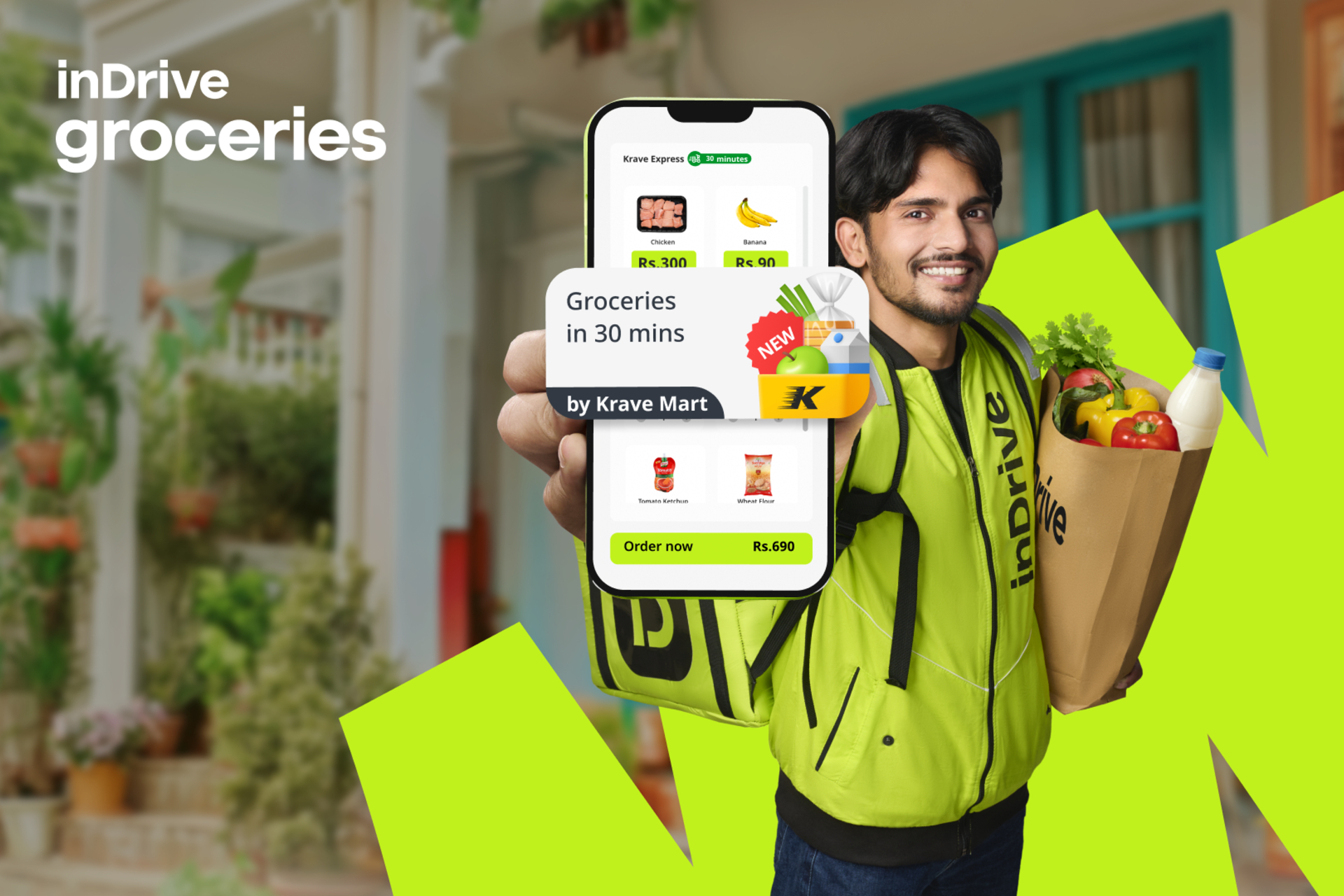
The focus on in-app advertising dovetails with inDrive’s push into groceries, a higher-frequency use case where the company expects to generate stronger engagement and advertising demand than from rides alone. InDrive is scaling grocery delivery in Pakistan, its second market after Kazakhstan, through a partnership with local dark-store operator Krave Mart, which received an investment from inDrive in December 2024.
Techcrunch event
San Francisco
|
October 13-15, 2026
Pakistan stands out, Smit said, because of a combination of rising demand for quick commerce and inDrive’s own scale in the market. Grocery retail remains highly fragmented and informal, while urban consumers are increasingly turning to app-based delivery as more households juggle work and family responsibilities. Simultaneously, inDrive has emerged as one of the country’s leading mobility platforms, giving it a large, engaged user base to cross-sell groceries without the high customer acquisition costs that have weighed on many quick-commerce startups.
Since launching in 2021, inDrive has steadily expanded its footprint in Pakistan, with ride volumes rising nearly 40% year-over-year in 2025, while deliveries through its courier services grew 67% in the first half of the year, per company data shared with TechCrunch. The company views Pakistan as one of its fastest-growing markets globally, with particularly high usage in major cities such as Karachi, Lahore, and Islamabad. Overall, inDrive operates ride-hailing services in more than 20 Pakistani cities and intercity services across over 200 locations.
InDrive’s grocery rollout in Pakistan will begin in Karachi, the country’s largest city and one of the company’s strongest markets, where users will be able to order daily essentials through the app with delivery times of around 20 to 30 minutes. The service will then expand to other major cities, including Lahore, Islamabad, and Rawalpindi, later this year as inDrive builds out supply and logistics with Krave Mart. The platform plans to offer more than 7,500 products — spanning fresh produce, meat and dairy, snacks and household items — alongside free delivery on orders above PKR 499 (about $2) with no service fees.

In addition to its rapid growth as a ride-hailing market, Pakistan has also emerged as a focal point for inDrive’s capital deployment. Of the company’s $100 million multi-year investment program announced in late 2023, Smit said the largest share so far has been directed toward Pakistan, though he declined to disclose specific figures. He added that at least half of the overall $100 million commitment has already been deployed.
“We’re seeing incredible potential in Pakistan,” said Smit. “Ideally, we want to continue and double down on [investments] as we see performance.”
InDrive’s growing focus on Pakistan comes despite broader investor caution toward the market. Venture capital and public investors have largely stayed on the sidelines amid geopolitical and macroeconomic risks, even as activity shows signs of recovery. Equity funding in Pakistan rose 63% YoY in 2025 to $36.6 million across 10 rounds, per a recent report by Karachi-based startup analyst firm Data Darbar — well below the $347 million and $331 million raised in 2021 and 2022, respectively.
However, the gap between investor caution and on-the-ground demand is precisely where inDrive sees opportunity. Having operated across dozens of emerging markets, Smit said the company is more accustomed to volatility and less reliant on shifting capital-market sentiment, giving it confidence to invest where others hesitate. With an established local business and a large active user base, he noted that inDrive can also help partners scale without heavy spending on customer acquisition — an advantage that becomes especially valuable when external funding is scarce.
InDrive’s push into advertising and commerce is underpinned by scale. The company operates in 1,065 cities across 48 countries and has surpassed 360 million app downloads, making it the world’s second most-downloaded mobility app for the third consecutive year, behind Uber, per company data.
Looking ahead, inDrive expects advertising to become a more meaningful contributor over the medium term, particularly as grocery and delivery volumes grow and create more opportunities for contextual promotions. Ride-hailing, which accounted for about 95% of inDrive’s revenue just a few years ago, now makes up closer to 85%, even as the core business continues to grow, reflecting how newer verticals are beginning to scale.
Groceries, delivery, advertising and, eventually, financial services are expected to play a larger role over the next three to five years as the company expands selectively across priority markets, Smit said.


