













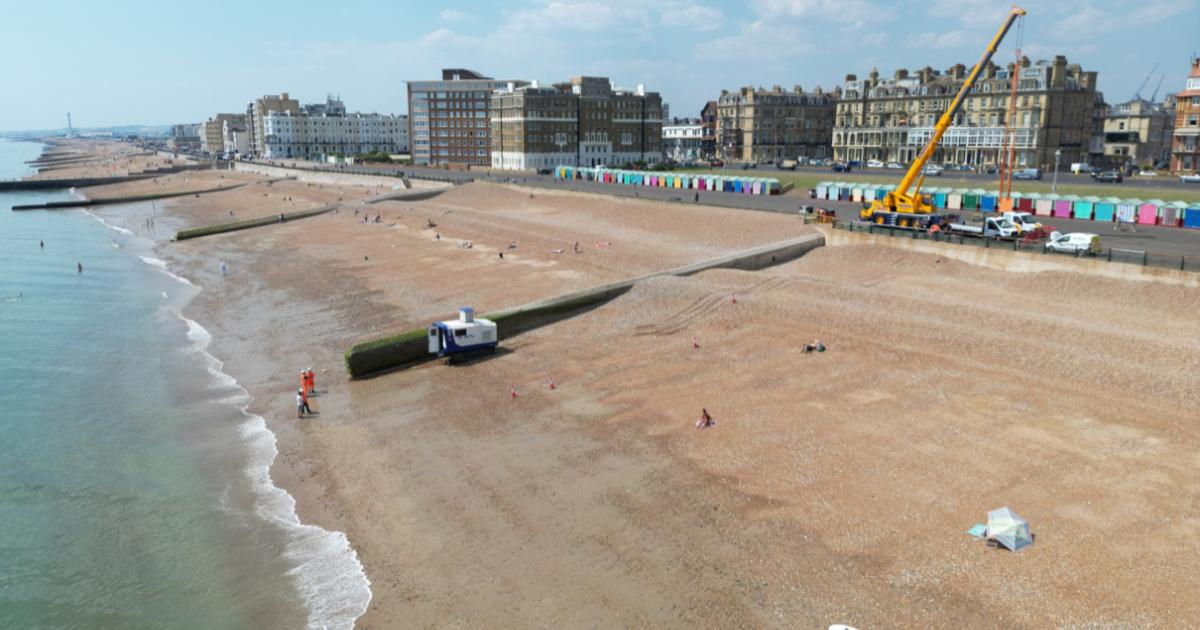
The bird was discovered west of the Rockwater restaurant today (Sunday, January 11) and reported to the Brighton and Hove Wildlife Rescue group, which sent rescuer Shaz Hawthorn to the scene.
A volunteer for the group said: “It is extremely rare to see one here and even more unlikely this time of year.”
The Atlantic puffin after being rescued (Image: Brighton and Hove Wildlife Rescue)
The rescue group believes it had been washed up due to Storm Goretti, which pummelled the south coast at the end of last week.
Fortunately, the puffin was uninjured but had lost some of its weatherproofing from being bashed about in the storm.
Ms Hawthorn transported the seabird to the East Sussex Wildlife Rescue & Ambulance Service’s hospital in Whitesmith, Lewes, a 40-minute drive away.
The volunteer said: “We do this journey at least once a day which is why we really need donations to be able to do these rescues.”
The Atlantic puffin after being rescued (Image: Brighton and Hove Wildlife Rescue)
This sighting brings back memories of a similar encounter in May 2019, when paddle-boarder Harvey Klee found a struggling Atlantic puffin on Brighton seafront.
Mr Klee said: “I thought it was a pigeon at first. But I realised when I got closer that it was a puffin.
“He kept flapping on the sea. I’m not sure the seagulls would have ever seen one so I’m sure they were taken aback.
“They kept diving on him.”
Concerned for the bird’s safety, Mr Klee took the puffin to Roger’s Wildlife Centre on Downs Valley Road in Brighton.
Roger Musselle, who runs the centre with his wife Fleur, said he had never before received a puffin.
Mr Musselle said: “I’ve never had a puffin come in.
“I thought it was very unusual when Harvey called in about it.
“There are breeding colonies in Yorkshire and Dorset.
“He may have just got lost.
“They are only usually found on the south coast washed up dead, so it’s very rare to find a live one.”
The Atlantic puffin is the only puffin species native to the Atlantic Ocean.
It breeds in coastal regions across Russia, Iceland, Ireland, Britain, Norway, Greenland, Newfoundland and Labrador, Nova Scotia, the Faroe Islands, and as far south as Maine and parts of France.
Known as the “clown of the sea” or “sea parrot” due to its colourful beak and distinctive waddling gait, the Atlantic puffin is listed as vulnerable by the International Union for Conservation of Nature (IUCN) because of rapid population declines in parts of its range.
Puffins nest in colonies on clifftops, digging burrows where they lay a single egg.
After about six weeks, the chick fledges under cover of darkness and heads out to sea, not returning to land for several years.
Source link
[Featured]
[Just In]


