













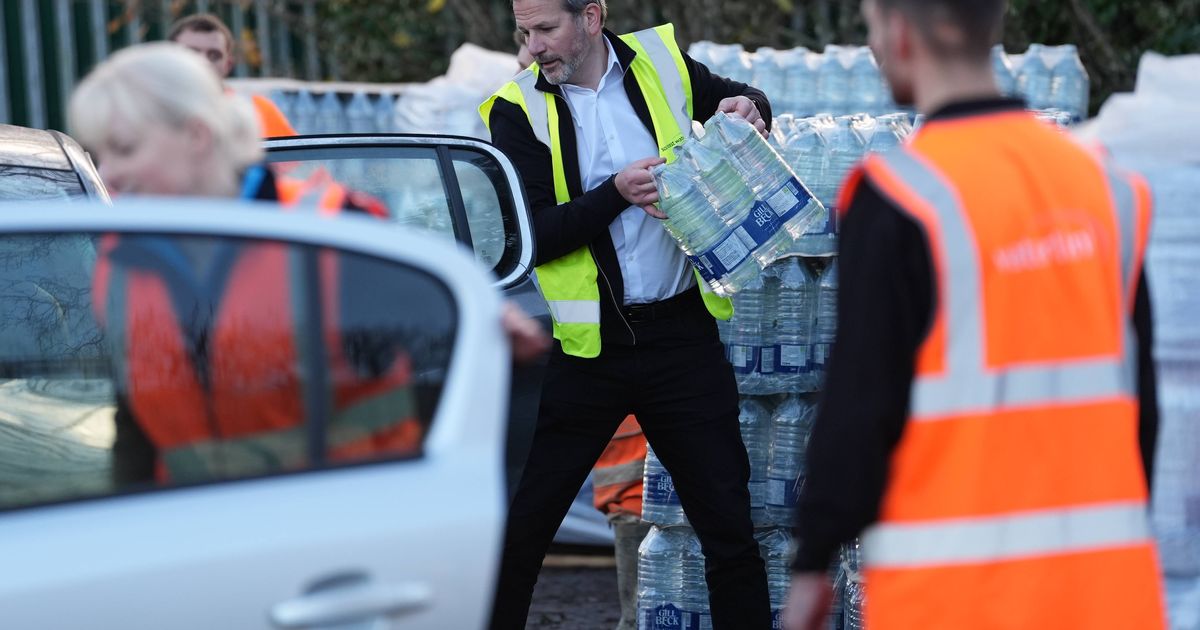
Some 24,000 customers were left without water in Tunbridge Wells for days after a ‘water quality issue’


The company responsible for thousands of water outages was “flying blind” for weeks before the crisis began, the regulator has said. Some 24,000 customers were left without water in Tunbridge Wells for days after a “water quality issue” at the Pembury Water Treatment Works.
Marcus Rink, chief inspector at the Drinking Water Inspectorate (DWI), said the problem began almost three weeks before South East Water (SEW) declared the emergency. On Tuesday (January 6), he told the Environment, Food and Rural Affairs Committee that the failure “shouldn’t have been a surprise” to SEW.
“We’ve identified that Pembury Works have been operating suboptimally for weeks and months prior to the event,” Mr Rink told the committee. The problems in Tunbridge Wells officially began on Saturday, November 29 and continued for almost two weeks.
Originally, properties experienced a loss of water or low pressure before the company brought back undrinkable water so that people could shower and flush their toilets. A “boil water notice” was then put in place until December 12, when the company reported it had “changed” its water treatment processes.
The problem with the water was caused when the coagulant chemical used during the water treatment process stopped working. Mr Rink told MPs: “There is clear evidence of poor filter performance, inadequate coagulation management, reduced backwash capacity and reliance on manual interventions and a lack of online performance visibility to enable a critical assessment response.
“They were flying blind. There was no electronic collection of data on coagulation.” He added that the scientist responsible for the site was off work sick leading up to the crisis and that there was “noticeable accumulated deuteriation” at the plant from November 19 onwards.
David Hinton, chief executive of SEW, also gave evidence on Tuesday and called the problem an “unexpected failure”, blaming climate change and a lack of necessary infrastructure. Mr Hinton, who has an annual base salary of £400,000, told the committee he “hates it” when things go wrong, but was picked up by MPs for a lack of accountability in his responses.
During the crisis, Mr Hinton was criticised repeatedly for not giving interviews and a lack of “clear communication” from SEW. On Tuesday, he told MPs: “When I do an interview, those three things we’re trying to get across to customers don’t get put across the customers… I get asked about all the other CEO questions.
“So I’m very happy to do that, but at the right time in the event, because during the event, we want customers to understand the risks. I get asked about what you might imagine.
“I get asked about dividends, salary etc, and that isn’t the key message we want to deliver to customers during the event.” Mr Hinton later added: “In terms of the clarity of the communications the story did, in our own mind, as well as in the communications, change throughout this event.
“So we initially thought it was a batch of chemicals, and that’s what we originally communicated.” In 2023, SEW was found to be the worst company for supply interruptions in the UK, since then there have been multiple high profile outages.
Last year, Mr Hinton received a £115,000 bonus for his work at SEW. Liberal Democrat MP for Tunbridge Wells Mike Martin called for Mr Hinton’s resignation during the crisis.
He also described a frosty telephone conversation with the chief executive where he was asked “how he could sleep at night” after “politicising” the crisis. Asked about the telephone call, Mr Hinton said: “I don’t recall the entire conversation, but I can give you context…”
“You don’t need to recall the entire conversation. Is the quotation that I have read to you a faithful, fair representation of part of what you said?” asked committee chairman Alistair Carmichael MP. “I honestly don’t recall exactly what I said, so I couldn’t precisely say those are the words I actually used,” said Mr Hinton.
Later he added: “He (Mike Martin) said some things to me then I responded to him, it wasn’t my finest moment, it was a one-to-one conversation, it wasn’t my finest thing but all I’m prepared to say is the things Mike said to me elicited that kind of response, and I think the rest of it was a private conversation.” One committee member said they were “quite shocked” at the “lack of accountability” the chief executive was taking for the incident, although he did begin his questioning with an apology to customers.
He blamed a lack of infrastructure in the South East for the failures and said that the risks are “inevitable” without investment. Mr Hinton also said that in the “absence of the infrastructure” they had focused resources on the response, including “mobilising” 100 people on the ground.
“We’ve done so much in terms of in terms of the response,” he said. Mr Carmichael said: “I would have more sympathy for this line of reasoning if this had come out (of) a clear blue sky but it didn’t, did it?
“There was repeated failures down the years, up to and including the warnings from the drinking water inspector last year. “Essentially, it looks to me like your procurement, your quality control, your contingency arrangements at site were just not adequate. Is that not the case?”
Mr Hinton replied: “There was no asset failure, none of the assets failed. The assets did what they were supposed to do. All the monitors did what they were supposed to do.
“In hindsight, we wish we had another alternative chemical that we could have switched to and not taken three days to get to that position.” Ninety-five percent of the affected customers were domestic households who will not be expecting compensation from the company.
The total pot for compensation is £16.5 million with £1.9 million of that allocated to affected businesses, the SEW have said. Asked whether he thought the firm’s plan was fair, Mr Hinton insisted he does not decide “fairness on a UK level” and that SEW is following regulations.
“Does this come to the crux of your evidence today? You’re just determined not to admit liability for anything, because, you know, there’s going to be a cost attached?” Mr Carmichael asked. “That’s not the case at all,” said Mr Hinton.


