












Across Kent many dog tracks have come and gone over the years. But following the closure of Crayford this time last year, there is just one such sole-surviving venue in the county.
It begs the question, why has Central Park in Sittingbourne managed to stay open when so many have shut, and what does its future hold? Senior reporter Joe Crossley spent an evening at his hometown track in Sittingbourne to find out…


Central Park already has quite the history despite only being built 35 years ago.
It was originally constructed and opened as the new home for Sittingbourne FC in 1990, following the sale of the Bull Ground – now a Sainsbury’s supermarket – for £4.5 million.
But the club overspent on the new stadium and, due to financial troubles, was locked out by Swale council, which owned the land. The club eventually quit the ground and now plays its games at Woodstock Park.
However, greyhound racing, first introduced at Central Park in 1994, remained and has since outlasted all other dog tracks in the county.
Rochester and Chatham Sports Stadium, next to Warren Wood, had shut in 1979, the Athletic Ground in Maidstone, closed in 1988, and Dumpton Park Stadium, near Ramsgate, went in 1996.


Meanwhile, racing came to an end at Kingsmead Stadium in Canterbury in 1999.
So, why is my hometown track still alive when so many others have, gone to the dogs?
I headed down there on the Saturday night before Christmas, one of its busiest periods of the year, to find out why.
It was not the first time I have been there. I have a vague memory of it when I went there more than 15 years ago as a child footballer with Milton and Fulston FC for our Christmas meet-up.
The stadium exterior had not changed much from what I can remember, and the Sittingbourne FC logo is still on the gates.


I met with Regan James, who became operations manager in January but has been at the track for eight years – working his way up the ladder from the kitchen.
The 27-year-old says the track remains busy despite a decline in the popularity of the sport.
This is why Arena Racing Company has pumped in cash to the stadium including £500,000 it spent in 2023 when a new racing surface, base and drainage system was installed.
But Sittingbourne’s survival is partly because race days are not the only way it gets cash into the coffers.
Regan added: “We’ve got a restaurant, we’ve got private boxes, but then we’ve also got capability to do private events, so corporate events in the week for companies.


“So, we’ve got plenty going on all the time.”
But he admits the sport is less popular than it used to be, despite more punters visiting the stadium this year than they did last year – 15,100 people compared to 17,100.
“Greyhound racing is in decline,” he said, “I don’t like saying [that], but it is what it is.
“I love ground racing, and we still get massive crowds in. [It’s] Just one of those things. I think all things die out eventually, don’t they?”
Nevertheless, part of the problem the sport faces is its perception, especially surrounding the health and welfare of the dogs.


In the summer, eight protesters gathered outside the stadium, demanding the “cruel practice” be banned.
The Greyhound Board of Great Britain (GBGB) says more than 1,300 greyhounds died on UK tracks between 2017 and 2024. Although total fatality rate has halved since 2018 when it was 0.06% and was recorded as now 0.03% against total dogs run.
When I spoke to Spencer Mavrias, one of the resident dog owners at the track, to find out more about how the owners treat their animals he was keen to reiterate just how much the welfare side of the sport has come on.
The dad of one, who lives in Wingham and has 52 greyhounds, says “misconceptions” stem from people not being educated about the sport, adding the dogs “love to race” and are never forced.


“They are looked after, and they are checked over by the vet before they race and after they run,” the 56-year-old said.
“Regulations have changed massively all for the welfare of the dogs. For example, they used to travel in minivans, but now they travel separately with air conditioning.
“People do not see that or the affection they get or us owners building a bond with them. They only see the negatives.
“We’ve had injured dogs. It’s not a nice feeling as they have their own characters and they are part of a larger family.”
As we talked in the bar area, the races started to begin.


The lights are turned down just before a heat starts and after a couple of reminders on the tannoy people start to stand up from their tables in the restaurant area to get a better view.
After the traps raise, there are cheers, and as the racers head towards the finish line, punters are willing on their choice.
Whoops and groans follow from the winners and losers.
I can sense Spencer’s thrill as our chat briefly pauses for the twenty seconds of the race.
Read more: The rise and fall of Crayford Greyhound Stadium as Ladbroke call time on historic track after nearly 90 years of racing
He isn’t a winner this time, but I ask him, despite being in the game for 30 years, why does he still enjoy it?
“I still get a buzz,” he answers, “It gets me up in the morning.
“When you win a race on a Saturday it’s a great feeling.
“It’s a shame to see tracks close down. Part of the problem is that youngsters have not been around racing.
“It means a new generation isn’t getting involved and bringing life into the sport. But it’s hard to get people into it.”
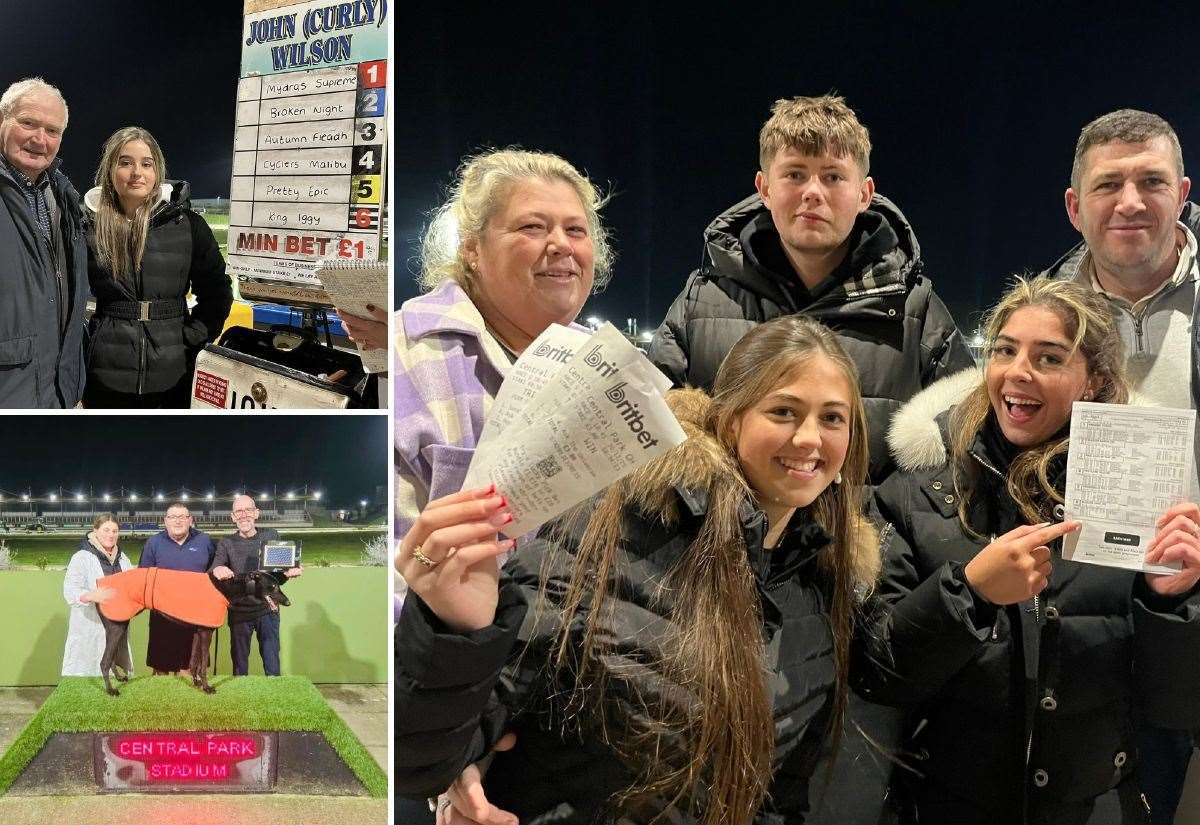
A person who’s been in and around greyhound racing for even longer than Spencer is veteran bookmaker John Wilson.


The 85-year-old became a bookie in 1966 after first getting involved by going to see the daughter of the Tilbury greyhound track owner, as he had “taken a shine” to her.
The owner was 25-stone former wrestler ‘Man Mountain Dean’, who had four bookies working the 300-yard track.
When one day one had fallen ill and another got two punctures in the tyres of his car, the six-foot-eight boss told John he would have to fill in.
The then 25-year-old tried to protest as he had no interest in becoming a bookmaker. But he was handed £40 and told, ‘Don’t you lose my f****** money’.
“I was put with one of the bookmakers, and I was mesmerised by it all,” John remembers, “I was thrilled to return him a £4 or £5 profit.


“Plus, it meant I got to have a drink with his daughter.”
He went on to own five betting shops across the county – two in Sittingbourne and one in Queenborough, Eastchurch and Maidstone – and also operated at Rochester, Ramsgate, Maidstone and Dumpton tracks.
In the early 2000s, he moved over from Canterbury tracks to Sittingbourne tracks.
John used to be one of four bookies but since the track reopened after the Coronavirus lockdowns, he is out there on his own – albeit joined by his family.


He says the reduced numbers are partly because of the changes in gambling habits, which have altered the industry itself.
Despite John taking a bit of a “back seat” in recent years, his family has taken on his profession.
When I spoke to him he was with his daughter, Joe Lockheart, 52, who has been a bookmaker for 38 years, and his granddaughter Jess Lockheart, 18, who is an aspiring bookie now too.
John added: “Some of my regulars do not come to the track. You don’t have to come anymore as you can gamble on your phone.
“You don’t have to get out the car, pay the admission, pay for parking. If you come to the track you have to pay for everything.


“It (betting online) can be dangerous. Once you have lost the money in your account, you can deposit more.
“But if you come to the track with your cash in your pocket, it’s real money you’re losing.
“This time of year, you get a false impression [of how busy it is]. If you’re here on the first week of February, you will get five or 10 people on a Saturday night.
“That’s changed from the mid 2010s when I would have 300 people, at least, coming to me.
“It’s become more of a leisure sport. People come with their families and have an afternoon or evening out.


“For example, on Easter Monday, there were 300 or 400 people here. It was because there was free parking and free admission and people wanted to do something on their afternoon off.”
The track brings in that kind of number again tonight, with more than 361 people showing up.
But with the sport in a general decline, what does the future have in store for Kent’s last track?
New general manager Dovile Skapciute, who took on the role in October, could be the answer to that.
The 39-year-old has 15 years of experience in the gaming industry, including working for Admiral and comes into the sport with no experience of dog racing.


However, the mum of one, who lives in Gillingham, speaks about Sittingbourne’s untapped potential and teased some future plans for the track.
She said: “This venue has got so much to offer. From private parties to corporate events to student nights. All of that is obviously a work in progress and we are looking to expand on that.
“I think because we can kind of accommodate and tailor packages to anyone for any occasion is why this place is still going.
“We’re investing into catering side of the business as well.
“Not to give too many details away but 2026 is looking very exciting for this place.”


