













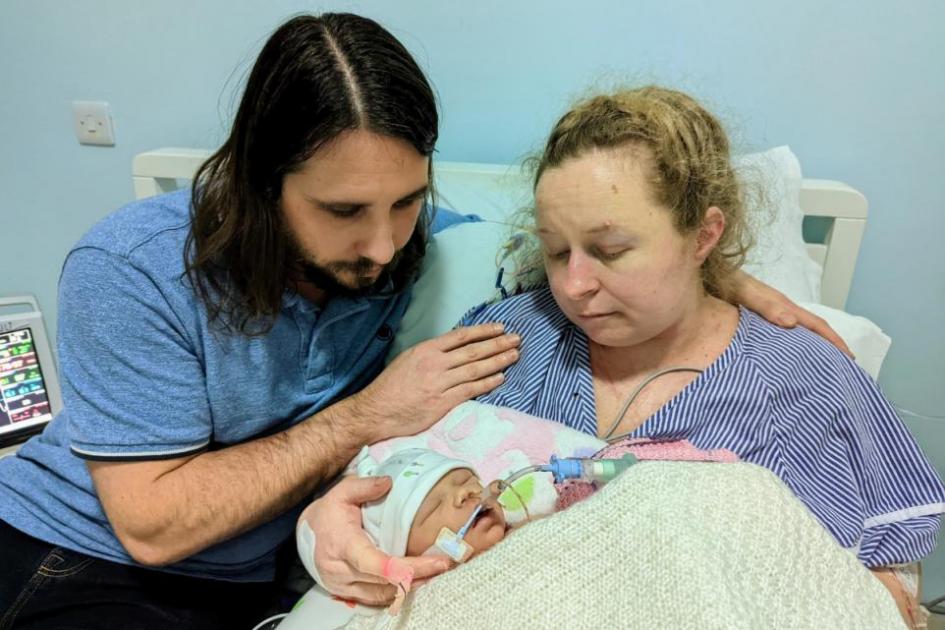


Abigail Fowler Miller died two days after being born at the Royal Sussex County Hospital (RSCH) in Brighton on January 21, 2022.
Rob Miller had contacted the hospital’s maternity ward four times that day with growing concerns over Katie’s worsening condition.
The couple travelled to the hospital by taxi which arrived at the hospital’s Millennium Wing, rather than the accident and emergency or labour departments.
READ MORE: Couple demand national maternity inquiry after Sussex baby death
Ms Fowler had collapsed by the time they arrived. An emergency caesarean section was performed by the maternity registrar and Ms Fowler was given resuscitation whilst her baby was being resuscitated on a nearby chair.
An inquest into Abigail’s death concluded she would likely have survived if her mother, Katie Fowler, had received medical treatment sooner.
Mr Miller had been pursuing secondary victim compensation over the incident, but the Supreme Court ruled last month that bereaved relatives could not claim compensation over the psychological impact of seeing a loved one die, even if it was caused by medical negligence.
Speaking on Thursday, Mr Miller said that the court’s ruling had “missed the mark” and failed to consider the variety of cases that could be affected.
“I saw Katie go into cardiac arrest, I was there for the phone calls, I was the one who had to phone when Katie couldn’t speak and couldn’t get her words out,” he said.
“I was directly involved in this and it has massively affected my mental health.”
Mr Miller said that his “only legal route to be heard and to be recognised as a victim of this situation, this incident, my wife nearly dying and my baby passing away” had gone due to the Supreme Court ruling.
The judgment came after families of three people who witnessed a loved one die due to medical negligence brought legal action, claiming that the psychological impact of witnessing the event was a “personal injury”.
However, six Supreme Court justices dismissed the claim, stating that doctors could not be expected to prevent family members from witnessing traumatic events.
In the ruling, Lord Leggatt and Lady Rose said: “The thought that these tragic events could have been avoided if the hospital or doctor had exercised due care must, as in every case of wrongful death, add further to the agony and perhaps anger that they feel.
“The law cannot, however, impose duties and liabilities on the basis of sympathy, however strongly felt.”
Mr Miller was seeking compensation from the University Hospitals Sussex NHS Foundation Trust, which runs the RSCH, over the failings which led to Abigail’s death.
While the couple travelled in a taxi to the hospital, Ms Fowler went into cardiac arrest after suffering a uterine rupture, which required 20 minutes of resuscitation.
Mr Miller has since received private treatment for post-traumatic stress disorder which he pays for himself, without which he says he “would not be functioning”.
He said that relatives should be able to claim compensation for such treatments.
Mr Miller said: “I feel helpless, I feel worthless. The legal system has failed me.”
He added: “I just feel that they, the judges, have missed the mark and not considered the total spectrum of cases that cover secondary victims.
“We should be able to claim for the help that we need to try and carry on living some sort of normality.”
Mr Miller, from Hove, also reiterated his calls for a national review of maternity services.
It comes as an independent review into the care given to mothers and babies at a Nottingham NHS trust continues, which is expected to be the biggest review of its kind in NHS history.
Mr Miller said that seeing frequent news stories about maternity failings across the country was “heartbreaking”.
He said: “It’s clear that this is a national problem and I think the only way to get to the root cause of it is for a national inquiry.”
Source link
[Featured]
[Just In]


