










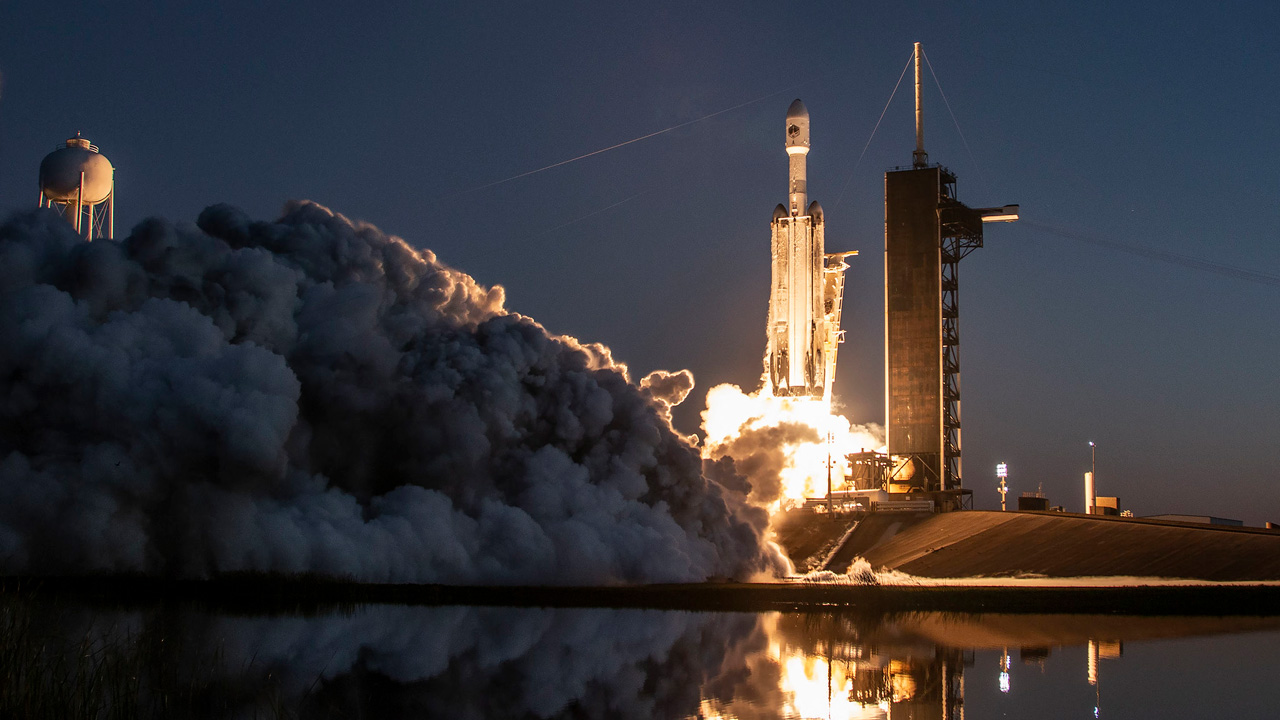


Falcon Heavy launches in January 2023. Image credit: SpaceX.
Image credit: SpaceX webcast.
Welcome to this week’s Launch Roundup! SpaceX is gearing up to launch the largest geosynchronous communications satellite in history, Northrop Grumman’s Antares (version 2) rocket is set to roar off into the sunset, and India will conduct a commercial mission. Plus, all the launch activity from the past week and global stats for the year.
Upcoming Launches
SpaceX’s third Falcon Heavy launch is scheduled for Thursday, July 27. The booster will carry EchoStar’s Jupiter-3 (EchoStar-24) communications satellite, which weighs in at over 9,000 kg (198,416 lb). It will be the largest communication satellite ever launched to geostationary orbit.
Jupiter-3, which was built by Maxar Technologies, will support Internet connectivity across North and South America, in-flight Wi-Fi, community Wi-Fi services, maritime connections, enterprise networks, and backhaul for mobile network operators.
SpaceX had planned to conduct the first dual first-stage landings on offshore drone ships. The company switched to landing the boosters on concrete pads at the Cape Canaveral Space Force Station in Florida.
Upcoming Launches
| Date | Launcher – Organization | Payloads – Organization | Purpose(s) | Launch Site |
|---|---|---|---|---|
| July 26 | Long March 2D – CASC | TBA | TBA | Xichang |
| July 27 | Falcon Heavy | Jupiter-3 (EchoSta-24) – EchoStar | Communications | Kennedy |
| July 28 | Falcon 9 | 22 Starlink – SpaceX | Communications | Cape Canaveral |
| July 28 | Electron | Acadia 1 – Capella Space | Earth observation | Mahia |
| July 30 | PSLV – ISRO | DS-SAR – DSTA* | Earth observation | Satish Dhawan |
| ARCADE – NTU+ | Ionospheric research | |||
| Galassia-2 – NUS^ | Tech demo | |||
| NuLIon – NuSpace | Internet of Things | |||
| ORB-12 STRIDER – OrbAstro | Tech demo | |||
| SCOOB-II – NTU+ | Tech demo | |||
| Velox-AM – NTU+ | Tech demo | |||
| Aug. 1 | Antares – Northrop Grumman | Cygnus NG-19 – Northrup Grumman | ISS Resupply | MARS~ |
| DUPLEX – CU Aerospace | Tech demo | |||
| SeaLion (VSCP-1A) – ODU**/USCGA++ | Communications | |||
| Ut ProSat-1 (VSCP-1B) – Virginia Tech | Communications |
+ Nanyang Technological University (Singapore)
^ National University of Singapore
~ Mid-Atlantic Regional Spaceport
** Old Dominion University
++ U.S. Coast Guard Academy
Source: Wikipedia
Northrop Grumman is set to launch a Cygnus resupply ship to the International Space Station on August 1. It will be the final launch of the second version of the Antares rocket.
The first version of Antares was developed by Orbital Sciences Corporation to launch Cygnus resupply ships to ISS. (Orbital Sciences later became Orbital ATK through a merger. Orbital ATK was later bought by Northrop Grumman.)
When it first flew in April 2013, Antares featured a Ukrainian first stage powered by repurposed NK-33 engines left over from the Soviet Union’s manned lunar program. (Aerojet Rocketdyne renamed AJ-26 when the company imported them.
The engines were seen as a temporary solution, and Orbital Sciences was already seeking a replacement engine when an AJ-26 exploded shortly after Antares lifted off on Oct. 28, 2014. The spectacular nighttime explosion grounded the rocket and sped up the replacement effort.
The Antares first stage was refitted with two Russian RD-181 engines. The Russian invasion of Ukraine in February 2022 cut off Northrop Grumman’s supply of first stages. Russia stopped shipping the RD-181 engines after the U.S. imposed sanctions over the invasion.
Northrop Grumman has contracted with Firefly Aerospace to supply a new first stage powered by seven Miranda engines. The maiden launch is scheduled for the second half of 2024. In the meantime, Northrop Grumman will pay SpaceX to launch Cygnus cargo ships to the space station on Falcon 9s.

Other Launches
India’s upcoming PSLV launch is a commercial mission for Singapore. DS-SAR is a synthetic aperture radar satellite for Singapore’s Defence Science and Technology Agency. There are also five CubeSats aboard from Singapore and one for British satellite manufacturer OrbAstro.
Rocket Lab is scheduled to conduct its seventh orbital launch of the year when an Electron booster places Capella Space’s Acadia 1 satellite into orbit from Mahia Peninsula in New Zealand.

Recent Launches
SpaceX launched 37 Starlink broadband satellites on two different Falcon 9 rockets. There are fewer spacecraft on each launch because the Starlink V2 Mini spacecraft are much larger and more capable than the version 1 and version 1.5 satellites the company previously launched. Falcon 9 originally carried 60 satellites at a time.
Starlink Launches
| Year | Launches | Satellites |
|---|---|---|
| 2023 | 27 | 1,194+ |
| 2018-2023 | 97 | 4,860* |
* Does not include 16 secondary payloads from other companies.
China ramped up its launches in the past week with three flights that carried 10 satellites into orbit. China, which is aiming to launch more than 60 times this year, has 30 launches under its belt.
Recent Launches
| Date | Launcher – Organization | Payloads – Organization | Purpose(s) | Launch Site |
|---|---|---|---|---|
| July 20 | Kuaizhou 1A – ExPace | Tianmu-1 07-10 – Xiyong Microelectronics | Communications | Jiuquan |
| July 20 | Falcon 9 – SpaceX | 15 Starlink – SpaceX | Communications | Vandenberg |
| July 22 | Ceres – Galactic Energy | Qiankun-1 – Cspace | Tech demo | Jiuquan |
| Xingshidai-16 – ADASpace | Earth observation | |||
| July 23 | Long March 2D – CASC* | Lingxi-03 – Galaxy Space | Communications | Taiyuan |
| Skysight AS-01 – Skysight | Earth observation | |||
| Skysight AS-02 – Skysight | Earth observation | |||
| Skysight AS-03 – Skysight | Earth observation | |||
| July 24 | Falcon 9 – SpaceX | 22 Starlink – SpaceX | Communications | Cape Canaveral |
Source: Wikipedia
Launches by Nation
The United States continues to lead the world, conducting 60 of the 111 launches so far this year. The US has a record of 56 successes and four failures.

China is in second place with 30 successful launches. Russia is a distant third with nine launches, followed by India with five and Europe and Japan with two apiece.
Launches by Company/Agency
SpaceX has now hit 50 launches, half the 100 that CEO Elon Musk said the company was aiming for by the end of the year. Twenty-seven launches have been dedicated to placing Starlink satellites into orbit.
Launches by Company/Agency
| Company/Agency | Successes | Failures | Total | Payloads Orbited |
Payloads Lost |
|---|---|---|---|---|---|
| SpaceX (USA) | 49 | 1 | 50 | 1,572 | 12* |
| China Aerospace Science and Technology Corporation | 21 | 0 | 21 | 91 | 0 |
| Roscosmos (Russia) | 7 | 0 | 7 | 49 | 0 |
| Rocket Lab (USA) | 6 | 0 | 6 | 18 | 0 |
| Indian Space Research Organisation | 5 | 0 | 5 | 43 | 0 |
| Strategic Rocket Forces (Russia) | 2 | 0 | 2 | 2 | 0 |
| Arianespace (Europe) | 2 | 0 | 2 | 3 | 0 |
| ExPace (China) | 3 | 0 | 3 | 9 | 0 |
| CAS Space (China) | 1 | 0 | 1 | 26 | 0 |
| Galactic Energy (China) | 2 | 0 | 2 | 7 | 0 |
| Korea Aerospace Research Institute (South Korea) | 1 | 0 | 0 | 7 | 1^ |
| Mitsubishi Heavy Industries (Japan) | 1 | 0 | 1 | 1 | 0 |
| Israel Aerospace Industries | 1 | 0 | 1 | 1 | 0 |
| Space Pioneer (China) | 1 | 0 | 1 | 1 | 0 |
| United Launch Alliance (USA) | 1 | 0 | 1 | 1 | 0 |
| i-space (China) | 1 | 0 | 1 | 0 | 0 |
| LandSpace (China) | 1 | 0 | 1 | 0 | 0 |
| Virgin Orbit+ (USA) | 0 | 1 | 1 | 0 | 9 |
| ABL Space Systems (USA) | 0 | 1 | 1 | 0 | 2 |
| Japan Aerospace Exploration Agency | 0 | 1 | 1 | 0 | 1 |
| National Aerospace Development Administration (North Korea) | 0 | 1 | 1 | 0 | 1 |
| Relativity Space (USA) | 0 | 1 | 1 | 0 | 0 |
| Total | 103 | 6 | 109 | 1,831 | 26 |
^ Deployment failure
+ Company defunct
The China Aerospace Science and Technology Corporation is in second place with 21 launches that have placed 91 payloads into orbit. Russia’s Roscosmos has launched seven times, with Rocket Lab close behind with six successful flights.
Launches by Booster
| Launch Vehicle | Company/Agency | Successes | Failures | Total |
|---|---|---|---|---|
| Falcon 9 | SpaceX | 47 | 0 | 47 |
| Long March 2C, 2D | China Aerospace Science and Technology Corp. | 10 | 0 | 10 |
| Electron | Rocket Lab | 6 | 0 | 6 |
| Soyuz-2.1a, 2.1b | Roscosmos, Russia Strategic Rocket Forces | 5 | 0 | 5 |
| Long March 3B/E | China Aerospace Science and Technology Corp. | 3 | 0 | 3 |
| Kuaizhou 1A | ExPace | 3 | 0 | 3 |
| Falcon Heavy | SpaceX | 2 | 0 | 2 |
| Long March 4C | China Aerospace Science and Technology Corp. | 2 | 0 | 2 |
| Long March 7, 7A | China Aerospace Science and Technology Corp. | 2 | 0 | 2 |
| Proton | Roscosmos | 2 | 0 | 2 |
| Ariane 5 | Arianespace | 2 | 0 | 2 |
| LVM III | Indian Space Research Organisation | 2 | 0 | 2 |
| Ceres-1 | Galactic Energy | 2 | 0 | 2 |
| Delta IV Heavy | United Launch Alliance | 1 | 0 | 1 |
| GSLV Mk II | Indian Space Research Organisation | 1 | 0 | 1 |
| H-IIA | Mitsubishi Heavy Industries | 1 | 0 | 1 |
| Hyperbola 1 | i-space | 1 | 0 | 1 |
| Long March 2F | China Aerospace Science and Technology Corp. | 1 | 0 | 1 |
| Long March 4B | China Aerospace Science and Technology Corp. | 1 | 0 | 1 |
| Long March 6 | China Aerospace Science and Technology Corp. | 1 | 0 | 1 |
| Long March 11 | China Aerospace Science and Technology Corp. | 1 | 0 | 1 |
| Nuri | Korea Aerospace Research Institute | 1 | 0 | 1 |
| PSLV | Indian Space Research Organisation | 1 | 0 | 1 |
| Shavit 2 | Israel Defense Forces | 1 | 0 | 1 |
| SSLV | Indian Space Research Organisation | 1 | 0 | 1 |
| Soyuz-2.1v | Russia Strategic Rocket Forces | 1 | 0 | 1 |
| Tianlong-2^ | Space Pioneer | 1 | 0 | 1 |
| Zhuque-2 | LandSpace | 1 | 0 | 1 |
| Chollima-1^ | National Aerospace Development Administration | 0 | 1 | 1 |
| H3^ | Japan Aerospace Exploration Agency | 0 | 1 | 1 |
| LauncherOne* | Virgin Orbit+ | 0 | 1 | 1 |
| RS1^ | ABL Space Systems | 0 | 1 | 1 |
| Starship/Super Heavy^ | SpaceX | 0 | 1 | 1 |
| Terran 1*^ | Relativity Space | 0 | 1 | 1 |
| Total | 105 | 6 | 111 |
* Launch vehicle retired
+ Company defunct
SpaceX’s Falcon 9 is the most flown booster in the world with 47 successful flights and no failures. China’s Long March 2C and 2D rockets have combined for 10 launches.
Launches by Spaceport
Florida remains the busiest launch site in the world with 30 launches from Cape Canaveral Space Force Station and seven from NASA’s Kennedy Space Center. Vandenberg Space Force Base is in second place among US spaceports with 14 launches.
Launches by Spaceport
| Location | Nation | Successes | Failures | Total |
|---|---|---|---|---|
| U.S. LAUNCH PROVIDERS | ||||
| Cape Canaveral | USA | 29 | 1 | 30 |
| Vandenberg | USA | 14 | 0 | 14 |
| Kennedy | USA | 7 | 0 | 7 |
| Mahia Peninsula | New Zealand | 4 | 0 | 4 |
| Mid-Atlantic Regional Spaceport | USA | 2 | 0 | 2 |
| Cornwall | UK | 0 | 1 | 1 |
| Pacific Spaceport Complex – Alaska | USA | 0 | 1 | 1 |
| Starbase | USA | 0 | 1 | 1 |
| CHINESE LAUNCH PROVDERS | ||||
| Jiuquan | China | 18 | 0 | 18 |
| Taiyuan | China | 6 | 0 | 6 |
| Xichang | China | 4 | 0 | 4 |
| Wenchang | China | 2 | 0 | 2 |
| RUSSIAN LAUNCH PROVIDERS | ||||
| Baikonur | Kazakhstan | 5 | 0 | 5 |
| Plesetsk | Russia | 2 | 0 | 2 |
| Vostochny | Russia | 2 | 0 | 2 |
| INDIAN LAUNCH PROVIDERS | ||||
| Satish Dhawan | India | 5 | 0 | 5 |
| EUROPEAN LAUNCH PROVIDERS | ||||
| Guiana Space Centre | French Guiana | 2 | 0 | 2 |
| JAPANESE LAUNCH PROVIDERS | ||||
| Tanegashima | Japan | 1 | 1 | 2 |
| OTHER LAUNCH PROVIDERS | ||||
| Naro | South Korea | 1 | 0 | 1 |
| Palmchim | Israel | 1 | 0 | 1 |
| Sohae | North Korea | 0 | 1 | 1 |
| Total | 105 | 6 | 111 |
China’s Jiuquan Satellite Launch Center is the second-most-used spaceport with 18 launches. China’s other three launch centers have hosted a combined 12 flights.


