











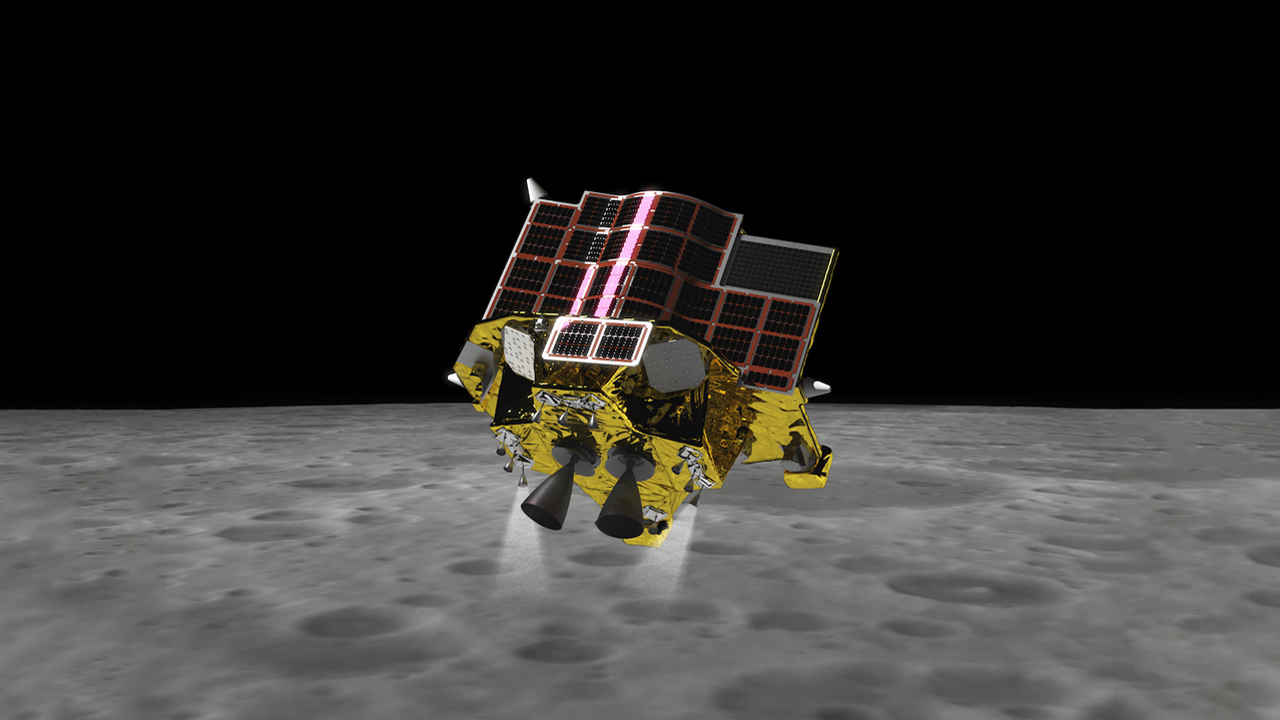


Illustration of JAXA’s SLIM lander descending to the lunar surface.
Image credit: JAXA.
Welcome to the Launch Roundup! In this edition, SpaceX set a new record for the number of launches in a year, Japan’s Moon mission is ready to go, India launched a solar observatory, Amazon was sued over its decision to award launch contracts to Blue Origin, SpaceX and Firefly won launch contracts, the timing of Ariane 6’s maiden flight remains as uncertain as ever, and much more.
Booster bytes
- Amazon has been sued by the Cleveland Bakers and Teamsters Pension Fund, which claims the company did not adequately consider launching its Kuiper broadband constellation on SpaceX rockets before awarding contracts to Jeff Bezos’ Blue Origin. Amazon says the claims have no merit.
- SpaceX won a $64 million contract to launch a group of GlobalStar communications contracts in 2025.
- L3Harris Technologies signed a contract with Firefly Aerospace for three dedicated launches in 2026.
- On August 30, Firefly and Millennium Space Systems entered a hot standby phase for the Space Systems Command’s VICTUS NOX responsive space mission, which the two companies would launch with 24 hours’ notice.
- In a briefing on Monday (September 4), European officials said Arianespace had conducted a successful full-duration hot fire of the second stage of the Ariane 6 launch vehicle. Testing of the first stage is continuing. Officials did not provide a window for the maiden launch next year.
- German launch provider HyImpulse conducted an engine test that moved the company closer to its first suborbital launch from SaxaVord Spaceport in Scotland.
- Andoya Space has hired Vincent Ciccarelli as its commercial director for North America and Asia.
- Andoya Space said construction of its orbital launch complex is nearly completed and will be dedicated by Norwegian Crown Prince Haakon in two months. Isar Space will conduct the first launch from the new facility.
- Spanish launch company PLD Space said it is close to conducting the maiden launch of its MIURA 1 suborbital rocket.

Recent launches
With three additional flights over the past week, SpaceX has now launched 63 times, surpassing the 61 successful launches the company conducted in 2022. The Elon Musk-led company has a record of 62-1, with the maiden launch of Starship being the only blemish on the record. SpaceX has conducted 59 Falcon 9 launches and three Falcon Heavy flights.
Earlier this year, Musk committed SpaceX to launching 100 times in 2023. SpaceX averaged 7.6 launches per month through August 31, so the company will have to average 9.75 launches per month during the last third of the year to reach that total.
Recent Launches
| Date | Launcher – Organization | Payloads – Organization | Purpose(s) | Launch Site |
|---|---|---|---|---|
| Aug. 31 | Long March 2D – CASC* | Yaogan 39-01A – CAS+ | Reconnaissance | Xichang |
| Yaogan 39-01B – CAS+ | Reconnaissance | |||
| Yaogan 39-01C – CAS+ | Reconnaissance | |||
| Sept. 1 | Falcon 9 – SpaceX | 22 Starlink – SpaceX | Communications | Cape Canaveral |
| Sept. 2 | PSLV – ISRO^ | Aditya-L1 – ISRO^ | Heliophysics | Satish Dhawan |
| Sept. 2 | Falcon 9 – SpaceX | 11 Transport Layer Tranche 0 – SDA** | Military communications | Vandenberg |
| 2 Tracking Layer Tranche 0 – SDA** | Missile tracking | |||
| Sept. 3 | Falcon 9 – SpaceX | 21 Starlink – SpaceX | Communications | Kennedy |
| Sept. 5 | Ceres-1S – Galactic Energy | Tianqi 21-24 | Internet of Things | Yellow Sea |
+ Chinese Academy of Sciences
^ Indian Space Research Organisation
** Space Development Agency
Source: Wikipedia
SpaceX has now launched 1,383 Starlink satellites on 36 dedicated Falcon 9 flights this year. The company has launched 5,048 Starlink spacecraft since 2018.
Starlink Launches
| Year | Launches | Satellites |
|---|---|---|
| 2023 | 36 | 1,383+ |
| 2018-2023 | 106^ | 5,048* |
^ Includes 103 dedicated launches, two Transporter rideshare missions, and the launch of two test satellites as secondary payloads.
* Does not include 16 secondary payloads from other companies.
ISRO launched its Aditya-L1 observatory on September 2. The spacecraft will study the solar atmosphere from Lagrange Point 1 located between the Earth and Sun.
Galactic Energy launched the Ceres-1S rocket from a platform in the Yellow Sea for the first time. The company has launched the Ceres-1 small satellite booster five times this year. The rocket has a 9-0 record.

Upcoming launches
Japan is scheduled to launch its Smart Lander for Investigating Moon (SLIM) mission and the X-Ray Imaging and Spectroscopy Mission (XRISM) satellite on September 6 at 7:42:11 PM EDT (23:42:11 UTC). SLIM will test precision landing on the Moon and deploy a lunar rover and lunar hopper.
Upcoming Launches
| Date | Launcher – Organization | Payloads – Organization | Purpose(s) | Launch Site |
|---|---|---|---|---|
| Sept. 6 | Long March 4C – CASC | TBA | TBA | Jiuquan |
| Sept. 6 | H-IIA — MHI* | XRISM – JAXA+/NASA | X-ray astronomy | Tanegashima |
| SLIM – JAXA | Lunar lander | |||
| LEV-1 – JAXA | Lunar hopper | |||
| LEV-2 – JAXA, Tomy, Doshishma University | Lunar rover | |||
| Sept. 8 | Falcon 9 – SpaceX | Starlink – SpaceX | Communications | Cape Canaveral |
| Sept. 9 | Atlas V – ULA | Silent Barker — NRO^ | Space domain awareness | Cape Canaveral |
| Sept. 10 | Long March 6A – CASC | TBA | TBA | Taiyuan |
| Sept. 15 | Soyuz-2.1a – Roscosmos | Soyuz MS-24 – Roscosmos | ISS crew | Baikonur |
+ Japan Aerospace Exploration Agency
^ National Reconnaissance Office
Source: Wikipedia
Russia will launch a new three-member crew to the International Space Station on September 15. The crew includes Russian cosmonauts Oleg Kononenko and Nikolai Chub and NASA astronaut Loral O’Hara.


Launches by nation
The world is on pace for more than 200 launches if current trends continue. US companies have conducted 75 of the 142 launches attempted this year. Seventy-one launches were successful and four were failures.

Chinese companies have launched 40 times without fail. China Aerospace Science and Technology Corporation (CASC) has conducted 67.5 percent of the nation’s launches, with the growing number of government- and privately-owned providers performing the rest.

Russia is in third place with 12 launches, followed by India with seven flights. Europe, Japan, Israel, South Korea, and North Korea have combined for eight launches.
Launches by company/agency
SpaceX continues to lead the world with 63 launches that have carried almost 1,800 payloads into orbit. SpaceX has conducted 84 percent of the 75 launches attempted by U.S. companies. Rocket Lab’s seven launches represent 9.3 percent of American orbital flights.
Launches by Company/Agency
| Company/Agency | Successes | Failures | Total | Payloads Orbited |
Payloads Lost |
|---|---|---|---|---|---|
| SpaceX (USA) | 62 | 1 | 63 | 1,781 | 12* |
| China Aerospace Science and Technology Corporation (CASC) | 27 | 0 | 27 | 101 | 0 |
| Roscosmos (Russia) | 8 | 0 | 8 | 50 | 0 |
| Indian Space Research Organisation (ISRO) | 7 | 0 | 7 | 51 | 0 |
| Rocket Lab (USA) | 7 | 0 | 7 | 19 | 0 |
| Galactic Energy (China) | 5 | 0 | 5 | 19 | 0 |
| ExPace (China) | 4 | 0 | 4 | 14 | 0 |
| Strategic Rocket Forces (Russia) | 3 | 0 | 3 | 3 | 0 |
| Arianespace (Europe) | 2 | 0 | 2 | 3 | 0 |
| CAS Space (China) | 1 | 0 | 1 | 26 | 0 |
| Korea Aerospace Research Institute (South Korea) | 1 | 0 | 0 | 7 | 1^ |
| Northrop Grumman (USA) | 1 | 0 | 1 | 4 | 0 |
| Mitsubishi Heavy Industries (Japan) | 1 | 0 | 1 | 1 | 0 |
| Israel Aerospace Industries | 1 | 0 | 1 | 1 | 0 |
| Space Pioneer (China) | 1 | 0 | 1 | 1 | 0 |
| United Launch Alliance (USA) | 1 | 0 | 1 | 1 | 0 |
| i-space (China) | 1 | 0 | 1 | 0 | 0 |
| LandSpace (China) | 1 | 0 | 1 | 0 | 0 |
| Virgin Orbit+ (USA) | 0 | 1 | 1 | 0 | 9 |
| ABL Space Systems (USA) | 0 | 1 | 1 | 0 | 2 |
| Japan Aerospace Exploration Agency | 0 | 1 | 1 | 0 | 1 |
| National Aerospace Development Administration (North Korea) | 0 | 2 | 2 | 0 | 2 |
| Relativity Space (USA) | 0 | 1 | 1 | 0 | 0 |
| Total | 135 | 7 | 142 | 2,083 | 27 |
^ Deployment failure
+ Company defunct
CASC is in second place with 27 launches that have placed 101 payloads into orbit. The Indian Space Research Organisation has now launched 51 satellites on seven flights, followed by Roscosmos with 50 payloads on the same number of flights.

Launches by booster
SpaceX leads the world with 59 Falcon 9 launches. The company also launched three Falcon Heavy rockets and one Starship/Super Heavy booster.
China’s Long March 2C and Long March 2D rockets have launched a combined 13 times. Russia’s Soyuz-2.1a and Soyuz-2.1b boosters have been launched nine times, followed by the seven flights of Rocket Lab’s Electron rocket.
Launches by Booster
| Launch Vehicle | Company/Agency | Successes | Failures | Total |
|---|---|---|---|---|
| Falcon 9 | SpaceX | 59 | 0 | 59 |
| Long March 2C, 2D | China Aerospace Science and Technology Corp. | 13 | 0 | 13 |
| Soyuz-2.1a, 2.1b | Roscosmos, Russia Strategic Rocket Forces | 9 | 0 | 9 |
| Electron | Rocket Lab | 7 | 0 | 7 |
| Ceres-1, 1S | Galactic Energy | 5 | 0 | 5 |
| Long March 3B/E | China Aerospace Science and Technology Corp. | 4 | 0 | 4 |
| Kuaizhou 1A | ExPace | 4 | 0 | 4 |
| Long March 4C | China Aerospace Science and Technology Corp. | 4 | 0 | 4 |
| Falcon Heavy | SpaceX | 3 | 0 | 3 |
| Long March 7, 7A | China Aerospace Science and Technology Corp. | 2 | 0 | 2 |
| Proton | Roscosmos | 2 | 0 | 2 |
| Ariane 5 | Arianespace | 2 | 0 | 2 |
| LVM III | Indian Space Research Organisation | 2 | 0 | 2 |
| PSLV | Indian Space Research Organisation | 3 | 0 | 3 |
| Antares | Northrop Grumman | 1 | 0 | 1 |
| Delta IV Heavy | United Launch Alliance | 1 | 0 | 1 |
| GSLV Mk II | Indian Space Research Organisation | 1 | 0 | 1 |
| H-IIA | Mitsubishi Heavy Industries | 1 | 0 | 1 |
| Hyperbola 1 | i-space | 1 | 0 | 1 |
| Long March 2F | China Aerospace Science and Technology Corp. | 1 | 0 | 1 |
| Long March 4B | China Aerospace Science and Technology Corp. | 1 | 0 | 1 |
| Long March 6 | China Aerospace Science and Technology Corp. | 1 | 0 | 1 |
| Long March 11 | China Aerospace Science and Technology Corp. | 1 | 0 | 1 |
| Nuri | Korea Aerospace Research Institute | 1 | 0 | 1 |
| Shavit 2 | Israel Defense Forces | 1 | 0 | 1 |
| SSLV | Indian Space Research Organisation | 1 | 0 | 1 |
| Soyuz-2.1v | Russia Strategic Rocket Forces | 1 | 0 | 1 |
| Tianlong-2^ | Space Pioneer | 1 | 0 | 1 |
| Zhuque-2 | LandSpace | 1 | 0 | 1 |
| Chollima-1^ | National Aerospace Development Administration | 0 | 2 | 2 |
| H3^ | Japan Aerospace Exploration Agency | 0 | 1 | 1 |
| LauncherOne* | Virgin Orbit+ | 0 | 1 | 1 |
| RS1^ | ABL Space Systems | 0 | 1 | 1 |
| Starship/Super Heavy^ | SpaceX | 0 | 1 | 1 |
| Terran 1*^ | Relativity Space | 0 | 1 | 1 |
| Total | 135 | 7 | 142 |
* Launch vehicle retired
+ Company defunct
Launches by spaceport
Florida has hosted 46 launches from the Cape Canaveral Space Force Station and NASA’s Kennedy Space Center. Eighteen launches have been conducted from Vandenberg Space Force Base in California.
Launches by Spaceport
| Launch Sites | Successes | Failures | Total |
|---|---|---|---|
| UNITED STATES | |||
| Cape Canaveral | 35 | 1 | 36 |
| Vandenberg | 18 | 0 | 18 |
| Kennedy | 10 | 0 | 10 |
| Mid-Atlantic Regional Spaceport | 3 | 0 | 3 |
| Pacific Spaceport Complex – Alaska | 0 | 1 | 1 |
| Starbase | 0 | 1 | 1 |
| CHINA | |||
| Jiuquan | 22 | 0 | 22 |
| Xichang | 8 | 0 | 8 |
| Taiyuan | 7 | 0 | 7 |
| Wenchang | 2 | 0 | 2 |
| Yellow Sea | 1 | 0 | 1 |
| INDIA | |||
| Satish Dhawan | 7 | 0 | 7 |
| KAZAKHSTAN | |||
| Baikonur* | 6 | 0 | 6 |
| RUSSIA | |||
| Plesetsk | 3 | 0 | 3 |
| Vostochny | 3 | 0 | 3 |
| NEW ZEALAND | |||
| Mahia+ | 5 | 0 | 5 |
| EUROPE | |||
| Guiana Space Centre (French Guiana) | 2 | 0 | 2 |
| JAPAN | |||
| Tanegashima | 1 | 1 | 2 |
| OTHER NATIONS | |||
| Sohae (North Korea) | 0 | 2 | 2 |
| Naro (South Korea) | 1 | 0 | 1 |
| Palmchim (Israel) | 1 | 0 | 1 |
| Cornwall^ (UK) | 0 | 1 | 1 |
| 135 | 7 | 142 |
+ Rocket Lab Electron launches
^ Final Virgin Orbit launch, company defunct
The Jiuquan Satellite Launch Center leads all Chinese spaceports with 22 launches. The nation’s other three land-based spaceports have combined for 17 launches. One launch has occurred from a platform in the Yellow Sea.


