












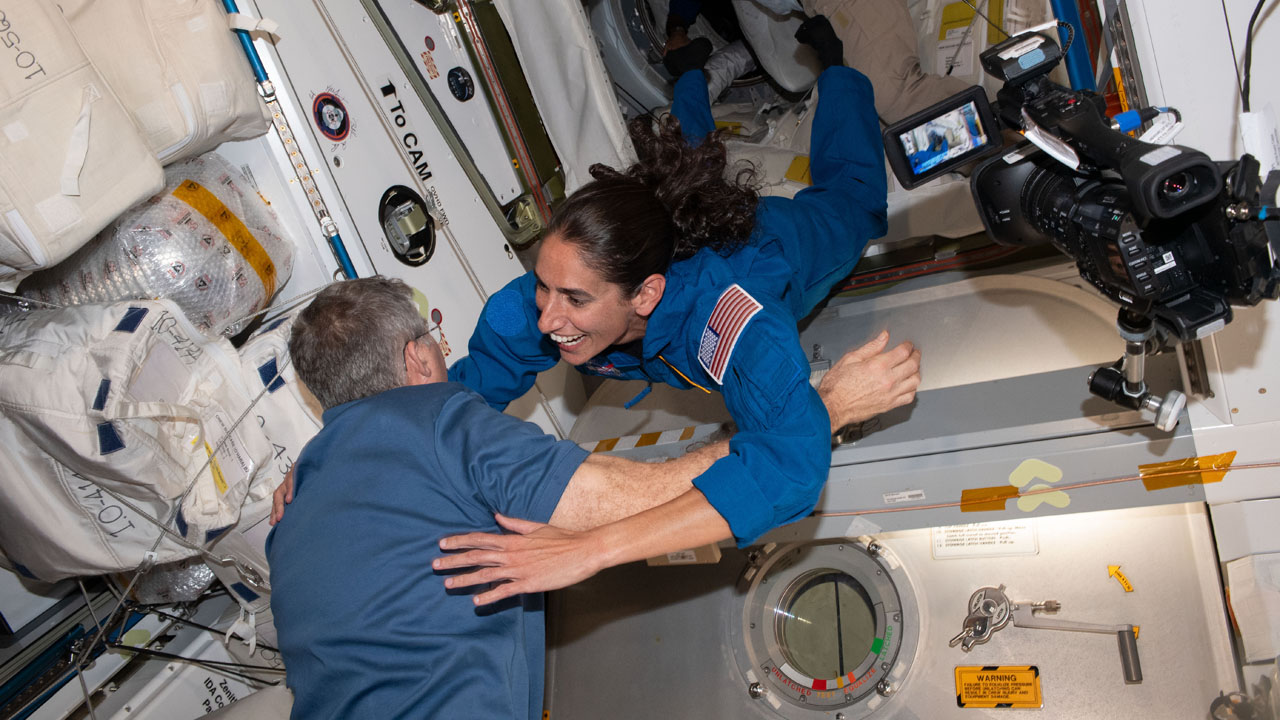


NASA astronaut and Crew-7 Commander, Jasmin Moghbeli, goes for a hug with NASA astronaut Stephen Bowen after entering through the hatch following Crew-7’s arrival to the International Space Station on August 27, 2023.
Image credit: NASA.
Welcome to the Launch Roundup! In this edition, a new crew arrived at the International Space Station (ISS), SpaceX has now launched more than 5,000 Starlink satellites, Rocket Lab reused an engine, weather delayed the launch of Japan’s Moon mission and an American military satellite, and there was no joy in North Korea following a recent launch failure.

Recent launches
NASA astronaut Jasmin Moghbeli, Russian cosmonaut Konstantin Borisov, European Space Agency astronaut Andreas Mogensen of Denmark, and Japanese astronaut Satoshi Furukawa arrived safely at the International Space Station aboard a SpaceX Crew Dragon spacecraft on June 27. A Falcon 9 rocket launched the international crew the previous day during what was SpaceX’s seventh operational mission to the station. They will stay aboard for six months.
The arrival of Crew-7 raised the number of astronauts on ISS to 11. Crew-6, which includes NASA astronauts Stephen Bowen and Warren Hoburg, Roscosmos cosmonaut Andrey Fedyaev, and United Arab Emirates astronaut Sulta Al Neyadi, is due to return to Earth aboard a Crew Dragon spacecraft no earlier than Friday, September 1. Al Neyadi is the second Emirati to fly into orbit and the first to make a long-term stay on the ISS.
In other ISS news, Roscosmos launched the Progress MS-24 resupply to the station on August 23.
Recent Launches
| Date | Launcher – Organization | Payloads – Organization | Purpose(s) | Launch Site |
|---|---|---|---|---|
| Aug. 23 | Soyuz-2.1a – Roscosmos | Progress MS-24 (85P) – Roscosmos | ISS resupply | Baikonur |
| Aug. 23 | Chollima-1 – NADA* | Malligyong-1 F2 – NADA* | Flight test/ reconnaissance | Sohae |
| Aug. 24 | Electron – Rocket Lab | Acadia 1 – Capella Space | Earth observation | Mahia |
| Aug. 25 | Ceres-1 – Galactic Energy | Jilin-1 Kuanfu-02A (HKUST-Xiongbin-1) – Chang Guang Satellite Technology | Earth observation | Jiuquan |
| Aug. 26 | Falcon 9 – SpaceX | Crew Dragon – SpaceX | ISS Crew | Kennedy |
| Aug. 27 | Falcon 9 – SpaceX | 22 Starlink – SpaceX | Communications | Cape Canaveral |
Source: Wikipedia
SpaceX has now placed over 5,000 Starlink satellites into orbit with the launch of 22 more on August 27. However, fewer than 5,000 are currently operational; Jonathan McDowell reports that 4,661 satellites remain in orbit, with 4,630 still functioning.
Starlink Launches
| Year | Launches | Satellites |
|---|---|---|
| 2023 | 34 | 1,339+ |
| 2018-2023 | 104^ | 5,005* |
^ Includes 101 dedicated launches, two Transporter rideshare missions, and the launch of two test satellites as secondary payloads.
* Does not include 16 secondary payloads from other companies.
North Korea’s new Chollima-1 launch vehicle failed for the second time this year. Officials announced that the flight termination system on the third stage accidentally activated. The maiden launch of the rocket fell short due to the failure of its second stage on May 30.

Rocket Lab reused a Rutherford engine for the first time when an Electron rocket launched the Acadia-1 satellite for Capella Space on August 23. CEO Peter Beck said the engine performed exactly as designed. The engine had been part of a first stage fished out of the ocean during an earlier launch.
Upcoming launches
Japan scrubbed the launch of the Smart Lander for Investigating Moon (SLIM) mission and the X-Ray Imaging and Spectroscopy Mission (XRISM) satellite due to high winds. A new date for the launch has not been announced.
United Launch Alliance also postponed the first Atlas V launch of the year due to Hurricane Idalia, which is bearing down on Florida. No new launch date has been set yet.
Upcoming Launches
| Date | Launcher – Organization | Payloads – Organization | Purpose(s) | Launch Site |
|---|---|---|---|---|
| TBD | H-IIA — MHI+ | XRISM – JAXA/NASA | X-ray astronomy | Tanegashima |
| SLIM – JAXA | Lunar lander | |||
| LEV-1 – JAXA | Lunar hopper | |||
| LEV-2 – JAXA, Tomy, Doshishma University | Lunar rover | |||
| TBD | Atlas V – ULA | Silent Barker — NRO^ | Space domain awareness | Cape Canaveral |
| Aug. 30 | Long March 2D – CASC | Yaogan 38-01A | Reconnaissance | Xichang |
| Yaogan 38-01B | Reconnaissance | |||
| Yaogan 38-01C | Reconnaissance | |||
| Aug. 31 | Falcon 9 – SpaceX | 11 Transport Layer Tranche 0 – SDA* | Military communications | Vandenberg |
| 2 Tracking Layer Tranche 0 – SDA* | Missile tracking | |||
| Sept. 2 | PSLV – ISRO | Aditya-L1 – ISRO | Heliophysics | Satish Dhawan |
| Sept. 4 | Falcon 9 – SpaceX | 22 Starlink – SpaceX | Communications | Kennedy |
| Sept. 5 | Ceres-1 – Galactic Energy | Tianqi 21-24 – Guodian Gaoke | Internet of Things | Yellow Sea |
^ National Reconnaissance Office
* Space Development Agency
Source: Wikipedia
ISRO is scheduled to launch its Aditya-L1 satellite on September 2. The spacecraft will study the solar atmosphere from Lagrange Point 1 located between the Earth and Sun.
Launches by nation
The United States has conducted 72 of the 136 launches attempted this year. Sixty-eight of the launches were successful and four failed.


Chinese companies have launched 38 times without fail. Russia, which long led the world in this category, has conducted only a dozen times with nearly two-thirds of the year completed.
Launches by company/agency
SpaceX continues to lead the world with 60 launches that have carried more than 1,700 payloads into orbit. The company launched 61 times last year, tying a record the Soviet Union set in 1980.
Launches by Company/Agency
| Company/Agency | Successes | Failures | Total | Payloads Orbited |
Payloads Lost |
|---|---|---|---|---|---|
| SpaceX (USA) | 59 | 1 | 60 | 1,724 | 12* |
| China Aerospace Science and Technology Corporation (CASC) | 26 | 0 | 26 | 98 | 0 |
| Roscosmos (Russia) | 8 | 0 | 8 | 50 | 0 |
| Indian Space Research Organisation (ISRO) | 6 | 0 | 6 | 50 | 0 |
| Rocket Lab (USA) | 7 | 0 | 7 | 19 | 0 |
| ExPace (China) | 4 | 0 | 4 | 14 | 0 |
| Galactic Energy (China) | 4 | 0 | 4 | 15 | 0 |
| Strategic Rocket Forces (Russia) | 3 | 0 | 3 | 3 | 0 |
| Arianespace (Europe) | 2 | 0 | 2 | 3 | 0 |
| CAS Space (China) | 1 | 0 | 1 | 26 | 0 |
| Korea Aerospace Research Institute (South Korea) | 1 | 0 | 0 | 7 | 1^ |
| Northrop Grumman (USA) | 1 | 0 | 1 | 4 | 0 |
| Mitsubishi Heavy Industries (Japan) | 1 | 0 | 1 | 1 | 0 |
| Israel Aerospace Industries | 1 | 0 | 1 | 1 | 0 |
| Space Pioneer (China) | 1 | 0 | 1 | 1 | 0 |
| United Launch Alliance (USA) | 1 | 0 | 1 | 1 | 0 |
| i-space (China) | 1 | 0 | 1 | 0 | 0 |
| LandSpace (China) | 1 | 0 | 1 | 0 | 0 |
| Virgin Orbit+ (USA) | 0 | 1 | 1 | 0 | 9 |
| ABL Space Systems (USA) | 0 | 1 | 1 | 0 | 2 |
| Japan Aerospace Exploration Agency | 0 | 1 | 1 | 0 | 1 |
| National Aerospace Development Administration (North Korea) | 0 | 2 | 2 | 0 | 2 |
| Relativity Space (USA) | 0 | 1 | 1 | 0 | 0 |
| Total | 129 | 7 | 136 | 2,019 | 27 |
^ Deployment failure
+ Company defunct
Rocket Lab is the only American launch provider that has launched more than once. The company has conducted seven orbital Electron launches and the maiden flight of its HASTE suborbital rocket in 2023.
The government-owned China Aerospace Science and Technology Corporation (CASC) continues to lead all Chinese providers with 26 launches. Six other Chinese companies have launched a dozen times this year.

China’s launch providers are a mixed group of government-owned and privately-held companies. It is believed that a number of the solid-fuel launchers are based on intercontinental ballistic missiles used by the Chinese military.
Chinese Launch Companies
| Company | Type | Launch Vehicles | Fuel | Notes |
|---|---|---|---|---|
| China Aerospace Science and Technology Corporation (CASC) | Government | Long March family | Liquid | 484 launches as of August 29, 2023. |
| ExPace | Fully owned subsidiary of the state-owned China Aerospace Science and Industry Corporation (CASIC) | Kuaizhou 1A, Kuaizhou 11 | Solid | |
| Galactic Energy | Private | Ceres 1 | 3 solid stages, hydrazine fourth stage | 8-0 launch record |
| CAS Space | partially owned by the Chinese Academy of Sciences. | Kinetica 1 | Solid | Two launches as of Aug. 29, 2023 |
| i-space | Private | Hyperbola-1 | Solid | |
| LandSpace | Private | Zhuque-1, Zhuque-2 | Solid (Zhuque-1), LOX-methane (Zhuque-2) | First methane rocket to reach orbit |
| Space Pioneer | Private | Tianlong-2 | Kerosene-LOX | Maiden launch in April 2023 |
Launches by Booster
SpaceX leads the world with 56 Falcon 9 launches. The company also launched three Falcon Heavy rockets and one Starship/Super Heavy booster.
China’s Long March 2C and Long March 2D rockets have launched a combined 12 times. Russia’s Soyuz-2.1a and Soyuz-2.1b boosters have been launched nine times, followed by the seven flights of Rocket Lab’s Electron rocket.
Launches by Booster
| Launch Vehicle | Company/Agency | Successes | Failures | Total |
|---|---|---|---|---|
| Falcon 9 | SpaceX | 56 | 0 | 56 |
| Long March 2C, 2D | China Aerospace Science and Technology Corp. | 12 | 0 | 12 |
| Soyuz-2.1a, 2.1b | Roscosmos, Russia Strategic Rocket Forces | 9 | 0 | 9 |
| Electron | Rocket Lab | 7 | 0 | 7 |
| Ceres-1 | Galactic Energy | 4 | 0 | 4 |
| Long March 3B/E | China Aerospace Science and Technology Corp. | 4 | 0 | 4 |
| Kuaizhou 1A | ExPace | 4 | 0 | 4 |
| Long March 4C | China Aerospace Science and Technology Corp. | 4 | 0 | 4 |
| Falcon Heavy | SpaceX | 3 | 0 | 3 |
| Long March 7, 7A | China Aerospace Science and Technology Corp. | 2 | 0 | 2 |
| Proton | Roscosmos | 2 | 0 | 2 |
| Ariane 5 | Arianespace | 2 | 0 | 2 |
| LVM III | Indian Space Research Organisation | 2 | 0 | 2 |
| PSLV | Indian Space Research Organisation | 2 | 0 | 2 |
| Antares | Northrop Grumman | 1 | 0 | 1 |
| Delta IV Heavy | United Launch Alliance | 1 | 0 | 1 |
| GSLV Mk II | Indian Space Research Organisation | 1 | 0 | 1 |
| H-IIA | Mitsubishi Heavy Industries | 1 | 0 | 1 |
| Hyperbola 1 | i-space | 1 | 0 | 1 |
| Long March 2F | China Aerospace Science and Technology Corp. | 1 | 0 | 1 |
| Long March 4B | China Aerospace Science and Technology Corp. | 1 | 0 | 1 |
| Long March 6 | China Aerospace Science and Technology Corp. | 1 | 0 | 1 |
| Long March 11 | China Aerospace Science and Technology Corp. | 1 | 0 | 1 |
| Nuri | Korea Aerospace Research Institute | 1 | 0 | 1 |
| Shavit 2 | Israel Defense Forces | 1 | 0 | 1 |
| SSLV | Indian Space Research Organisation | 1 | 0 | 1 |
| Soyuz-2.1v | Russia Strategic Rocket Forces | 1 | 0 | 1 |
| Tianlong-2^ | Space Pioneer | 1 | 0 | 1 |
| Zhuque-2 | LandSpace | 1 | 0 | 1 |
| Chollima-1^ | National Aerospace Development Administration | 0 | 2 | 2 |
| H3^ | Japan Aerospace Exploration Agency | 0 | 1 | 1 |
| LauncherOne* | Virgin Orbit+ | 0 | 1 | 1 |
| RS1^ | ABL Space Systems | 0 | 1 | 1 |
| Starship/Super Heavy^ | SpaceX | 0 | 1 | 1 |
| Terran 1*^ | Relativity Space | 0 | 1 | 1 |
| Total | 129 | 7 | 136 |
* Launch vehicle retired
+ Company defunct
Launches by Spaceport
Florida has hosted 44 launches from the Cape Canaveral Space Force Station and NASA’s Kennedy Space Center. Vandenberg Space Force Base in California has hosted 17 launches.
Launches by Spaceport
| Launch Sites | Successes | Failures | Total |
|---|---|---|---|
| UNITED STATES | |||
| Cape Canaveral | 34 | 1 | 35 |
| Vandenberg | 17 | 0 | 17 |
| Kennedy | 9 | 0 | 9 |
| Mid-Atlantic Regional Spaceport | 3 | 0 | 3 |
| Pacific Spaceport Complex – Alaska | 0 | 1 | 1 |
| Starbase | 0 | 1 | 1 |
| CHINA | |||
| Jiuquan | 22 | 0 | 22 |
| Taiyuan | 7 | 0 | 7 |
| Xichang | 7 | 0 | 7 |
| Wenchang | 2 | 0 | 2 |
| RUSSIA | |||
| Plesetsk | 3 | 0 | 3 |
| Vostochny | 3 | 0 | 3 |
| INDIA | |||
| Satish Dhawan | 6 | 0 | 6 |
| EUROPE | |||
| Guiana Space Centre (French Guiana) | 2 | 0 | 2 |
| JAPAN | |||
| Tanegashima | 1 | 1 | 2 |
| OTHER NATIONS | |||
| Baikonur* (Kazakhstan) | 6 | 0 | 6 |
| Mahia+ (New Zealand) | 5 | 0 | 5 |
| Naro (South Korea) | 1 | 0 | 1 |
| Palmchim (Israel) | 1 | 0 | 1 |
| Sohae (North Korea) | 0 | 2 | 2 |
| Cornwall^ (UK) | 0 | 1 | 1 |
| 129 | 7 | 136 |
+ Rocket Lab Electron launches
^ Virgin Orbit launch
The Jiuquan Satellite Launch Center leads all Chinese spaceports with 22 launches. The nation’s other three spaceports have 16 launches combined among them.


