













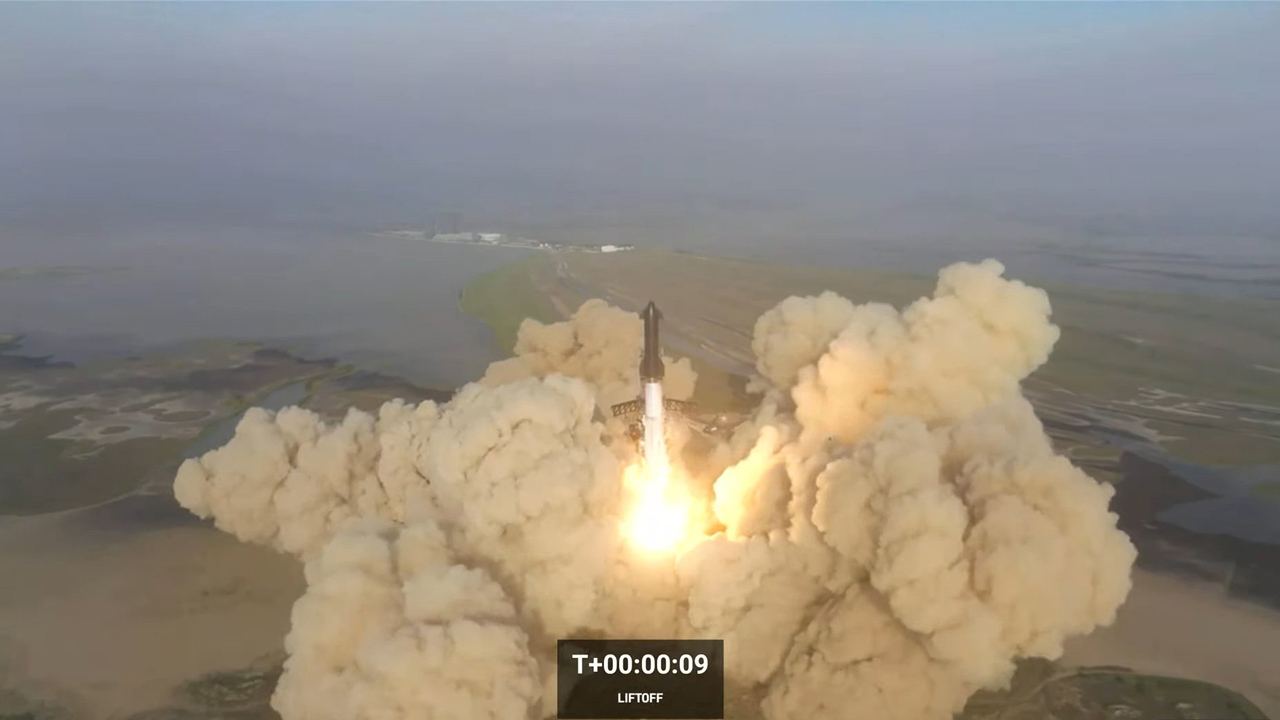


Starship lifts off from Starbase in Texas.
Image credit: SpaceX webcast.
The Federal Aviation Administration (FAA) said on Friday (September 8) that it closed the investigation into the failure of SpaceX’s Starship/Super Heavy rocket in April and that SpaceX must make 63 corrective actions before the booster can launch for a second time.
“Corrective actions include redesigns of vehicle hardware to prevent leaks and fires, redesign of the launch pad to increase its robustness, incorporation of additional reviews in the design process, additional analysis and testing of safety critical systems and components including the Autonomous Flight Safety System, and the application of additional change control practices,” the FAA said in a statement.
“The closure of the mishap investigation does not signal an immediate resumption of Starship launches at Boca Chica. SpaceX must implement all corrective actions that impact public safety and apply for and receive a license modification from the FAA that addresses all safety, environmental and other applicable regulatory requirements prior to the next Starship launch,” the agency said.
The FAA noted what went wrong during the April 20 launch in a letter to SpaceX closing out the investigation (PDF).
“During lift-off, structural failure of the launch pad deck foundation occurred, sending debris and sand into the air. On ascent, the vehicle deviated from the expected trajectory, resulting in the Autonomous Flight Safety System (AFSS) issuing a destruct command. After an unexpected delay following AFSS activation, Starship broke up, resulting in the loss of the launch vehicle,” the agency wrote.
The FAA licensed SpaceX for a single launch. The company will need to demonstrate compliance with all corrective actions when it applies for a modified launch license for future flights.
In an update posted on SpaceX’s website, the company acknowledged propellant leaks had occurred during the flight.
“During ascent, the vehicle sustained fires from leaking propellant in the aft end of the Super Heavy booster, which eventually severed connection with the vehicle’s primary flight computer. This led to a loss of communications to the majority of booster engines and, ultimately, control of the vehicle,” SpaceX said.
“SpaceX has since implemented leak mitigations and improved testing on both engine and booster hardware. As an additional corrective action, SpaceX has significantly expanded Super Heavy’s pre-existing fire suppression system in order to mitigate against future engine bay fires,” the post said.
SpaceX said the Autonomous Flight Safety System (AFSS) activated and fired all detonators to destroy the rocket after it veered off course, lost altitude and began to tumble. The booster eventually broke up as it descended. SpaceX said it has enhanced and requalified the Autonomous Flight Safety System (AFSS) to improve its reliability.
“SpaceX is also implementing a full suite of system performance upgrades unrelated to any issues observed during the first flight test. For example, SpaceX has built and tested a hot-stage separation system, in which Starship’s second stage engines will ignite to push the ship away from the booster,” the company said. “Additionally, SpaceX has engineered a new electronic Thrust Vector Control (TVC) system for Super Heavy Raptor engines. Using fully electric motors, the new system has fewer potential points of failure and is significantly more energy efficient than traditional hydraulic systems.”
A launch mount that elevated Starship/Super Heavy off the ground was damaged during the launch. As well the concrete pad on the ground designed to absorb the force of liftoff was also damaged.
“SpaceX also made significant upgrades to the orbital launch mount and pad system in order to prevent a recurrence of the pad foundation failure observed during the first flight test. These upgrades include significant reinforcements to the pad foundation and the addition of a flame deflector, which SpaceX has successfully tested multiple times,” the company said.


