













| Updated:


For an array of reasons, England face the toughest test of their World Cup credentials late on Sunday night when they face co-hosts Mexico. At the Azteca Stadium, they will come up against a team who have won four games out of four at this tournament, are backed by fervent home support and who have a formidable record in Mexico City.
On top of all that, England will also be at a significant physical disadvantage. Mexico have played their games over a period of 21 days and have not had to move from their base in the capital, while Thomas Tuchel’s team have had six days’ less rest and played in Dallas, Boston, New York and Atlanta – all while travelling back and forth from their Kansas City camp.
But perhaps the biggest inequality is the altitude. Mexico are naturally more accustomed to the 2,000m elevation and have the added benefit of having been in situ for several weeks. The thin air will affect England more severely but, with the help of some British sports tech companies, they have been doing their best to mitigate it for the last 16 fixture.
“When playing at altitude, the oxygen content is reduced compared to sea-level and as a result the players’ bodies will have to work harder and compensate via breathing more intensively,” says Phil Keehne MSc, who is director of sports science at FC Cincinnati in Major League Soccer and previously worked in the Premier League.
“Game actions that players would undertake with ease at sea-level due to high aerobic capacities will now be harder to the body working more anaerobically due to less oxygen available. If we use the analogy of a car, less air going through the engine means less power is put out, with the car starting to feel slower when you try to go quicker.”


How blood-flow restriction training can help England
Tuchel has admitted that England will not have time to acclimatise to the altitude, which typically takes 10-14 days, but they have attempted to prepare for a fixture that has long looked likely. They spent a pre-tournament training camp in the heat and humidity of Florida, and are using blood-flow restriction wearables which, like altitude, force muscles to cope with reduced oxygen.
“Playing at altitude presents a unique challenge because reduced oxygen availability makes repeated high-intensity efforts more demanding and recovery between them more difficult,” says Dr Warren Bradley, co-founder of pioneering British sports tech company Hytro, which makes the BFR bands and garments.
“That’s particularly important in football, where repeated sprints, technical execution and decision-making can all decline as fatigue builds. England won’t be able to fully acclimatise in just a few days, so the emphasis shifts to optimising everything they can control: training load, recovery, hydration, nutrition and ensuring players arrive in the best possible state.
“It’s been interesting therefore to see England using blood flow restriction during active recovery on the bike in the build-up to the Mexico game. BFR creates brief periods of low oxygen within the working muscles followed by a large rebound in oxygen when the restriction is removed, enhancing circulation and a range of physiological responses associated with recovery and readiness.
“While it doesn’t replace weeks of altitude acclimatisation, it seems a sensible strategy to support neuromuscular readiness and help players cope with what’s likely to be an extremely demanding match at altitude.”

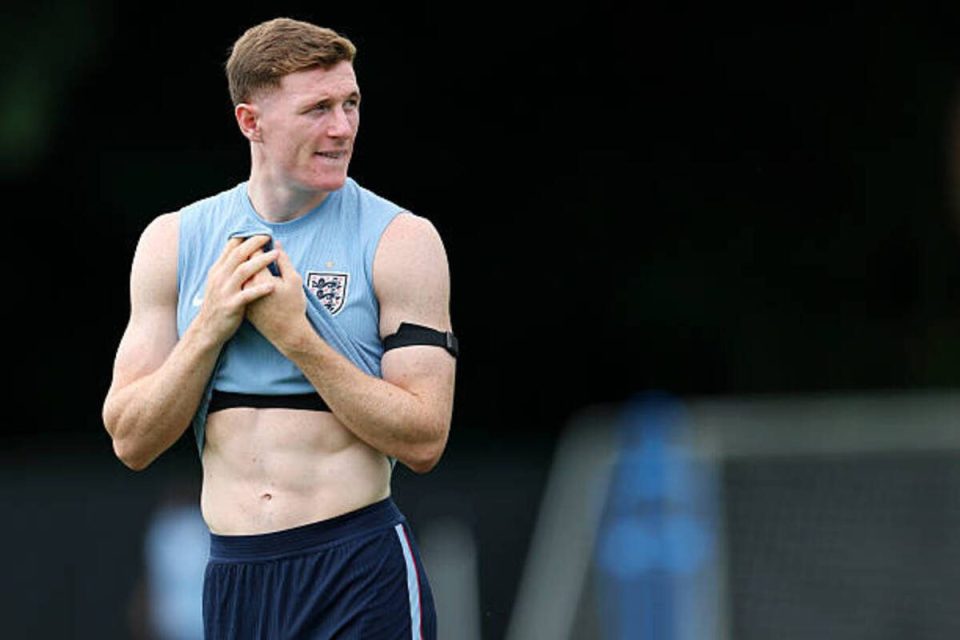
Coaches can react in-game to live GPS monitoring
England staff have another tool in their kit for both optimising training and identifying when a player needs replacing during a match. StatSports GPS live monitoring allows coaches to check sessions are hard but not too hard, and quickly spot when players are flagging in-game. This is the first World Cup in which the real-time data has been used.
“Intensity metrics, such as distance and high-intensity distances covered per minute, may act as an indicator of fatigue, if these numbers start to consistently fall below players’ normative values,” says Keehne. “Performance staff can therefore be proactive in seeing a drop in physical performance within a player and communicate with coaching colleagues.”
StatSports, whose GPS vests have become ubiquitous in elite sport, was founded in Northern Ireland and is still headquartered there. Like Hytro, its products are being used by other teams besides England at this World Cup. There is another hack that Tuchel’s men can try to power through the Mexico game, though, and it’s one that fans back home may turn to as well: eating.
“Practices that England may adopt to mitigate the impact of altitude include increasing their fuelling through sources such as carbohydrates,” says Keehne. “With higher demands, energy expenditure increases, resulting in greater and quicker use of fuel compared to at sea-level. If we increase our fuel intake, then players may delay the impact of altitude emptying fuel stores.”


