













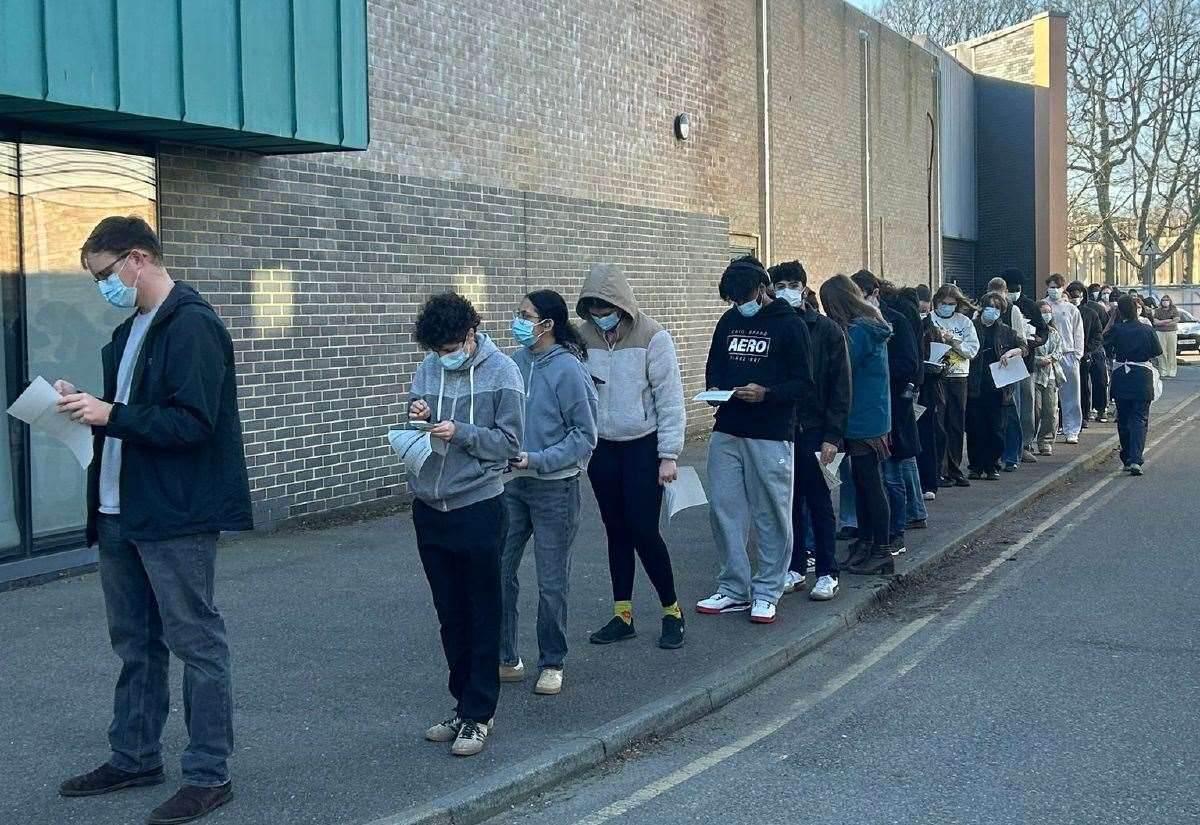
Thousands of young people across England will be offered a meningitis vaccine following the deadly Kent outbreak.
The government today announced a one-off MenB vaccination campaign for Year 13 pupils and under-25s starting university or residential further education for the first time this autumn.


The move comes after the unprecedented meningitis outbreak centred on Canterbury earlier this year, which became the fastest-growing and largest MenB outbreak ever recorded in the UK.
It sparked calls for a wider roll-out of MenB jabs from campaigners and families of those affected.
Announcing the new national programme, Health Secretary James Murray said: “The Kent outbreak and recent clusters indicate a possible change to the way MenB affects people.
“While we assess the latest evidence, we are acting now to help protect young people at highest immediate risk as they enter university and residential colleges this autumn.
“By offering two doses of the jabs ahead of the academic year, we will help reduce the risk of serious illness and larger outbreaks of this horrendous disease.”


The Department of Health says all Year 13 pupils born between September 1, 2007, and August 31, 2008, will be eligible for the new vaccination campaign, regardless of whether they plan to go on to higher education. Under-25s entering university or certain residential further education settings for the first time will also qualify.
Several of the meningitis cases in Kent were linked to people attending three nights at Club Chemistry in Canterbury.
Louise Jones-Roberts, owner of the nightclub, told KentOnline she is “really relieved” the vaccination campaign has been launched, but is “slightly baffled” as to why it is a one-off.
She said: “I would have thought it made sense for a rolling programme of this… these are young, preventable, completely unnecessary deaths.
“This recommendation was put before the Joint Committee on Vaccinations and Immunisation well prior to the outbreak that we saw… I feel we probably shouldn’t have got to this place, honestly.”


Ms Jones-Roberts added: “The speed at which people deteriorate with this disease was one of the most shocking things.
“Vaccine, no vaccine, people have to be alert to the symptoms and know that they have to act rapidly if they see any of them.”
Medway GP Dr Julian Spinks said the scale and speed of the outbreak “came as a shock to a lot of the medical profession”.
“It was a large outbreak, much larger than the normal one, and impacted so many people from one place,” he told KentOnline.
Dr Spinks welcomed the programme but questioned how second doses would be delivered during the summer holidays.


“The problem we’ve got is three weeks into July the schools break up and the second dose would be right in the middle of August and the school holidays… it’s not clear what they’re doing at this point.”
The Kent outbreak led to one of the biggest public health responses seen in the county in recent years. At its peak, 34 people were hospitalised with confirmed or suspected invasive meningococcal disease, while 21 cases were ultimately confirmed.
Two people died, including a University of Kent student and 18-year-old Faversham schoolgirl Juliette Kenny.
Thousands of students, school pupils and close contacts were subsequently offered emergency MenB vaccinations and precautionary antibiotics.
MenB is a rare but potentially life-threatening bacterial infection which can cause meningitis and sepsis. It is fatal in around one in 10 cases and can leave survivors with life-changing injuries, including amputations, hearing loss and brain damage.


Dr Spinks said: “The problem is that this progresses quite quickly.
“In that case, I would be dialling 999, not contacting your GP, because sometimes hours make the difference between being mildly ill and being able to treat it, and being seriously ill, ending up in intensive care, or potentially dying.”
UK Health Security Agency figures show there were 313 confirmed MenB cases in England during 2024/25, accounting for around 83% of all invasive meningococcal disease cases.
Dr Thomas Waite, deputy chief medical officer, said: “There has been an increase in clusters of disease this year and so this one-off programme is designed to provide direct protection to those at highest immediate risk.”
The announcement follows months of campaigning by families affected by the Kent outbreak and meningitis charities calling for wider protection for teenagers and young adults, many of whom were too old to benefit from the routine infant MenB vaccination programme introduced in 2015.
While this autumn’s rollout is a one-off measure, the Joint Committee on Vaccination and Immunisation (JCVI) is currently updating its assessment on whether a routine, permanent MenB vaccination programme for this age group is necessary.
Last week, Juliette Kenny’s parents Mike and Becky joined Meningitis Research Foundation chief executive Vinny Smith and Canterbury MP Rosie Duffield in Parliament to press ministers for action.
Meanwhile, colleagues at Macknade in Faversham have been raising money in Juliette’s memory through a “Ride to Verona” spinathon, cycling the equivalent 900-mile distance between Faversham and the Italian city which held special significance for her family.
The event has already raised more than £3,500 for the Meningitis Research Foundation, smashing its initial £1,500 target. You can see the fundraiser here.


Rosie Collins, Macknade’s sales and marketing director, said they wanted to “make Juliette proud”.
Stacey Heywood, Juliette’s former manager at Macknade, described her as “wonderful”.
“She had a beautiful maturity about her,” she said.
“Juliette was incredibly keen on nature and the environment and I think we want to see that legacy continue on. We’ve all gone home and planted our sunflower seeds and hopefully we’ll see those bloom soon.”
Meningitis Research Foundation chief executive Vinny Smith welcomed the fundraising efforts.


“What’s important to know about the Kenny family is their incredible commitment to using the tragedy of Juliette’s death to help no one else have to go through this in future,” he said.
“Their strength is inspirational.
“We will work with them to use this awful event to increase the call to close the gap in protection for people who would have included Juliette in future.”
Faversham and Mid-Kent MP Helen Whately (Con) welcomed the news.
She added: “I know many parents will be hugely relieved that their children will be able to head off to college or university vaccinated against this horrible illness.
“It will mean a huge amount to Juliette Kenny’s family who have put so much energy into campaigning for the MenB vaccination to be offered more widely. They’ve been amazing – fighting with such determination, so soon after losing her.
“I encourage all those eligible to make sure you have your two jabs over the summer.
“This is progress – but I don’t see it as job done. What about students already at university? And what about students who will not be residential? After all, we believe Juliette and other Year 13 students who got Meningitis in the recent outbreak caught it on a night out.”
Ms Whately vowed to continue pressing for answers.
The NHS says eligible students will be contacted directly through the NHS App, text, email or letter, while under-25s starting university for the first time will also be able to book appointments through participating community pharmacies.
Bookings are expected to open in mid-July.
Postgraduates or those starting a second or later year of university will not be covered by the offer, while international students under 25 entering their first year of university are being advised to receive their first dose in their home country where possible.
Eligible young people will need two doses of the vaccine, given at least four weeks apart, with the first appointments expected from the end of July and second doses in August ahead of the new academic year.
Today’s announcement marks the first nationwide expansion of MenB vaccination to older teenagers and young adults since the Kent outbreak, although campaigners continue to press ministers to make the programme permanent.
Additional reporting by kmfm’s Nicola Everett and Lucy Hudson, and KMTV’s Kristin Hawthorne


