










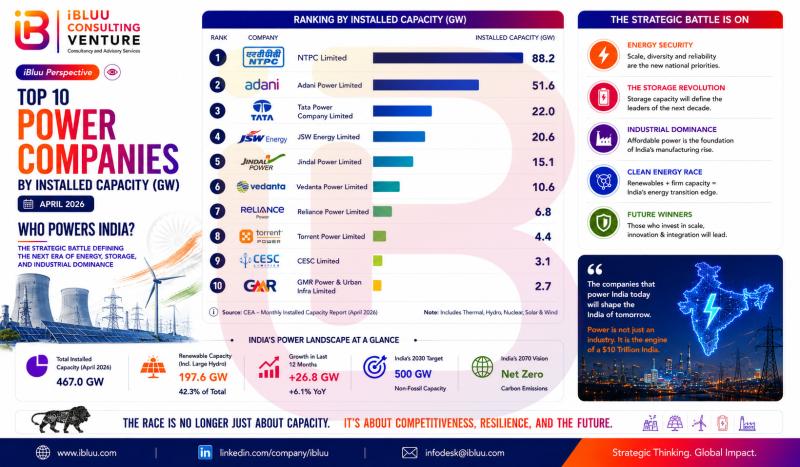
India’s power sector is entering one of the most strategically consequential transitions in its modern economic history, according to a new infrastructure and energy market perspective released by iBCV (iBluu Consulting Venture Private Limited), a venture of iBluu Corporations.
The report argues that India’s energy transformation is no longer merely a renewable expansion story. Instead, it is evolving into a broader contest over infrastructure control, energy storage dominance, industrial electrification, and long-duration global capital alignment.
As India’s installed power capacity surpasses approximately 475 GW in 2026, the country’s leading power companies are rapidly repositioning themselves from traditional electricity generators into integrated infrastructure platforms capable of shaping the future of manufacturing, logistics, AI infrastructure, EV ecosystems, data centers, and industrial-scale economic growth.
According to iBCV’s analysis, the next phase of India’s energy economy will likely be determined not by generation scale alone, but by the ability to control:
dispatchable renewable power,
large-scale storage systems,
grid flexibility,
transmission integration,
and industrial energy reliability.
The report identifies a major structural divide emerging across the sector.
Legacy thermal-heavy utilities continue to maintain dominance in installed capacity and baseload reliability. However, a new generation of energy platforms is aggressively investing in storage infrastructure, renewable orchestration, hybrid energy systems, and grid intelligence – areas increasingly viewed as decisive to India’s long-term infrastructure competitiveness.
Among the key trends highlighted:
NTPC remains India’s largest installed-capacity player and is accelerating renewable and green hydrogen investments.
Adani’s energy ecosystem is evolving into a vertically integrated infrastructure platform spanning generation, logistics, transmission, manufacturing, and industrial connectivity.
Tata Power continues to strengthen its institutional positioning through renewable integration, EV infrastructure, and distributed energy systems.
Greenko, ReNew, JSW Energy, and other renewable-focused players are aggressively expanding into pumped hydro storage and dispatchable clean-energy systems.
The report further highlights that some of the world’s largest pools of sovereign and infrastructure capital – including ADIA, GIC, ORIX, KKR, and other long-duration investors – are increasingly embedding themselves into India’s energy infrastructure ecosystem.
According to iBCV, this trend reflects a growing global conviction that India may emerge as one of the most strategically important energy infrastructure markets of the 21st century.
“The future of power is no longer simply about electricity generation,” the report notes. “It is increasingly about infrastructure orchestration – controlling when, where, and how energy becomes economically decisive.”
The perspective also identifies energy storage as the defining strategic battleground of the next decade.
While solar and wind generation capacity continues to scale rapidly, the report argues that storage infrastructure – particularly pumped hydro and hybrid renewable systems – may ultimately determine the competitiveness, resilience, and economics of India’s future grid architecture.
The analysis further connects India’s power transformation to broader national priorities including:
semiconductor manufacturing,
logistics corridor expansion,
AI and data infrastructure,
industrial policy,
export manufacturing,
and economic resilience.
From the iBCV perspective, energy infrastructure is no longer operating as an isolated utility sector. It is increasingly becoming the foundational layer of industrial sovereignty and long-term national competitiveness.
The report also acknowledges several structural risks that remain critical to monitor, including transmission bottlenecks, DISCOM financial stress, land acquisition challenges, storage economics, and the balancing of renewable expansion with thermal grid stability.
According to J Parasher, infrastructure transitions of this scale should be understood not merely as sectoral developments, but as long-horizon economic transformations capable of reshaping industrial power, capital flows, export capability, and geopolitical influence simultaneously.
The analytical framework behind the iBCV perspective approaches infrastructure as a strategic economic architecture – one that integrates energy, logistics, manufacturing, technology, capital, and national capability into a unified long-term growth system.
As India advances toward its 2030 energy and industrial expansion targets, iBCV believes the defining competitive advantage will belong to companies capable of combining:
scalable infrastructure execution,
storage-led energy flexibility,
institutional capital access,
and integrated industrial energy ecosystems.
“The next industrial order will not be shaped solely by the biggest generators,” the report concludes. “It will be shaped by the smartest infrastructure orchestrators.”
Disclaimer
This press release is intended solely for informational, strategic insight, branding, and industry discussion purposes. All market observations, installed-capacity figures, projections, sectoral assessments, and forward-looking statements are based on publicly available information, industry estimates, company disclosures, and independent analytical interpretations available as of May 2026. Actual market conditions, regulatory developments, investment outcomes, or infrastructure execution timelines may differ materially. This release does not constitute financial, investment, legal, regulatory, or commercial advice, nor should it be interpreted as a solicitation or recommendation for investment or partnership decisions. Readers are advised to conduct independent due diligence and consult appropriate professional advisors before making strategic or investment-related decisions.
iBluu Consulting Venture Private Limited
(A venture of iBluu Corporations)
Romano Tower, Mahagun Moderne,
Sector 78, Noida, Uttar Pradesh, India.
Website: https://www.ibluu.com/insights/beyond-megawatts-inside-the-high-stakes-strategic-battle-for-renewable-infrastructure-energy-storage-and-grid-control/
LinkedIn: https://www.linkedin.com/company/ibluu
About iBluu Consulting Venture Private Limited (iBCV)
iBluu Corporations is a multi-sector strategic platform operating across investment consulting, institutional engagement, and infrastructure advisory.
Through iBluu Consulting Venture Private Limited (iBCV), a venture of iBluu Corporations, the group delivers integrated solutions spanning business strategy, renewable energy advisory, infrastructure consulting, transaction structuring, capital alignment, and partnership development, enabling both global and domestic stakeholders to participate effectively in India’s evolving private markets landscape.
The firm partners with institutional stakeholders to navigate complex investment environments and drive long-term value creation.
This release was published on openPR.


