












| Updated:

Does Fifa want football to be pure sporting competition floating serenely above politics, or a global force for peace? Its current approach is dumbing down, writes Matt Readman.
On 21 June 1998, Iran faced the United States at the Fifa World Cup in what was billed as the most politically charged football match in history.
Fifa later declared it the match that “football won”. Iran may have technically taken the points, but the real moment came before kick-off when players politely exchanged white flowers symbolising peace.
The world governing body was so pleased it handed both teams a Fair Play award and presumably felt rather smug about the whole peace-through-petunias experiment.
Fast forward 28 years and Fifa is still handing out awards. Only now things have changed somewhat.
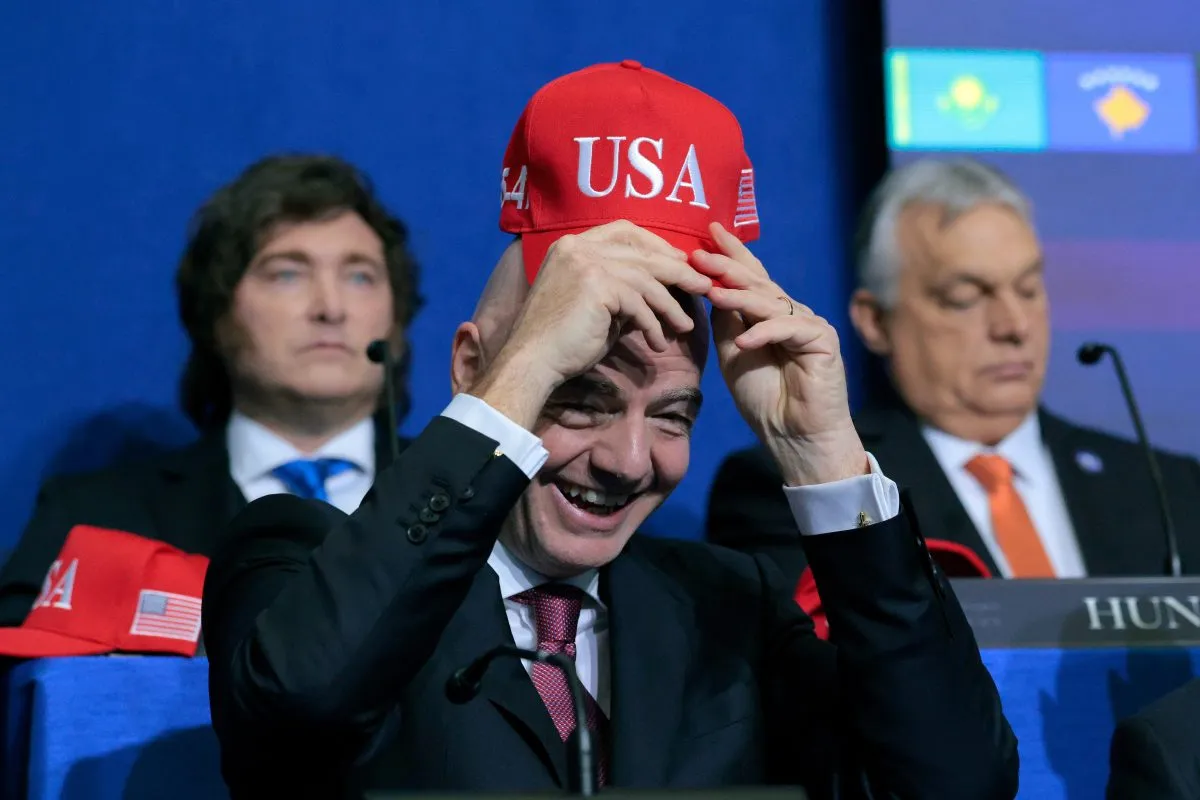
In December, Gianni Infantino proudly presented Donald Trump with Fifa’s inaugural peace prize. This was the latest laser-guided strike in a charm offensive so toe-curlingly blatant that even the most propagandised president would blush.
Three months later – and just 100 days before hosting most of this summer’s World Cup – the recipient of that prize has started a different kind of offensive against Iran, one of the 48 teams that had qualified to compete on American soil.
For Fifa, it leaves credibility at an all-time low. Led by Infantino, a man who begged for politics to be left out of football – “Please do not allow football to be dragged into every ideological or political battle” – this disaster completes a spectacular hat-trick.
In 2018 Vladimir Putin presided over a Russian World Cup four years after the annexation of Crimea. At Qatar 2022, awkward questions about human rights were quietly swept under the nearest ceremonial carpet.
And now Fifa finds itself cheerleading a host nation that is actively bombing another member. You almost have to admire an organisation that can so consistently find itself on the wrong side.
If Fifa truly wants to be apolitical, do it properly
The problem is that Fifa cannot quite decide what it wants to be. Is football a pure sporting competition floating serenely above politics? Or is it a global force for peace, unity and the occasional commemorative trophy?
Because if Fifa truly wanted to be apolitical, it could give it a proper go. No moral positioning. No virtue-signalling armbands. No “football unites the world” sloganeering. Just the game: 22 players, one ball and absolutely no lectures from anyone in a suit.
Imagine the bliss. Host selection could be a simple financial transaction or perhaps a cheerful lottery, like drawing teams in a cup.
Politicians and presidents would be barred from attending. Gratuitous opening ceremonies would be toast and of course both national flags and anthems would need to be removed.
Press conferences would be censored; questions would categorically have to stick to football. Any player who made a political statement would face instant banishment.
Sure, you’d need some more over-zealous security to confiscate flags and bash some skulls, but we would at least be able to say: “This is football, and that is politics”. And we could all breathe a sigh of relief.
Alternatively, Fifa could go in the opposite direction and become properly political. After all, the United Nations does seem a little tired these days, so perhaps the world’s most popular sport could step in and restore the international rules-based order?
Naughty nations could simply be banned from tournaments, rather like misbehaving schoolchildren being denied break time. Host nations would be selected according to rigorous tests covering human rights, environmental policy and general good behaviour.
Athletes could make political speeches whenever they liked. Journalists could ask whatever awkward questions occurred to them. All while world leaders gather quietly behind the stadium to negotiate peace treaties.
Admittedly, a few dictatorships might boycott, and the football might suffer slightly once half the planet had been disqualified for bad behaviour. But the moral alignment would be immaculate.
The lie that ‘sport and politics don’t mix’
Or perhaps not. I never said this was simple. But the thought experiment reveals the real problem: balance.
It is not enough for sporting leaders to insist politics and sport do not mix. That has never been true and never will be.
We need to acknowledge that global sport is sensitive, complex and politically charged. We need to treat it professionally, sensitively and with clear intent.
That intellectual thinking needs to be kept separate from the lure of commercial success so the two can’t become blurred.
Sport and politics is a complex issue, and it deserves to be treated as that. Dumbing it down to special prizes and detentions is demeaning to everyone.
Matt Readman is chief strategy officer at sports creative agency Dark Horses.


