










| Updated:
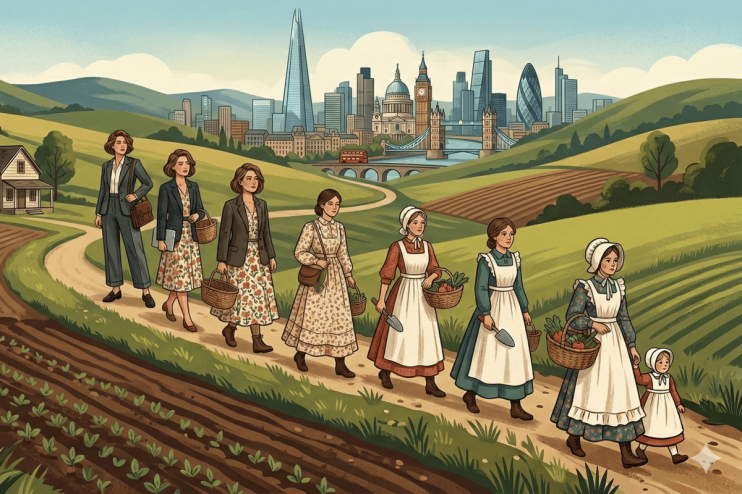

The trad wife isn’t a stay-at-home mum, she is a stay-at-home businesswoman. Don’t be fooled by the dream she is selling, writes Anna Moloney.
“The Girlboss is dead,” declared Vogue in 2023, hammering the last nail into the coffin of the female ideal that had reigned over the preceding decade: the rise and grind She-E-O, who got up at five, dropped the kids to school, all in time for a board meeting at nine – with a blowdry to boot. It was a narrative that shaped what some now call the “lean in” generation, a cohort of women shaped by ideas popularised by the book by former Meta COO Sheryl Sandberg, who told women they could have it all: the career, the family and, ultimately, power.
By now, the problems of that model have become very clear. Hustle culture has led to exhaustion not fulfilment; the majority of women cannot afford help at home; and, more than anything, women have learned that climbing the corporate ladder is not all it’s cracked up to be. Leaning in did not always mean cashing out, while the memoir of a former colleague of Sandberg’s, Sarah Wynn Williams, published last year, recounted disturbing instances of Sandberg’s behaviour, not least her allegedly insisting her assistants come to bed with her on a private jet.
Sarah Wragg, who runs her own PR agency, told City AM about her own regrets over falling for the ‘have-it-all’ messaging. “If I had my time again I wouldn’t pick a career and three children. Externally it may look like the dream but it’s bloody stressful, completely exhausting and, ultimately, I’m not doing anything as well as I could.”
In the wake of this disillusionment, we’ve seen a new, but very familiar, ideal of womanhood come to the forefront, embodied, in its most extreme form, by the ‘trad wife’. Glamorised by the likes of influencers Nara Smith and Hannah Neeleman, trad wives are exactly how they sound: women who have swapped the corporate grind for a more gentle, and “natural”, home life. Smith, a strikingly beautiful mother of four, cooks up the most impossibly complicated of meals dressed in the most impossibly extravagant of outfits for her 12m followers, while Hannah Neeleman of wildly successful Instagram account ‘Ballerinafarm’ documents her and her husbands’ lives as ‘City folk turned ranchers’ as they raise eight (soon to be nine) children on their farm in Utah. Neeleman does not, per her husband’s request (and trad wife orthodoxy), employ any nannies.
The trad wife as secret entrepreneur
Do not, however, mistake Neeleman or Smith for doormats. Neeleman, in particular, has been fierce in defending her choices amid inevitable backlash. Following criticism after a Sunday Times profile, Neeleman was clear that she was not, per the paper’s suggestion, “oppressed”, and that she had said nothing during her interview to suggest as much. Becoming a ‘trad wife’, though this was not how she would choose to frame it, was her choice – a way to prioritise her own desires for family life and the accompanying rewards. In a way, it spoke to a new form of “leaning in”, that Sandberg herself anticipated: “Framing the issue as ‘work-life balance’ – as if the two were diametrically opposed – practically ensures work will lose out. Who would ever choose work over life?” she acknowledged in her 2013 book.
And yet, Neeleman and the rest of the trad wife influencers who have followed her example have not, in fact, chosen life over work. Instead, really, they have managed to turn their lives into work, and monetize domesticity resultingly. They are not just stay-at-home mums, they are stay-at-home businesswomen; the power suits have simply been swapped for prairie dresses. Like the Girlboss, being a trad wife is a financial decision dressed in feminine imagery.
A video posted on Neeleman’s story this week, for example, initially looks simply like a charming family moment: “Flora insists on frothing her own morning hot coco”, reads the caption on a clip of her two-year-old daughter with an electric frother in hand. Tap just one slide on, however, and you’re met with the actual message: a link to purchase your own bag of Ballerina Farm’s ‘Bone Broth Hot Cocoa’ for $35. Smith, likewise, is estimated to make around $200,000 a month from Tiktok’s Creator Rewards programme alone, supplemented presumably generously by brand campaigns with the likes of Chanel, Skims and Marc Jacobs too.
The poster women for the trad wife movement are financially unrecognisable from their 1950s housewife predecessors. They are not financially dependent on their husbands – they are breadwinners.
Do not mistake dresses for conservatism
That doesn’t mean their influence is not dangerous. On the contrary, they are mis-selling the domestic dream; glamorising the lifestyle without being honest about the fact that they are uniquely able to monetise the housewife aesthetic, without the actual danger of financial dependence and entrapment.
They should be more transparent about this, but we, as content consumers, must also be more careful not to equate aesthetics with ideology. Singer Olivia Dean, for example, who happens to wear nice dresses and have voluminous hair, has been accused for promoting trad wife ideals due to her aesthetic – no matter that she is actually a single woman whose most famous song includes the lyric “I don’t want a boyfriend” (let alone a husband). Likewise, London influencer Saff Michaelis, who shares content about her life as a self-confessed “bougie” 26-year-old mother, was recently compelled to publish a statement defending herself against accusations of being (God forbid) a Tory. “Please do not mistake my traditionally (small c) conservative lifestyle choices for political ‘conservative’ values… My traditional leaning life choices were exercised as a right of being born into a free country. And I will use those rights to fight for it to remain that way,” she wrote in a post that went on to assert her support for pro-choice beliefs.
Why the trad wife dream is illusive (and dangerous)
Michaelis’s insistence on not being misread is important, as it comes at a time where we are on many counts seeing a real regression in women’s rights: from the repeal of abortion rights in the US to Andrew Tate and the UK’s maternity care crisis. On the latter, astoundingly, maternal deaths per 100,000 pregnancies in England have increased from 9.71 in 2022 to 13.41 in 2024, with rates even worse for black mothers – all while pro-natalist agendas ramp up. Reform’s Matthew Goodwin has called for childless women to be taxed more with a “negative child benefit tax”. In France, the government has announced it will now be sending all 29-year-old women letters warning them about their declining fertility. Men will receive them too, but we know where the pressure on ‘biological clocks’ is aimed.
Amid this, the danger of women falling for the trad wife dream but without the financial empowerment is real. Indeed, lawyer and recruiter Ana Vilhete told City AM she was seeing a worrying trend wherein women from more affluent backgrounds are going all in for their careers, while working class women are being encouraged to limit their ambitions: “Some have been told that high-earning women scare off potential partners.”
The trad wife propaganda, then, intentional or otherwise, is already having its effect. For too many, being a trad wife is nothing like the glitzy image portrayed by the professional influencers who have monetized it – it is a life of total financial dependence on a man. This Sunday is International Women’s Day, a day I’ve often dismissed as performative and patronising, but if the rise of the trad wife tells us anything, it’s that complacency has consequences.
Anna Moloney is City AM’s deputy comment and features editor


