




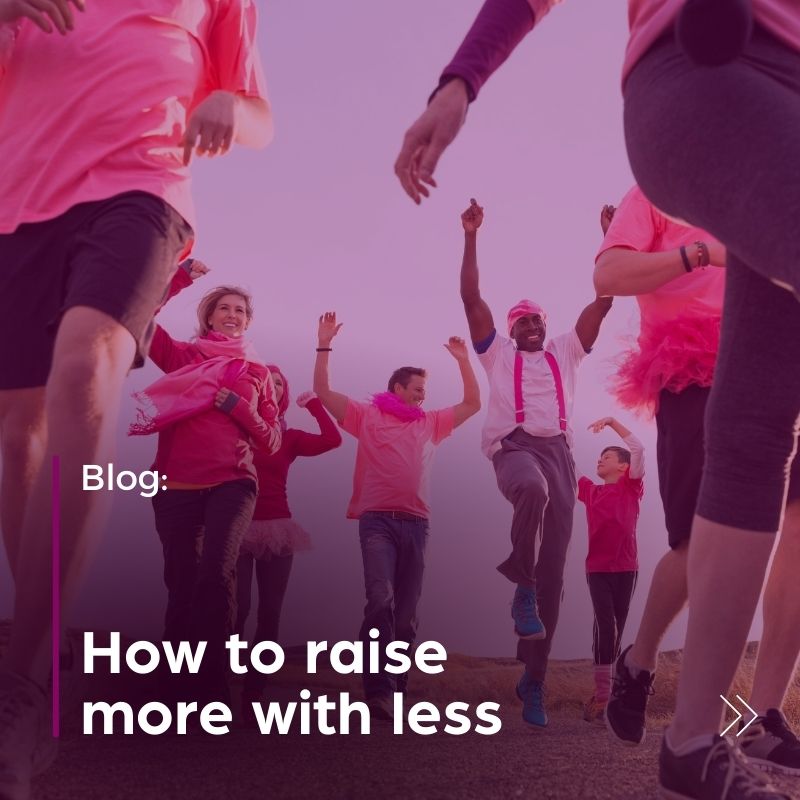
Last year, the number of people who took part in one flagship fundraising event for a hospice was down by a third. A familiar story of fundraising in challenging times.
And what do you guess happened to the total funds the event raised?
Interestingly, the event raised more money than the previous year!
In fact, net income grew by more than 8%.
I loved my recent conversation for the Fundraising Bright Spots podcast with Laura Elliott, Head of Supporter Fundraising at Rennie Grove Peace Hospice. What she shared about how her team achieved this, and other recent successes, is something I hope you will find helpful.
The 80/20 principle — and the tension at the heart of it
You may have heard of the Pareto principle — the idea that at least 80% of your results usually flow from 20% of your daily efforts, or 20% your donors, or for example, 20% of the people who raise funds by doing your events.

It’s a valuable concept to try to get your head around. But I’ve found it’s not always straight-forward to apply in practice.
Making use of it in your day job is not always easy, as we tend to get pulled to treat most of our daily activities and most of our supporters fairly equally.
Laura shared that episodes of the Fundraising Bright Spots podcast, for instance this episode with Craig Linton had helped them to apply the 80/20 principle in their fundraising.
Laura named a familiar tension fundraisers feel: “We obviously want everyone to have a brilliant experience. It’s really hard to accept that sometimes you can’t do the same for everyone.”
And it’s worth being clear about what this does and doesn’t mean. At Rennie Grove Peace Hospice, every single participant is appreciated and looked after — a schedule of emails, personalised to where they are in their journey, thanking them for their support and encouraging them.
Everyone’s support is appreciated and they are all properly thanked.
The question Laura’s team had to wrestle with was simply this: where do you direct your most intensive, personal time and attention, when you can’t possibly give that level of contact to 700 or 1,000 participants?
As Laura put it: “We had to make the choice… because we couldn’t cover 700 to a thousand participants with that same approach.”
What thoughtful, focused stewardship looks like
The team decided to focus their most personalised stewardship on participants who had taken the step of setting up a fundraising page and received their first donation, as not every participant does.
In these cases, the team work even harder to make you feel special.
For example, you receive a personalised video in your inbox from Laura’s colleagues Bobbi or Emma, celebrating that moment.
From there, the team use a carefully tiered approach: extra encouragement when supporters are approaching their target, further personalised emails as they progress, additional videos when they hit significant milestones, and actual phone calls.
By the time event day arrived, participants already felt like they knew the team. Laura described moments at their walking events where people recognised and were excited to see Bobbi, because the relationship had been built long before the day.
The results
Even with a third fewer participants, the numbers tell a remarkable story that helps explain the 8% increase in net income.
The conversion rate of participants setting up a fundraising page doubled compared to the previous year.
Income from fundraising pages increased by 28%. The average income raised per participant, was now greater than the level of the highest fundraising target tier.
And 40% of participants were repeat bookers — a strong sign that the experience itself is creating loyalty.
The takeaway for your fundraising
If you’re working with limited time and resource, this is an encouraging story. It suggests that the first way to increase fundraising income isn’t necessarily to seek more supporters / partners / donors, or to run more events. Though of course doing that successfully is valuable too.
Another way to grow fundraising income is to be very thoughtful about how you look after and connect with your existing supporters. And what can make it easier than you might think is to be determined to apply the 80/20 principle.
Obviously, thank and appreciate everyone who supports your charity.
But also, as long as your time is limited, be very curious as to those who can make the biggest difference. Look at your data. Then be deliberate about going the extra mile to add more value to those relationships.
As this example shows, applying the 80/20 principle to your event fundraising is great for both your supporters, and the fundraising success of your events.
If you’d like training for your whole fundraising team to apply strategies like this in practice, we provide bespoke Bright Spot training for charities. (This is one of the ways we’ve supported Laura’s team.) Find out more about team training with Bright Spot here.
And you can hear Laura’s full conversation, including other successful fundraising strategies on the Fundraising Bright Spots podcast.
Find this helpful? If so, please share it on, so we can help as many good causes as possible.
