




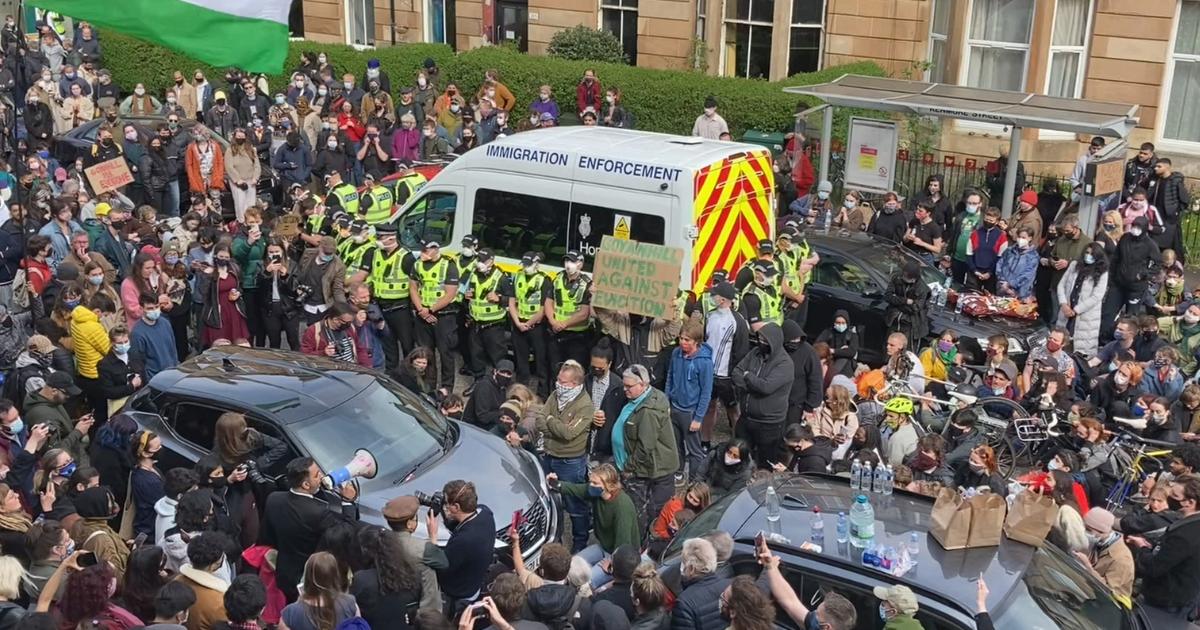
Felipe Bustos Sierra, a BAFTA-winning Glasgow-based filmmaker, has documented the events of the 2021 Home Office immigration raid in Pollokshields in his latest film titled Everybody to Kenmure Street.
On that day, hundreds of residents took to the street during an eight-hour stand-off to prevent the deportation of two of their neighbours during Eid.
Ahead of the documentary’s UK premiere at the Glasgow Film Festival (GFF) today, our reporter spoke with Felipe about what inspired him to make it.

He said: “It’s a film that we felt we couldn’t make fast enough. It’s made by, with, and for the people of Glasgow.
“It was the first week right after the protest that I decided to make this. It was really out of curiosity about what exactly happened and the mechanics of it.
“What was the evolution of the day? At what point did it turn? It was a lot of work that was put into really reconnecting all these people together.”
The documentary pieces together the events of the day as they unfolded from early in the morning, using footage from residents and people who were there.
Felipe explained that, as the protest had ended, he didn’t want to recreate it as that would have “just completely destroyed the integrity” of what he was trying to do.
Over the course of the next few years, Felipe collected clips providing different angles and perspectives of the scene.
This proved to be “challenging”, and in some ways, the director says he had to “learn how to make this film”.

READ NEXT:
Felipe added: “We couldn’t really do any filmmaking those first few months because of Covid and lockdown being so strict.
“So, we would go on these walks around Queen’s Park on different days with different people. The biggest challenge was getting all the footage, but that was also the exciting part of it all.
“I suppose filmmaking is about what you can learn and how you can improve yourself. So, really, in some ways, we had to learn how to make this film.
“It was a case of ‘this is what’s available’. The protest had ended, we’re not in a position where we can go and really recreate things because it would just completely destroy the integrity of what we’re trying to do.
“So, how do we use all these fragments of images, which at times were three seconds long, shot by people who are not trying to tell a story.
“They’re literally trying to bring people to the street and capture the urgency of it. But we got some absolutely amazing things.”

The film features the powerful testimonies of a man who lay under the immigration enforcement van to block it from moving and an off-duty nurse who stayed with him all day to ensure his safety.
Both remained anonymous, and actors were brought in to tell their stories. ‘Van man’ was portrayed by two-time Oscar winner Emma Thompson, who also executive-produced the documentary, while Scottish actress Kate Dickie took on the role of the nurse.
It also delves into Glasgow’s history of civil resistance, including clips from the Upper Clyde Shipyards’ sit-in in Govan, the Govanhill Bath sit-in, the Lee Jeans sit-in and the Glasgow Girls in Drumchapel.
READ NEXT:
Felipe commented: “The character of van man became near mythical in the days after the protest, and everybody was trying to find out who he was.
“Eventually, we got introduced. He was saying the only skill he had was that he turned up at the right time and made this split-second decision.
“What could he do to delay this? He said we could have his testimony, but he didn’t want to be in the film.
“He also told me about a nurse that I’d never heard of. She turned up 15 minutes after him and made him realise the precariousness of the situation.
“When I spoke to her, she was the same; she wanted to remain anonymous. We were going to have to have actors.
“When my debut documentary Nae Pasaran came out, I received a lovely letter from Emma Thompson.
“When this came up, I wrote to her; obviously, she had heard of the protest and was very supportive, and she said yes.”

Felipe went on to add: “People who didn’t have hope turned up anyway, which is so permeated in the history of Glasgow’s resistance, people just finding ways to think outside of the box to diffuse the situation.
“We’re going to disarm the situation, we’re going to find a different outcome, and Kenmure Street was a perfect presentation of that.”
