




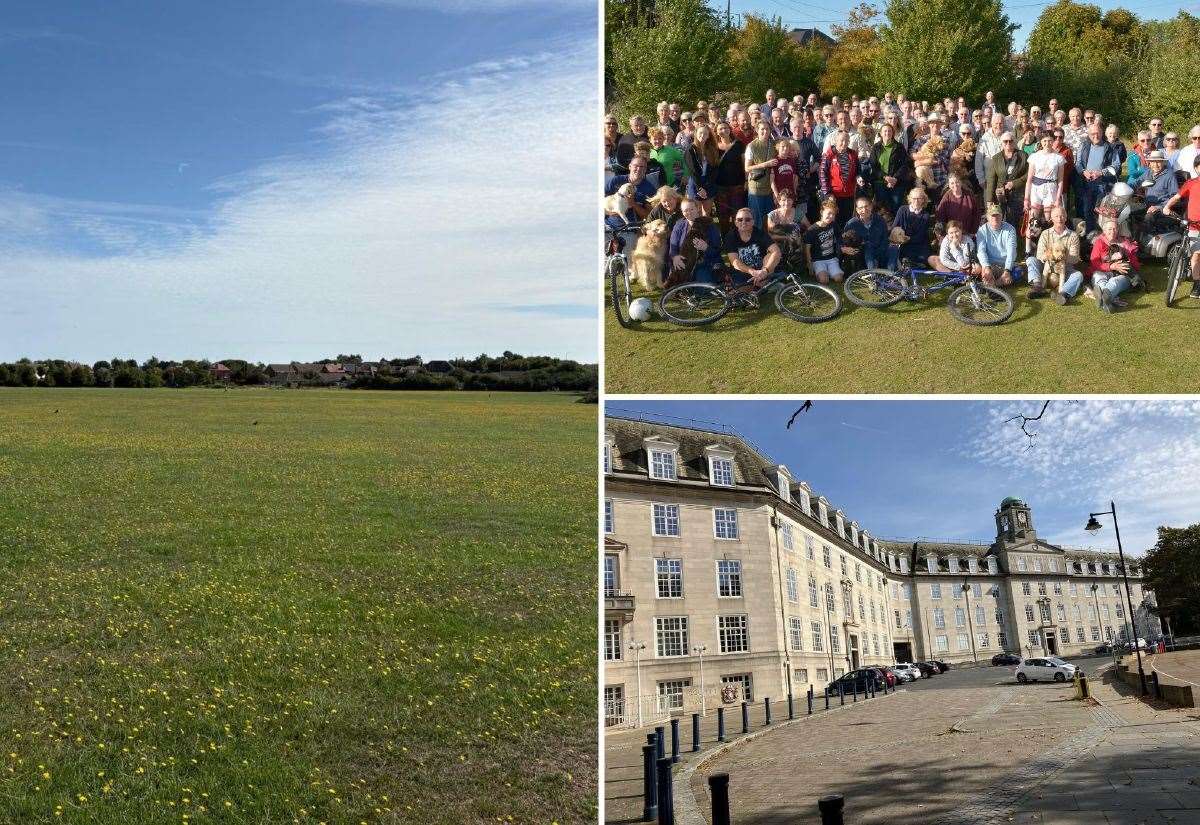
The future of a popular playing field hangs in the balance as a council argues the land was bought for education more than a century ago.
Kent County Council (KCC) secured government funding in 2023 to build the 120-pupil Whitstable Free School at Church Street Playing Fields in the town.


The almost 13-acre site is owned by KCC, but has been open to the public and used by children, dog walkers, sports clubs and schools for many decades.
In an effort to block the scheme, campaigners have petitioned the authority for the green space to be designated as a village green, protecting it from development of any kind. But KCC opposes the application.
Friends of Church Street Playing Fields say that while there is a need for more SEN provision in Kent, there are other places a new school could and should be built.
Legal proceedings chaired by independent inspector David Forsdick KC began on Monday at County Hall in Maidstone, between the Friends group and the county council.
Representing the local authority, Douglas Edwards KC said: “In the 1920s, the land was acquired and held for general educational purposes.
“From the very extensive archival research, it’s quite clear that there was an intention on the part of KCC to deliver on the land a secondary school for girls.”
But speaking for the Friends group, lawyer Claire Nevin contended that since no concrete plan to build a school ultimately transpired, the village green application could still be granted.
“There was initially an intention to use it for the purpose of a secondary school but, crucially, the local education authority did not take the necessary steps under the relevant legislation to appropriate that land,” she said.

“No steps were taken after acquisition for it to actually crystallise into a provision.
“No particular scheme was chosen, proposals were never submitted to the board of education for approval, and that was a prerequisite to the land being held for educational purposes.”
Mr Edwards disagreed, arguing that a council can acquire and hold land for a general or intended purpose without the need for detailed plans.
“Both in 1920, as in today, a local authority can acquire land without having any crystallised intent on how it was going to use that land.”
Mr Forsdick clarified: “A council could say, ‘We know we’re going to have a problem with secondary school places, we don’t know when or where but we had better buy land now in any case.’”
Mr Edwards went on to explain how Church Street Playing Field’s designation as a village green would be incompatible with KCC’s plans for the site.
“Rights would be vested in local inhabitants to use the area for sports and pastimes. And the restrictions would be effectively: no building on it, and no excluding people from using it.
“Building an SEN school, or indeed anything else on the land, would not be something the county council would be able to do.”

Making the point that a new SEN school would not necessarily take up the whole field, Ms Nevin suggested village green status could still be granted even if plans for Whitstable Free School went ahead.
“We know that over a long period, both children and the general public have been able to use the land,” she said.
“Registration of the land as a village green would not allow the public to use it any more intensely than they have been.
“The public would have to use their recreation rights in a reasonable way, having regard to the rights of the land owner.”
Having heard the evidence from both sides, Mr Forsdick will prepare written advice for KCC’s planning and oversight committee to consider.
If councillors in that committee find in favour of KCC, the village green application will be rejected, if they find in favour of the Friends group, a formal public inquiry will ensue.
Speaking after the hearing, Friends group member Dr Sarah Lieberman said: “We’ve heard a good history of the matter from both sides.
“We’re now relying on the impartial inspector to come up with his advice.
“We look forward to hearing what the result is.”
