




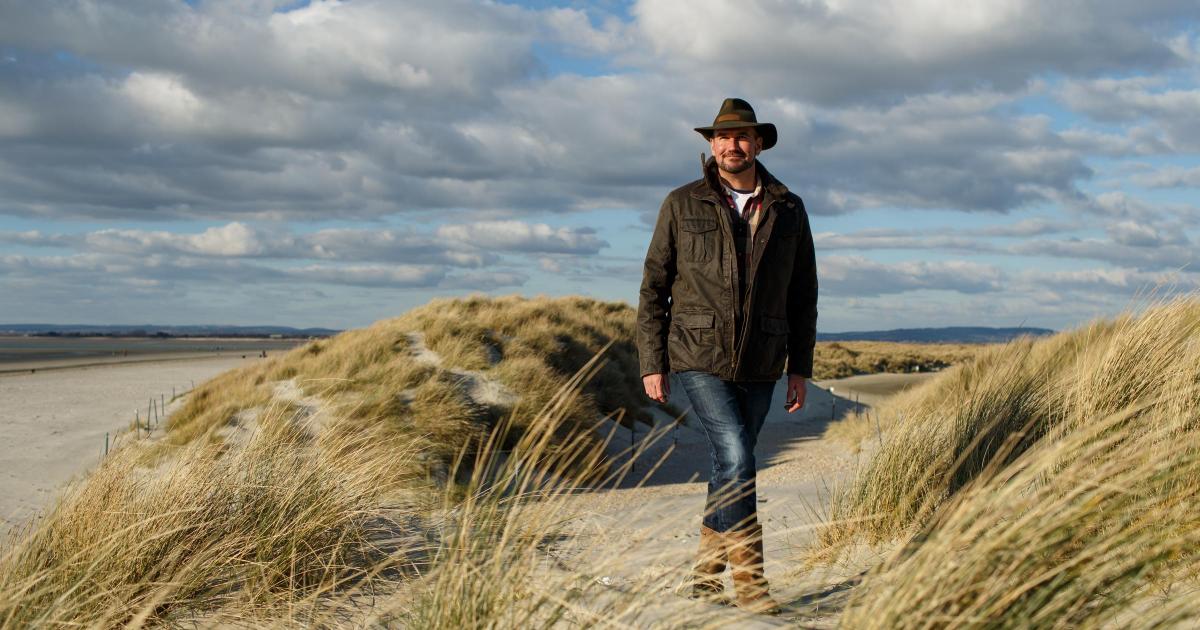
Tristan Gooley is smiling beneath his green Fedora hat.‘Think of it as a treasure hunt where the treasure doesn’t stand still,’ he says. Dressed in his trademark khaki outdoor gear, leather country boots and carrying a ruck sack, the explorer is describing how to use nature to navigate.
It’s a strange attire to wear to a church, St Mary the Virgin in Rye, but Tristan is here to preach about the wonder of ‘hidden nature’ and to implore us all to take a digital detox to reconnect with the natural world, and in particular, the changing of the seasons.
‘We are all being hit with over 11 million bits of data per second – our minds are so busy,’ he says. Too busy perhaps. ‘When you see something beautiful out in nature, take a moment and pause to see if there is a clue to be read.’

Eartham-based Tristan, 52, specialises in interpreting nature’s signs and as well as being the only living person to have flown and sailed solo across the Atlantic, he’s known to the fans of his bestselling guides to outdoors lore as the ‘Natural Navigator’ and the ‘Sherlock Holmes of Nature’.
He can find his way to the pub by looking in a puddle (the shape and depth can show the direction of the rays hitting the water), knows the wind is coming from the southwest if he finds sheep’s wool on the northeast side of gorse bushes (as the animals use them to shelter) and knows civilisation is near if he spots stinging nettles as they thrive in phosphate-rich soil. ‘Pretty much everything we do, from lighting a fire to farming to going for a pee, is increasing the phosphate levels.’
The more people using the land, the higher the phosphate. ‘So, if you are out on a walk at the weekend and you see a peacock butterfly fluttering near some stinging nettles, I’d say it’s time to get your drinks order in at the pub!’ he laughs.
Presumably, there’s no map or compass in his rucksack, but Tristan is convinced we can all discover this ‘sixth sense’ navigational skills and outdoors awareness that our ancestors had if we just stepped away from our lives crammed with social media feeds, air fryers and multiple screens.
To prove it, he takes us up to the top of the church roof – all 85 steps – to ‘read the roof tops.’ Below is the river Rother, two castles and a smuggler’s watchtower, but Tristan tells us there is far more than that if we pause to look closely.
‘The rooftops are bright green on one side and bright orange on the other,’ he explains. ‘Three seagulls face the orange and have their backs to the green side of the roof – that confirms there is a southerly breeze,’ he explains. ‘Perching birds face into the wind – it stops their feathers ruffling and allows them to take off quickly. They act as a weathervane.’
All these tips are in Tristan’s latest book The Hidden Seasons A Calendar of Nature’s Clues which hit both The Sunday Times’ and The New York Times’ bestsellers lists. It describes how to spot the endlessly unfolding clues and signs that reveal the hidden ways nature changes every day of the year.
Much of the research was carried out close to his Eartham home where he lives with podiatrist wife Sophie and sons Vinnie, 21 and Ben, 18.
Tristan decided to move to Sussex in 2007 after a sojourn in a light aircraft and being lured by a converted 18th century wood keeper’s cottage backing onto Eartham Woods.
‘I’d been told how Worthing was the place to be,’ he says, ‘but while flying overhead I saw the two dominant features of the castle and the river in Arundel, and it reminded me of my youth spent in Windsor,’ he says.
Once he’d touched down, Tristan drove his family from London to spend a weekend there, ‘and as we stepped out of the Land Rover, we must have been in the town for all of three minutes before we got that feeling. West Sussex was reaching out its friendly hand to us.
‘Living in Sussex is helpful professionally. I can be in London easily for meetings with my publisher, but I also love it personally too – within five minutes I am in the hills or in the woods. It’s been a life changer for the whole family.’
Tristan explains how the ‘Sussex experience’ offers great variety for naturalists. ‘The alkaline chalk Downs feel kind and friendly – it’s an easy and nice place for nature, and then there’s the Weald which is a bit more acidic, and then you have Ashdown Forest, also known locally as Little Scotland. It’s harsh and stark and nature has to try very hard in that landscape.’
Stark it may be, but A.A Milne famously chose to set his Winnie the Pooh stories at ‘Hundred Acre Wood’ (officially Five Hundred Acre Wood on the OS Map) at Ashdown Forest, ‘Storytellers know they are leading us on a journey with clues and choices’ says Tristan, ‘that is why we can learn to be better wayfinders by spotting the clues within every story. Milne tells us, in the story where Piglet meets a Heffalump, that the gang reached ‘the Six Pine Trees’. The six pines form a unique landscape – they stand out as a notable, unambiguous landmark. In my local woods I know three gnarly tree shapes as the Crown, the Viking Helmet and the Claw, and I get a warm fuzzy feeling each time I pass them. The brain likes recognising landmarks because this habit protected our ancestors and remains good for us.’
Tristan also acknowledges how the loss of a landmark can negatively affect us too. ‘I wrote an article for The Sunday Times about the tragic case of the Sycamore Gap tree,’ he says, describing how the world-famous tree that stood next to Hadrian’s Wall, in Northumberland, was felled by two men in September 2023. The pair were jailed for four years and three months in July after each being convicted of two counts of criminal damage.
‘Its loss was felt so keenly, not only because a much-loved tree had been taken down but because someone had the temerity to destroy a landmark and therefore change everyone’s relationship with that landscape, making them feel, at a deep level, less secure,’ he says.

Living so close to the South Downs means Tristan can explore and enjoy the ‘deep ecology’ on his doorstep and meet local experts, many of who he has included in The Hidden Seasons.
In one chapter, whilst deciphering clues about bird song he joins Mya Bambrick, a birder and team member of the Sussex Wildlife Trust, for a walk around Wood Mills, near Horsham. ‘We all know what the dawn chorus is, but scientists are unsure why birds sing in the morning rather than at another time of day,’ he says. Mya talked about how the [bird song] sounds would change as we passed from trees to fields. This simple observation shook the dust off the dawn chorus. Suddenly, I could see it more clearly and from a fresh angle. The dawn chorus reflects the space around us. It is more than a calendar and a clock: it is a map.’
It’s no wonder he has pioneered a renaissance in finding one’s way by using the clues given to us by nature and honed his vision to read the signs and symbols given to us by plants, animals, weather patterns, celestial positionings and even urban clues such as moss, lichens and those seagulls on the roof tops.

He was born into a family with nomadic tendencies. His father, Sir Michael Gooley, is the founder of Trailfinders, and he was taken on holidays to then far-flung and exotic locations such as Sri Lanka. After going to Eton and then Newcastle University, Tristan worked for Trailfinders before going on expeditions including trekking with the Touareg in the Sahara and researching Viking navigation in the Arctic. Finally, he decided to write and teach the art of natural navigation. In 2020 he was awarded the Harold Spencer-Jones Gold Medal by the Royal Institute of Navigation – it’s highest award, given for an outstanding contribution to navigation.
Nowadays he prefers wandering locally for at least two hours a days and even sleeping in the woods. With his skills you’d think he’d never get lost. ‘Oh I do – almost every week,’ he reveals. ‘But it’s deliberate, because I find it really stimulating.’ And no doubt exciting to use nature’s clues to find his way back home.
The Hidden Seasons is published by Hodder Press and is available to buy in all leading bookshops. You can also keep in touch with Tristan via: naturalnavigator.com and Instagram @thenaturalnavigator
Source link
[Featured]
[Just In]
