




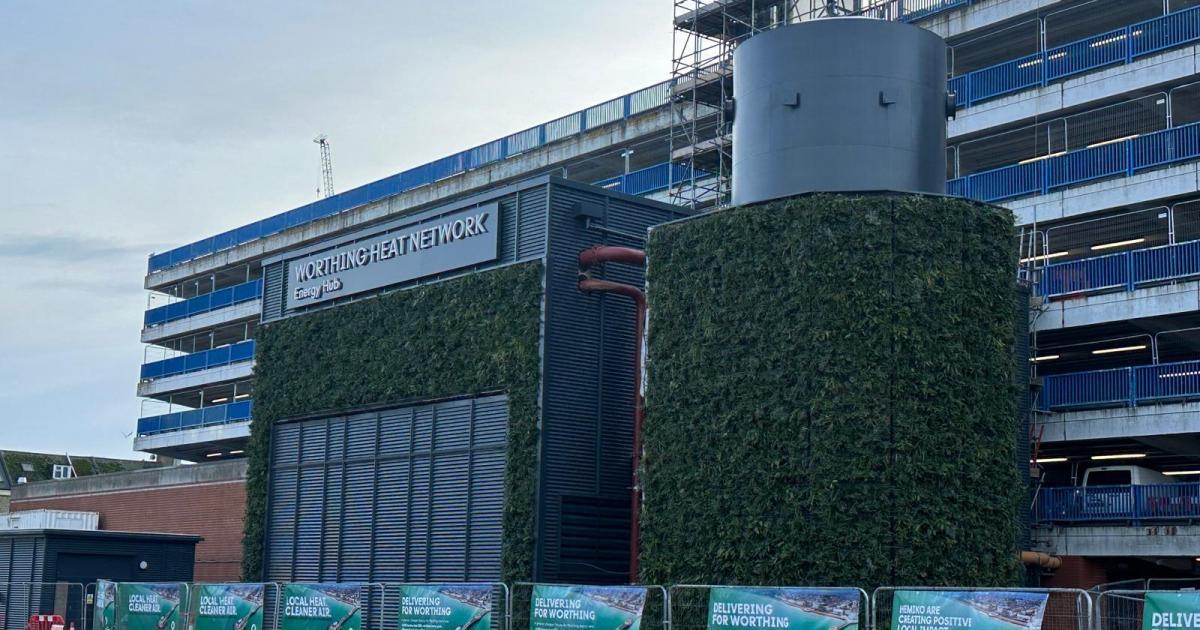
Hemiko has laid over two kilometres of pipes in Worthing to connect buildings to the low carbon network.
It is now providing heat to the town hall and Connaught Theatre, with Splashpoint Leisure Centre and the Pavilion Theatre the next to be connected. Preparatory works for phase two have begun and drilling is scheduled to start in March.
The system transfers hot water through insulated pipes underneath the town to connected buildings.
Politicians and press were given a tour of the pump room at the town hall and the energy centre outside High Street car park yesterday, February 12.

Construction began in Worthing in July 2024, with the first connection, the Connaught Theatre, going live in September last year.
The first phase of the project caused disruption in the town centre and to the businesses within it.
Traders reported being negatively impacted by works which led to a drop in sales.
Businesses in the Guildbourne Centre were particularly affected by the works, including jewellery store Sewsilver.

Owner Samantha Whittington said in October, when the second phase of the project was being approved, that she feared Hemiko’s works would “kill the town dead” and her business was operating at a loss for the first time in 15 years.
Worthing Business Improvement District (Bid) manager Hannah Manzaroli also advocated for struggling businesses, stating they “simply can’t afford anymore uncertainty”.
Hemiko’s chief executive Toby Heysham said lessons had been learned from phase one and changes would be made to phase two works to reduce disruption.

On the tour of the energy centre, he said: “We caused disruption here and it was something we had to learn a lot about.
“It’s something we’ve been learning from a lot and thinking about how we can do better on it.”
In October, Mr Heysham apologised to businesses for the disruption and said the company has installed networks across the country but “never had issues like [they] had here”.
During phase two, Hemiko will be using underground drilling to reduce open trenches and maintain public access to the seafront “wherever possible”.

The company said the first phase of the network will save 3,000 tonnes of carbon dioxide, “equivalent to taking around 2,000 cars off the road each year”.
It uses “locally wasted heat”, taken from places such as sewers and data centres, which is turned into “usable, cheap heating”.
Mr Heysham added: “We’re building long-term infrastructure to future-proof the town, providing a secure, local source of heat for years to come.
“No more will connected customers be at the mercy of huge gas price spikes such as the one we saw at the advent of the war in Ukraine.
“This is local infrastructure, collecting local wasted heat for local buildings.”

Hemiko said more than £80,000 has been donated to the Worthing Heat Network Community Fund.
Christopher Horner, project manager, said: “As we move into the next phase, we’re working closely with residents, businesses and community groups to ensure their needs are considered every step of the way.”

Councillor Rita Garner, cabinet member for regeneration, said: “This landmark project is helping our wonderful town move towards a greener and more sustainable future.
“We would once again like to thank residents, visitors and the town centre’s hard-working businesses for their patience during the construction of the network.
“We know the disruption has been challenging but believe in the benefits of this pioneering project.
“We look forward to seeing two more buildings connected to the network this year and welcome Hemiko’s revised approach for the next phase of works, which aim to minimise disruption across our town centre.”
Source link
[Featured]
[Just In]
