




GCC Fintech Market
GCC Fintech Market Overview
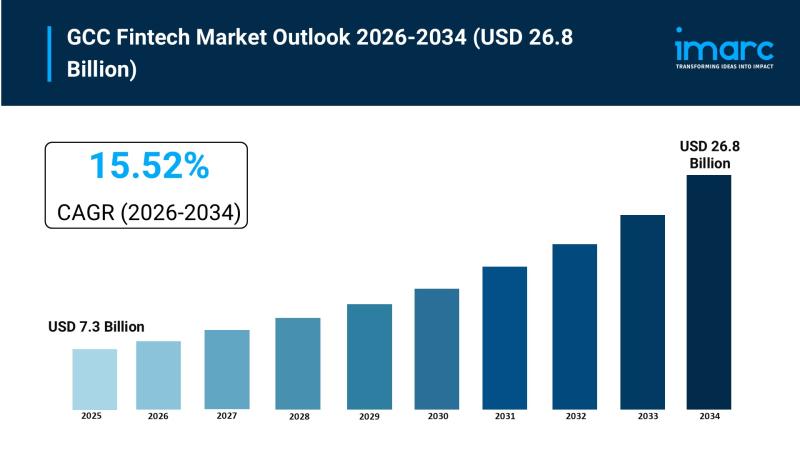
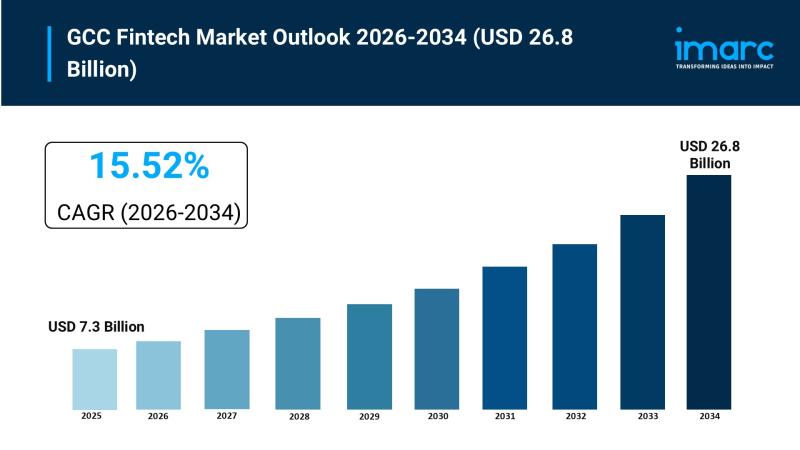
Market Size in 2025: USD 7.3 Billion
Market Size in 2034: USD 26.8 Billion
Market Growth Rate 2026-2034: 15.52%
According to IMARC Group’s latest research publication, “GCC Fintech Market Industry Trends, Share, Size, Growth, Opportunity and Forecast 2026-2034”, The GCC fintech market size reached USD 7.3 Billion in 2025. Looking forward, IMARC Group expects the market to reach USD 26.8 Billion by 2034, exhibiting a growth rate (CAGR) of 15.52% during 2026-2034.
How AI is Reshaping the Future of GCC Fintech Market
● AI enhances fraud detection and risk management in GCC fintech by analyzing transaction patterns in real-time, reducing losses and building trust in digital payments across high-volume markets like Saudi Arabia and UAE.
● Personalized financial services powered by AI deliver tailored recommendations for investments, loans, and budgeting, driving user engagement and retention for neobanks and digital wallets in the region’s young, tech-savvy population.
● AI automates customer support through advanced chatbots and virtual assistants, handling queries efficiently in multiple languages and improving service speed for seamless experiences in banking and payment platforms.
● In compliance and regulatory processes, AI streamlines KYC, AML checks, and reporting, enabling faster onboarding while meeting stringent standards in open banking frameworks across the GCC.
● AI optimizes lending and credit scoring by processing alternative data sources, expanding access to finance for SMEs and underserved segments, aligning with financial inclusion goals in diversification-driven economies.
Download a sample PDF of this report: https://www.imarcgroup.com/gcc-fintech-market/requestsample
How Vision 2030 is Revolutionizing GCC Fintech Industry
Saudi Vision 2030, alongside parallel strategies in UAE, Qatar, and other GCC nations, revolutionizes fintech by accelerating economic diversification beyond oil through digital transformation and innovation. The plan targets hundreds of fintech companies, massive venture capital inflows, and job creation in financial technology, with Saudi Arabia aiming for over 500 fintechs and thousands of positions by 2030. Regulatory advancements like open banking policies, regulatory sandboxes, and digital payment infrastructure from SAMA and central banks foster secure experimentation and rapid scaling of solutions in payments, lending, and insurtech. This supports financial inclusion, cashless societies, and integration of AI and blockchain, boosting digital transaction volumes and consumer adoption of mobile wallets and neobanks. Government initiatives promote public-private partnerships, attract global investments, and enhance cross-border capabilities, positioning the GCC as a leading fintech hub. Aligned with broader goals of non-oil GDP growth and talent development, Vision 2030 drives fintech as a core pillar for resilient, knowledge-based economies, enabling SMEs to thrive, tourism to expand via seamless payments, and regional competitiveness in global digital finance.
GCC Fintech Market Trends & Drivers
The GCC fintech market surges with rapid digital transformation, high smartphone penetration exceeding 95%, and widespread adoption of mobile wallets, digital payments, and neobanking. Open banking frameworks, blockchain integration, and embedded finance gain traction, while BNPL and AI-driven solutions dominate consumer preferences in Saudi Arabia, UAE, and Qatar amid young demographics favoring convenient, personalized services.
Key drivers include supportive government initiatives under Vision 2030 and similar national programs, regulatory sandboxes accelerating innovation, increasing venture capital and investments surpassing billions, and economic diversification pushing cashless economies. Rising demand for financial inclusion, cross-border payments, and sustainable practices, combined with infrastructure enhancements and tech-savvy populations, further propel sustained growth.
Ask analyst of customized report: https://www.imarcgroup.com/request?type=report&id=10530&flag=E
GCC Fintech Industry Segmentation:
The report has segmented the market into the following categories:
Deployment Mode Insights:
● On-premises
● Cloud-based
Technology Insights:
● Application Programming Interface
● Artificial Intelligence
● Blockchain
● Robotic Process Automation
● Data Analytics
● Others
Application Insights:
● Payment and Fund Transfer
● Loans
● Insurance and Personal Finance
● Wealth Management
● Others
End User Insights:
● Banking
● Insurance
● Securities
● Others
Country Insights:
● Saudi Arabia
● UAE
● Qatar
● Bahrain
● Kuwait
● Oman
Competitive Landscape:
The competitive landscape of the industry has also been examined along with the profiles of the key players.
Recent News and Developments in GCC Fintech Market
● August 2025: GCC fintech investments are smashing records, with more than $6.1 billion raised in just the first half of this year-a 37% jump compared to last year. Driving this is not only a sharp rise in funding for digital payments and open banking, but also the strong push by governments and new regulatory sandboxes that welcome startups in sectors like digital assets and AI-driven finance. As a result, about 65% of regional consumers now say they prefer digital-first financial services, marking a major cultural shift towards a cashless, tech-enabled society.
● July 2025: The UAE continues to lead the GCC’s startup and fintech boom, registering over 5,600 startups in a single recent quarter-more than any other country in the region. Fintechs in the UAE benefit from investor-friendly free zones and initiatives like Hub71, which attracted $224 million in early-stage investments this year and helped create more than 400 jobs. Meanwhile, Oman rolled out its regulated fintech sandbox, focusing on digital payments, blockchain, and open banking to accelerate responsible innovation in the broader Gulf region.
● July 2025: Fintech platforms specializing in SME support are gaining real traction across the GCC. Omnispay, a UAE-based digital payments platform for small businesses, secured $1.5 million in seed funding to expand its offering for SMEs. Other notable moves include the partnership between Paymob and Tamara to revolutionize SME payment solutions and the rapid funding success of companies like FlapKap ($34 million) and Pemo ($7 million), which are streamlining spend management and digital lending for businesses in the region.
Note: If you require specific details, data, or insights that are not currently included in the scope of this report, we are happy to accommodate your request. As part of our customization service, we will gather and provide the additional information you need, tailored to your specific requirements. Please let us know your exact needs, and we will ensure the report is updated accordingly to meet your expectations.
About Us:
IMARC Group is a global management consulting firm that helps the world’s most ambitious changemakers to create a lasting impact. The company provides a comprehensive suite of market entry and expansion services. IMARC offerings include thorough market assessment, feasibility studies, company incorporation assistance, factory setup support, regulatory approvals and licensing navigation, branding, marketing and sales strategies, competitive landscape and benchmarking analyses, pricing and cost research, and procurement research.
Contact Us:
IMARC Group
134 N 4th St., Brooklyn, NY 11249, USA
Email: sales@imarcgroup.com
Tel No:(D) +91 120 433 0800
United States: +1-201971-6302
This release was published on openPR.
