




When Sam Squire co-founded Inspire 2 Ignite three years ago, the first clients they helped were three young people and they delivered the session in a two-by-three-metre room. To date, they’ve worked with over 15,000 young people—helping those not in education, employment or training to become active members of society and the economy.
How have they grown so quickly, with very limited resources and no well-known brand?
I recently caught up with Sam for the Fundraising Bright Spots podcast, and he shared some brilliant insights about building partnerships that I think many fundraisers and leaders of charities will find helpful. Particularly if you work for a smaller charity or you sometimes feel like an underdog in a really competitive world.
Two things stood out: Sam’s willingness to co-design programs with partners even when he doesn’t yet have all the detail of how things will turn out, and his willingness to stay hungry and make things happen.
The Follow-Up That Haunts Him
Sam told me about a moment early on when he met the founder of one of the biggest applications in the world at a self-development conference. They had a conversation at the after-event.
He didn’t follow up.
“That still haunts me today,” he said. “What if? Where could that partnership be?”
That experience taught him something crucial: following up is actually fairly easy to do, but it’s also so easy to not do! As soon as you have that interaction or see that glimmer of opportunity, grasp it as quickly as possible.
The reality? No one is actually thinking about you all the time. You need to make sure you’re present in their mind.
Sam’s approach now is immediate. Yesterday, one of his team had a call about a potential funding opportunity. They followed up within ten minutes. The meeting is booked for Wednesday.
“If I’d taken maybe a day, and they hadn’t got aligned values or energy, that might have taken another week to respond. I’ve now accelerated that conversation by a week.”
When they first started, it took about two months just to get a meeting. Now? Sometimes it’s the same day.
The habit of rapid follow-up became a muscle his whole team developed. And the speed at which opportunities convert has been staggering.
Co-designing when you don’t know all the answers
Here’s where Sam’s approach gets really interesting for fundraisers who struggle with the pressure to have everything perfectly planned before approaching a partner.
When Inspire to Ignite partnered with one of the UK’s largest flower suppliers, Sam had never created an apprenticeship program before. But instead of pretending he had all the answers, he brought the senior leadership team into a room with his own team and asked: What would the perfect apprentice look like? What would their journey look like?
They co-designed the entire program together.
The organization had described themselves as “a white box that didn’t engage with the community.” Now they’re known by young people locally. All the apprenticeships got filled. And what started as a potential one-year program delivered in eight months has turned into a three-year partnership.
They’re now looking at scaling to three other UK locations and exploring research papers in the Netherlands.
Sam’s approach? Have conversations. Ask questions. Bring people on the journey. The more they input into the program, the more they buy into it.

Making the most of ice cream
One summer, Sam’s co-founder Alex was at a dinner with frustrated educators. That same week, someone had gifted them an ice cream cart. Alex pitched the head of a regional learning alliance: “I’ve got an ice cream cart. Do you want to try something new?”
They didn’t have any funding up front. It was a risk for a startup. But they said: “We’re going to work for you for free. We’re going to try something out and see what the impact is.”
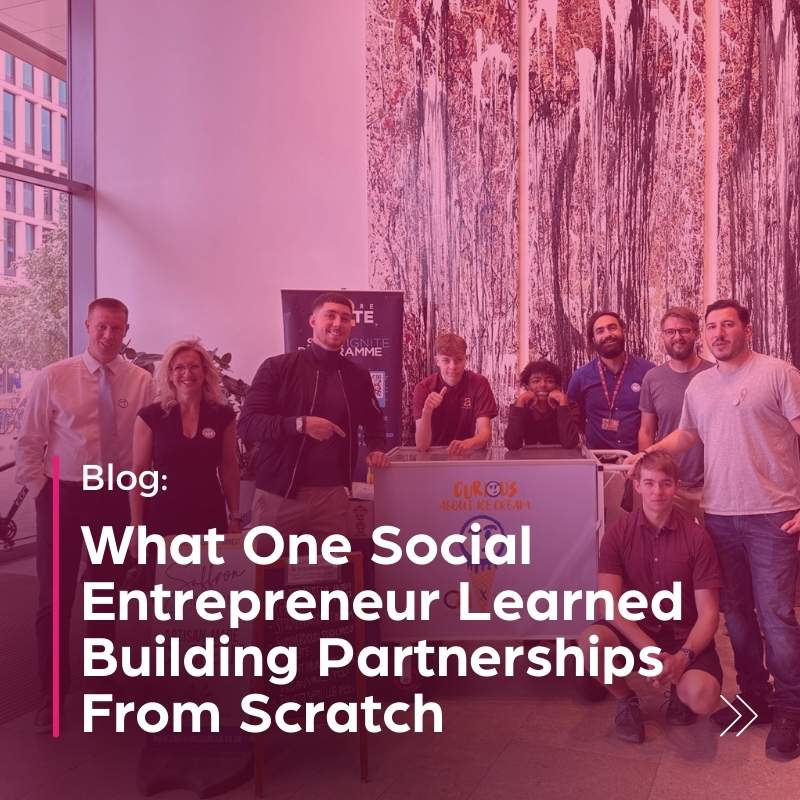
Young people built their own ice cream brand over six weeks. They deployed in the headquarters of major companies in Cambridge and made nearly £500 in two hours.
The following week, the head of the alliance said: “We want to work with these guys once a week. Here’s the contracts.”
Sam reflected: “When you’ve got limited resources, that’s where you can become most creative. You’re creativity is actually born from the constraints.”
The model that emerged through doing
When Inspire to Ignite partnered with Moss UK—a relationship that started at a school careers fair—they knew they were “going into the unknown together.”
The first year was experimenting, testing, making mistakes. But reflecting on what could be different.
This year, they’ve refined the model: pre-engagement activities in the community, then an open day experience, then paid work trials, then fully paid internships, then traineeships.
“We had no idea that was the model,” Sam said. “But now through trial and error, we understand that. And now that’s a trailblazer case study that could be used nationally.”
The partner knew full well they were trying something that hadn’t been done before. That was why they were doing it. The key was having aligned values and being willing to learn together.
The hospitality program that doesn’t exist yet
Last week, Inspire to Ignite received funding for a program to help young people work and learn skills in the hospitality industry. Two weeks ago it was just a spreadsheet.
They invited all the hospitality businesses in the local area to a co-design session. They shared over a hundred years of hospitality knowledge and Inspire 2 Ignite will present back a concept for feedback.
Sam doesn’t know what that program will look like or what the outcomes will be. But he knows it will be informed by a lot of experienced people sharing expertise he just wouldn’t have had on his own.
“I’d really encourage people to put yourself out there,” he told me. “Don’t be afraid to share your vision and mission. And watch the ripple effect that flows from ‘showing up’ consistently.’’
Being OK with uncertainty brings rich rewards
Sam’s approach might feel uncomfortable if you’re used to having every detail sorted before you approach a partner. But his results speak for themselves.
The essence seems to be: stay hungry, go to possible partners who align on values, share and get buy-int to a direction of travel, and work out the practicalities together as you go.
Want to go deeper?
If you’d like to hear the full conversation with Sam, including more examples about his powerful “five yard rule” and some helpful ideas on how to stay true to your mission, you can listen to the podcast here.
For Bright Spot’s practical tips on how to win more partnerships by showing them how valuable you are to their business, here is our article.
To find out more about Corporate Partnerships Mastery, our flagship training for corporate fundraisers, find out more here.
Find this helpful? If so, please share it on, so we can help as many good causes as possible.
