




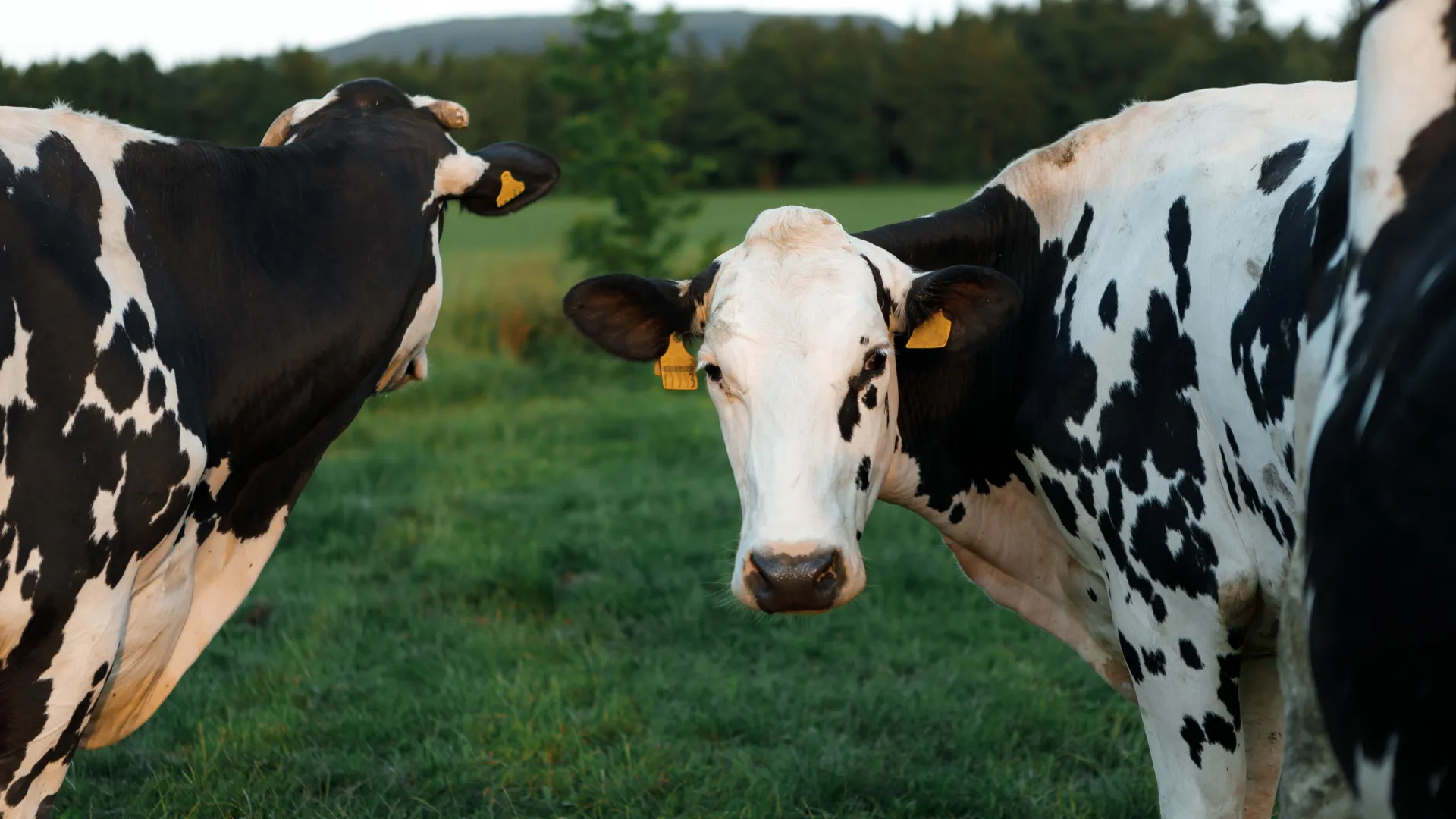
At a glance, the 400 acres of soybeans on the Preston family’s dairy farm in southern Michigan appear no different from any other field in the region. But this crop is far from ordinary. The soybeans are part of a research-driven collaboration with Michigan State University that is saving the farm tens of thousands of dollars each month on livestock feed. The results point to a shift that could have lasting effects across the dairy industry.
According to federally funded research from MSU’s College of Agriculture and Natural Resources, this soybean variety has the potential to improve milk quality when included in dairy cow diets. In the spring of 2024, the fourth-generation team at Preston Farms decided to commit nearly 400 acres, close to one third of their 1,500-acre operation, to growing the crop.
Brian Preston, an MSU graduate who oversees daily operations and manages nearly 1,000 cows, understood the risk involved. “Those 400 acres could have been our corn and our grain for the year,” he says.
Fast results after harvest
Once the soybeans were harvested, the family began incorporating them into the cows’ feed. The impact was noticeable almost immediately. Within three days, milk fat and protein levels increased, significantly raising the milk’s overall value.
“There was a lot of relief,” Preston says, “that it was all coming together and that it paid off.” That relief quickly gave way to confidence and excitement.
“The first thing we noticed when we started feeding the soybeans,” Preston says, “was that our purchased feed costs dropped by 20% per month, and that was huge. That’s a once-in-a-generation change.”
Years of dairy nutrition research behind the breakthrough
While the results appeared rapid, the science behind them developed over many years. Adam Lock, a professor in MSU’s Department of Animal Science and interim chair of the Department of Large Animal Clinical Sciences, leads a research group that has studied dietary fats and their influence on dairy cows for more than a decade.
One area of focus has been high-oleic soybeans, which are rich in oleic acid, a naturally occurring fatty acid found in animal and plant-based fats and oils. Researchers believed that adding these soybeans to dairy diets could increase milk fat and protein output while also improving farm profitability.
“Our work builds on over a decade of research in our lab exploring how dietary fats influence milk composition, cow health and farm economics,” Lock says. “High-oleic soybeans are a natural extension of our focus on practical, science-based feeding strategies.”
The research is supported by funding from the USDA National Institute of Food and Agriculture, as well as the Michigan Alliance for Animal Agriculture, the Michigan Milk Producers Association and the United Soybean Board. “Public funding drives innovation, industry partnerships and real-world impact for our state’s agricultural sector,” Lock says.
Roasting soybeans and cutting supplement costs
Data gathered by Lock’s team confirmed the original hypothesis. Additional studies showed that roasting the soybeans before feeding them to cows could further enhance milk production benefits.
Many dairy farms rely on expensive supplements, including added fats and amino acids, to fine-tune cow nutrition. Preston says high-oleic soybeans, especially when roasted on-site, can replace much of that purchased feed. As one of the early adopters, Preston Farms is no longer alone in its interest. Lock notes that seed suppliers across Michigan ran out of high-oleic soybean seed last year due to strong demand.
The benefits extend beyond a single farm. Public investment in dairy research helps strengthen trust within the agricultural community, supports Michigan’s farm economy and ensures that scientific findings lead to real-world improvements.
“Seeing our research in action at farms like Preston Farms is incredibly fulfilling,” Lock says. “It’s a reminder that the work we do at MSU doesn’t just live in journals, it lives in feed bunks, milk tanks and the day-to-day decisions of Michigan farmers. That kind of impact is what drives us.”
At a time when many universities are scaling back dairy research, MSU’s new Dairy Cattle Teaching and Research Center is expected to support continued producer-focused work like Lock’s.
A long-standing partnership and statewide benefits
The partnership between the Prestons and MSU stretches back generations, much like the farm itself. Several family members have attended MSU, beginning in the 1940s when Brian Preston’s grandfather, Stanley, completed an agricultural short course. The family has worked closely with MSU and MSU Extension for more than 30 years, but Preston says the recent soybean collaboration stands apart.
High-oleic soybeans, he believes, “could change our entire industry.”
Michigan is home to more than 850 dairy farms and about 436,000 dairy cows, and the industry contributes $15.7 billion to the state’s economy. That scale makes improvements in efficiency and milk quality especially meaningful. Michigan residents benefit from better dairy products, while farmers gain tools to maximize production and manage costs.
According to the United Dairy Industry of Michigan, fresh dairy products such as milk, cheese and yogurt are produced in-state and typically move from farm to processor to store within about 48 hours. Higher-quality milk from farms like Preston Farms adds value for consumers across Michigan.
For Glenn Preston, Brian’s uncle and the owner of Preston Farms, the partnership with MSU is essential. “Through MSU Extension and working with Adam Lock, we have access to the best and brightest minds in the world,” he says. “People at MSU are pushing the envelope to help our industry move forward — and they are helping us be more profitable. And what it comes down to in the end is that MSU helps our business, which means we’re able to be here for another generation.”
