





Artificial intelligence is moving quickly into drug discovery as pharmaceutical and biotech companies look for ways to cut years off R&D timelines and increase the chances of success amid rising cost. More than 200 startups are now competing to weave AI directly into research workflows, attracting growing interest from investors. Converge Bio is the latest company to ride that shift, securing new capital as competition in the AI-driven drug discovery space heats up.
The Boston- and Tel Aviv–based startup, which helps pharma and biotech companies develop drugs faster using generative AI trained on molecular data, has raised a $25 million oversubscribed Series A round, led by Bessemer Venture Partners. TLV Partners and Vintage Investment Partners also joined the round, along with additional backing from unidentified executives at Meta, OpenAI, and Wiz.
In practice, Converge trains generative models on DNA, RNA, and protein sequences then plugs them into pharma and biotech’s workflows to speed up drug development.
“The drug-development lifecycle has defined stages — from target identification and discovery to manufacturing, clinical trials, and beyond — and within each, there are experiments we can support,” Converge Bio CEO and co-founder Dov Gertz said in an exclusive interview with TechCrunch. “Our platform continues to expand across these stages, helping bring new drugs to market faster.”
So far, Converge has rolled out customer-facing systems. The startup has already introduced three discrete AI systems: one for antibody design, one for protein yield optimization, and one for biomarker and target discovery.
“Take our antibody design system as an example. It’s not just a single model. It’s made up of three integrated components. First, a generative model creates novel antibodies. Next, predictive models filter those antibodies based on their molecular properties. Finally, a docking system, which uses physics-based model, simulates the three-dimensional interactions between the antibody and its target,” Gertz continued. The value lies in the system as a whole, not any single model, according to the CEO. “Our customers don’t have to piece models together themselves. They get ready-to-use systems that plug directly into their workflows.”
The new funding comes about a year and a half after the company raised a $5.5 million seed round in 2024.
Techcrunch event
San Francisco
|
October 13-15, 2026
Since then, the two-year-old startup has scaled quickly. Converge has signed 40 partnerships with pharmaceutical and biotech companies and is currently running about 40 programs on its platform, Gertz said. It works with customers across the U.S., Canada, Europe and Israel and is now expanding into Asia.
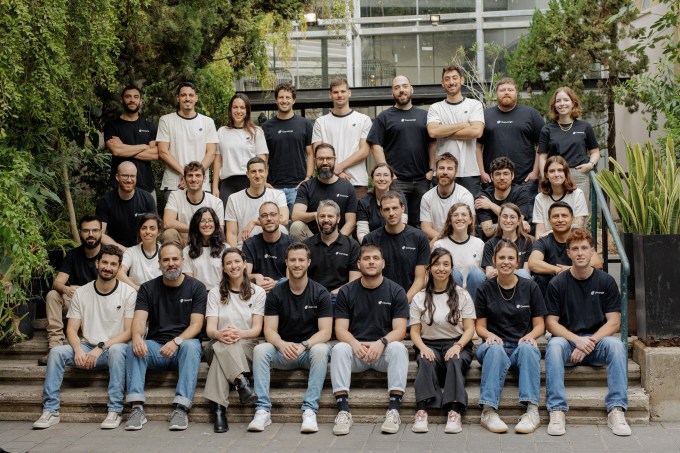
The team has also grown rapidly, increasing to 34 employees from just nine in November 2024. Along the way, Converge has begun publishing public case studies. In one, the startup helped a partner boost protein yield by 4 to 4.5X in a single computational iteration. In another, the platform generated antibodies with extremely high binding affinity, reaching the single-nanomolar range, Gertz noted.
AI-driven drug discovery is experiencing a surge of interest. Last year, Eli Lilly teamed up with Nvidia to build what the companies called the pharma industry’s most powerful supercomputer for drug discovery. And in October 2024, the developers behind Google DeepMind’s AlphaFold project won a Nobel Prize in Chemistry for creating AlphaFold, the AI system that can predict protein structures.
When asked about the momentum and how it is shaping Converge Bio’s growth, Gertz said that the company is witnessing the largest financial opportunity in the history of life sciences and the industry is shifting from “trial-and-error” approaches to data-driven molecular design.
“We feel the momentum deeply, especially in our inboxes. A year and a half ago, when we founded the company, there was a lot of skepticism,” Gertz told TechCrunch. That skepticism has vanished remarkably quickly, thanks to successful case studies from companies like Converge and from academia, he added.
Large language models are gaining attention in drug discovery for their ability to analyze biological sequences and suggest new molecules, but challenges like hallucinations and accuracy remain. “In text, hallucinations are usually easy to spot,” the CEO said. “In molecules, validating a novel compound can take weeks, so the cost is much higher.” To tackle this, Converge pairs generative models with predictive ones, filtering new molecules to reduce risk and improve outcomes for its partners. “This filtration isn’t perfect, but it significantly reduces risk and delivers better outcomes for our customers,” Gertz added.
TechCrunch also asked about experts like Yann LeCun, who remain skeptical about using LLMs. “I’m a huge fan of Yann LeCun, and I completely agree with him. We don’t rely on text-based models for core scientific understanding. To truly understand biology, models need to be trained on DNA, RNA, proteins, and small molecules,” Gertz explained.
Text-based LLMs are used only as support tools, for example, to help customers navigate literature on generated molecules. “They’re not our core technology,” Gertz said. “We’re not tied to a single architecture. We use LLMs, diffusion models, traditional machine learning, and statistical methods when it makes sense.”
“Our vision is that every life-science organization will use Converge Bio as its generative AI lab. Wet labs will always exist, but they’ll be paired with generative labs that create hypotheses and molecules computationally. We want to be that generative lab for the entire industry,” Gertz said.
