




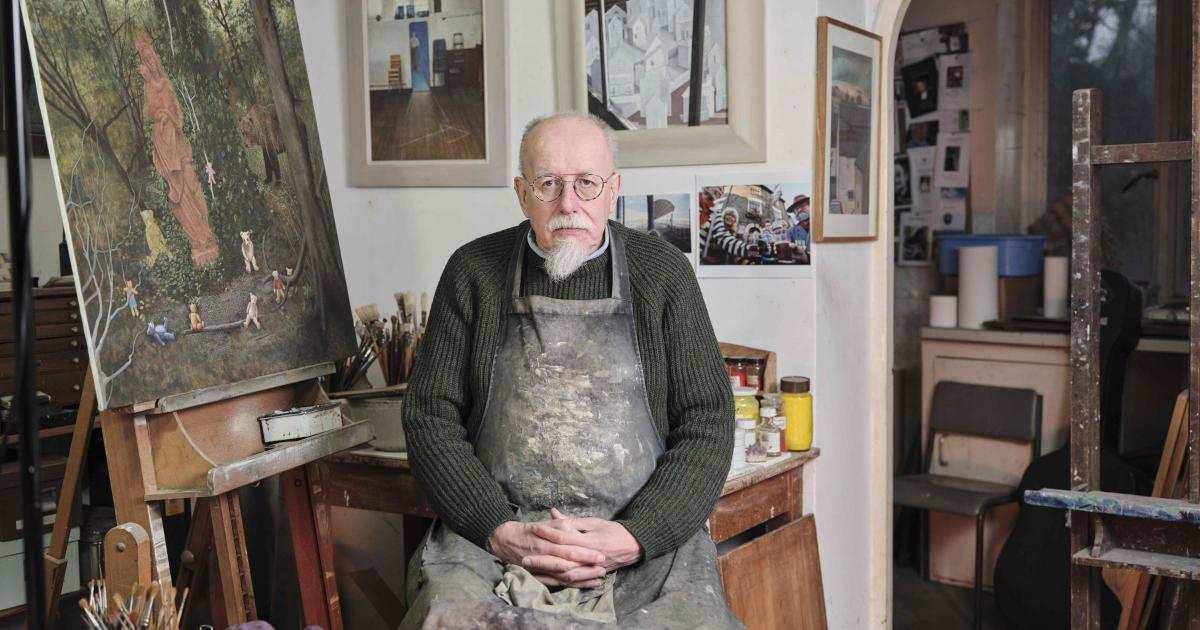
Walking into Peter Messer’s tiny studio in Lewes, I am confronted by a large painting on an easel. The scene it depicts is certainly a surreal one. In a woodland clearing, a group of teddy bears are sitting in a circle. Their haphazard arrangement suggests they have been abandoned in haste. What could have been the reason for this neglected teddy bears’ picnic? The answer is not difficult to deduce. Glimpsed through the trees stands a large, lumbering bear – a real one – eager to join the party. Exit children, pursued by a bear.

This is classic Peter Messer. In Peter’s paintings, you should expect the unexpected. Nothing, on first inspection, is quite what it seems. Beneath the surface of reality, anything can happen.
Peter calls it ‘the luck to be astonished in the right place’. Walk down a quiet Lewes street at dusk and who knows what spectral beings might be following you in the shadows? Sometimes they are ghosts from the past. A young girl in Edwardian clothes running down Castle Lane on a chilly evening. A Victorian sweep scolding his young apprentice on their way to the next job. Or a group of boys dressed in baker boy caps gathered in wonder round the moon-shaped glow of a light in a flint-lined twitten.

Sometimes Peter’s pictures are inhabited by even more mysterious creatures. A half wolf dances madly by the light of a full moon on Lewes Castle’s bowling green. An office worker casually unfurls his angel wings while grabbing a shop sandwich on a castle bench. A man takes flight over the Lewes rooftops suspended, Baron Munchausen style, from strings harnessed to a flock of birds.
How would you categorise this style of painting? In fiction, you’d call it magical realism. Peter also cites the artists Algernon Newton, Caspar David Friedrich and Edvard Munch as influences. But there is a more familiar reference point, and you can find it in the teddy bears’ picnic painting.
Look closely and you’ll see that one of the abandoned teddies is none other than Rupert Bear dressed in his trademark red jumper and yellow checked trousers. Peter adores Rupert, not to mention his best-known illustrator, Alfred Bestall, and that sense of the fantastical, which came to define the Rupert stories, also permeates his work. In Peter’s paintings, Nutwood lives and breathes in Lewes.

Peter, who studied fine art at the University of Brighton and exhibits at the Star Brewery Gallery in Lewes, has largely restricted his subject matter to the parameters of the town all his working life. As the art critic Julian Bell observes: ‘Has ever a stretch of any town, anywhere, been more attentively portrayed?’ It’s tempting to compare Peter with the painter Stanley Spencer, who similarly appropriated Cookham in Berkshire, even raising the dead in the local graveyard for his famous resurrection scene.
Peter used to be uncomfortable with the term ‘local artist’, feeling, to paraphrase the TV dramatist Dennis Potter, that putting ‘local’ in front of ‘artist’ was like putting ‘processed’ in front of ‘cheese’.

‘I have now come to realise that local doesn’t necessarily mean limited,’ he says, when we eventually find a place to sit in his cramped studio brimming with artist’s materials (unusually he works mainly in egg tempera on gesso). ‘It can be more rewarding to see one place with many pairs of eyes than to see many places with one. I’m not sure whether Lewes has a particular magic or whether, like many artists, I’m simply dealing with what is to hand.
‘I get rather tired of having the “magic of Lewes” rammed down my throat, often by those at least partly responsible for diminishing it. I used to think the foundry was magical and the railway yards, the wet fish shops and the seed merchants, the printers and the cement works. Many will recall the heady excitement of buying a useful everyday item in Lewes High Street. Be that as it may, any self-respecting artist should be able to discover magic or be capable of inventing it. Or both simultaneously. It is our job.’
Though he grew up in Burgess Hill, Peter’s connection with the town stretches back to boyhood. ‘I came to school here because quite a lot of grammar school kids from my area were sent to Lewes. Then, in the Eighties, I moved here.’

He resents the town’s gentrification. ‘A lot of people come here because it ticks the right boxes. They see it as a beautiful backdrop to their lovely lives. “I’ll do well here,” they say, but they don’t mix. You hear them referring to locals as “in-breds” with a condescending tone that grates. They only get to know people who come from the same bit of London as they do. They hunt in packs.
‘Lewes seems to have turned into a cross between Hampstead and the Groucho Club, but I remember a time when the people here had never heard of extra virgin olive oil. Loads of us still recall tractors in the town; when the traffic was held up by old vans with baler twine. When I was at school, there was a cattle market in Lewes. On market day the place would be full of drunk farmers in the afternoon.’
Peter, in contrast, a life member of Commercial Square Bonfire Society, is indelibly woven into the town’s fabric, and vice versa.
‘I have always been fairly sensitive to layers of narrative and experience, and because I have been in or around Lewes, on and off, since my schooldays, many of my personal layers have accumulated here,’ he says. ‘There are buildings and corners that I have looked on as a schoolboy, a young man and a middle-aged one, in a range of physical, mental and material states. People important to me have left, died or been redistributed around the town.’
For this reason, the past is almost as alive to Peter as the present. Echoing TS Eliot’s immortal lines from his poem, Burnt Norton, he is a great believer that ‘all time is eternally present’. Or as Einstein famously observed, ‘Time… is what keeps everything from happening at once.’ In the great space-time continuum, there is little to separate ‘time present and time past’. Just a pane of glass. A gust of wind. That’s why the dead inhabit his pictures.
‘Maybe past lives do impress themselves on the fabric around them,’ he says thoughtfully. ‘Who’s to say that the physical world isn’t one big recording device? I often think of the century-old glass-plate negatives of Edward Reeves Photography, our venerable High Street institution, capturing endless past aspects of a town as solid and present as the one I walk through now, thronged with people exactly as complex and alive. They, and we, echo from the flints and bricks.’
Peter talks of moving about Lewes in a state of almost hallucinatory immersion. ‘It is possible, like William Blake, to stare at a knot of wood until one becomes frightened of it,’ he says. ‘There are shadows, strange patches of luminosity, weird flints in the walls and gesticulating trees which, equally, can revert to familiarity when the light or wind changes.’
Perhaps that’s why he is attracted to the gloom, like another artist he admires, Atkinson Grimshaw, that great Victorian painter of moonlight. Who knows what comes out to play under the cover of darkness? Do the dead mingle with the living?
Solitary human figures, lost in thought, often inhabit Peter’s pictures, usually in lonesome and desolate places. Are they being watched? I’d say so. Sometimes they are substituted by a lone fox. A black cat. A wolf. The night is their time.
Messer prides himself on his spider sense; what he calls ‘being attuned to atmosphere’. He isn’t a religious man and doesn’t believe in the supernatural, but he doesn’t rule anything out either. ‘I’ve never seen God but then I’ve never seen an atom. The only thing I do believe in is the unknowable.’
Just as Doctor Who had his Tardis and Captain Kirk his teleportation machine, there is an area of Lewes that has a similar transporting effect on Peter, allowing him to enter different worlds. He estimates he has walked the stretch of ground between Castle Banks and Castle Lane, from his home to his studio, more than 7,000 times, in all lights, weathers and seasons, but it has never lost its hold over him.
‘I have painted aspects of this short walk in the middle of the county town for years, never quite knowing why I return to the same narrow beat. What is so compelling about it?
‘There is a Celtic tradition of so-called “thin places” where the borders between worlds become more fluid. I choose to think this area may fit that category. Perhaps some places behave like animals: if you ignore them and are immersed in your natural self, they will approach you. They may not trust you as such but they will sometimes drop their guard and, if you are lucky, things will be revealed.
‘Sometimes, when I walk up there, I feel a brush with something. It’s difficult to put into words without sounding silly, but I’ve felt a jolt which has made me think, “something just happened then”. It’s as if the texture of the light changes in a weird way. That’s what inspired my painting of the little Edwardian girl running. I sensed her presence.’
It’s not a gift shared by all. ‘The roots go deep in Lewes,’ he says, referencing its ancient history, ‘which is why it annoys me when I see people swanning around, viewing the town as some kind of lifestyle purchase.
‘I like the idea of Lewes not being what they think it is. I have a sense of them confidently sashaying around town, and little mocking spirits, who know where the truth really lies, following them around.’
He captures this brilliantly in his painting Two Shadows, depicting a man taking a nocturnal walk through Lewes, mobile phone clamped to his ear, oblivious to his surroundings. A street lamp casts his shadow against the flint wall beside him. Behind, at three paces, is another shadow, of a little mocking figure doing a Wilson and Keppel sand dance. It is surely Peter reincarnated as the imp of mischief.
To find out more about Peter Messer’s work or to purchase original work and prints, visit starbrewerygallery.com
Source link
[Featured]
[Just In]
