













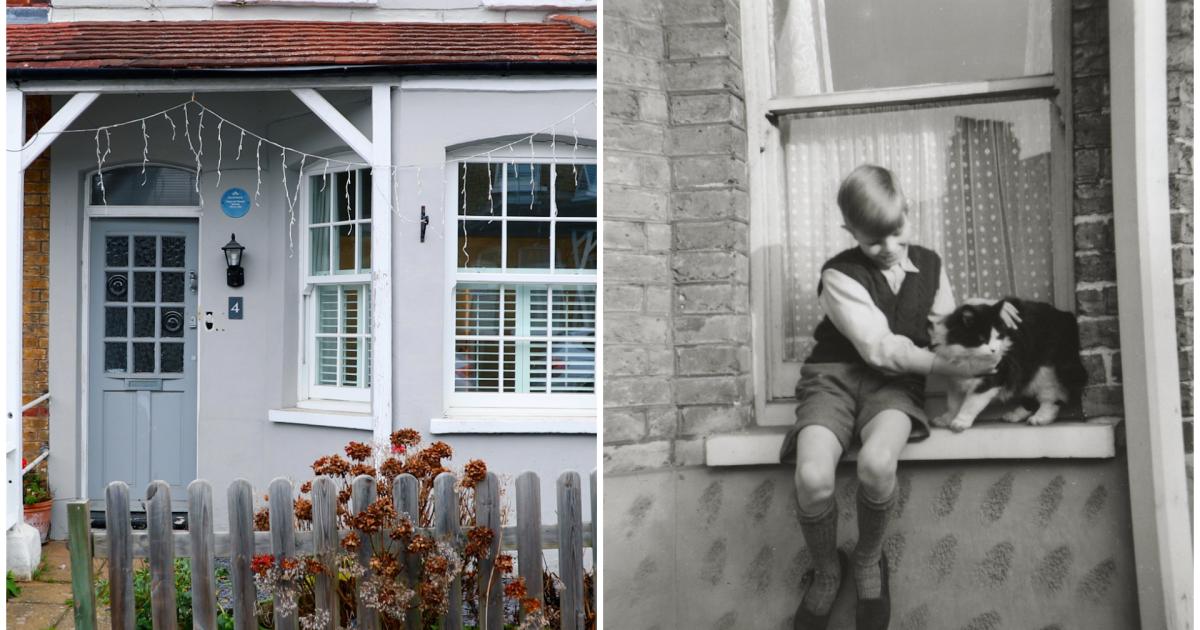
The house at 4 Plaistow Grove, where Bowie famously wrote Space Oddity, will be restored to its early 1960s appearance.
A never-before-seen archive will help recreate the interior as it looked when Bowie lived there, with guidance from Geoffrey Marsh, co-curator of the David Bowie exhibition at the Victoria and Albert Museum.
4 Plaistow Grove in Bromley, south London, the former childhood home of David Bowie (Image: Heritage Of London Trust/PA Wire)
He said: “It was in this small house, particularly in his tiny bedroom, that Bowie evolved from an ordinary suburban schoolboy to the beginnings of an extraordinary international stardom.
“As he said, ‘I spent so much time in my bedroom, it really was my entire world, I had books up there, my music up there, my record player, going from my world upstairs out on to the street, I had to pass through this no-man’s-land of the living room’.”
David Jones, later known as David Bowie. (Image: David Bowie Estate)
The immersive project has been backed by a £500,000 grant from the Jones Day Foundation, alongside a public fundraising campaign.
Its announcement coincides with what would have been Bowie’s birthday on January 8 and comes just days before the 10-year anniversary of his death on January 10.
It also comes on the 10th anniversary of the release of Bowie’s final album Blackstar, which has been lauded as one of the singer’s best works, incorporating jazz and hip-hop influences in songs which reference his impending death from liver cancer aged 69.
Nicola Stacey, director of Heritage Of London Trust, said: “David Bowie was a proud Londoner. Even though his career took him all over the world, he always remembered where he came from and the community that supported him as he grew up.
“It’s wonderful to have this opportunity to tell his story and inspire a new generation of young people and it’s really important for the heritage of London to preserve this site.
Undated handout photo issued by the Heritage Of London Trust of Geoffrey Marsh, George Underwood and Nicola Stacey, outside 4 Plaistow Grove in Bromley. (Image: Heritage Of London Trust/PA Wire)
“We are thrilled to have already secured a major grant of £500,000 from the Jones Day Foundation towards the project, and hope that people everywhere will want to be involved.”
George Underwood, Bowie’s lifelong friend, who is also an artist and musician, said: “We spent so much time together, listening to and playing music. I’ve heard a lot of people say David’s music saved them or changed their life.
A view from a window of the childhood home of David Jones, later known as David Bowie. (Image: David Bowie Estate)
“It’s amazing that he could do that and even more amazing that it all started here, from such small beginnings, in this house.
“We were dreamers, and look what he became.”
Bowie’s music career is legendary: five UK number-one singles, 11 UK number-one albums, and a constant reinvention of sound and image.
From glam rock hits like Ziggy Stardust to jazz and hip-hop influences on Blackstar, Bowie’s artistic evolution was as ground breaking as it was wide-ranging.
But his story began quietly in south London.
Born David Robert Jones in Brixton, he moved with his family across Bromley and Bromley Common before settling in Sundridge Park.
He first performed in bands at age 15 and pursued a pop career soon after leaving school.
It wasn’t until the release of Space Oddity in 1969 that Bowie achieved mainstream success, coinciding with the BBC’s coverage of the Apollo 11 moon landing.
The Plaistow Grove home is near the Edwardian “Bowie bandstand” in Bromley, restored in 2024, where Bowie performed in 1969.
Now, fans and local residents alike will be able to step inside the very rooms where a global superstar first dreamed big, creating an experience that celebrates both his roots and his extraordinary legacy.


