




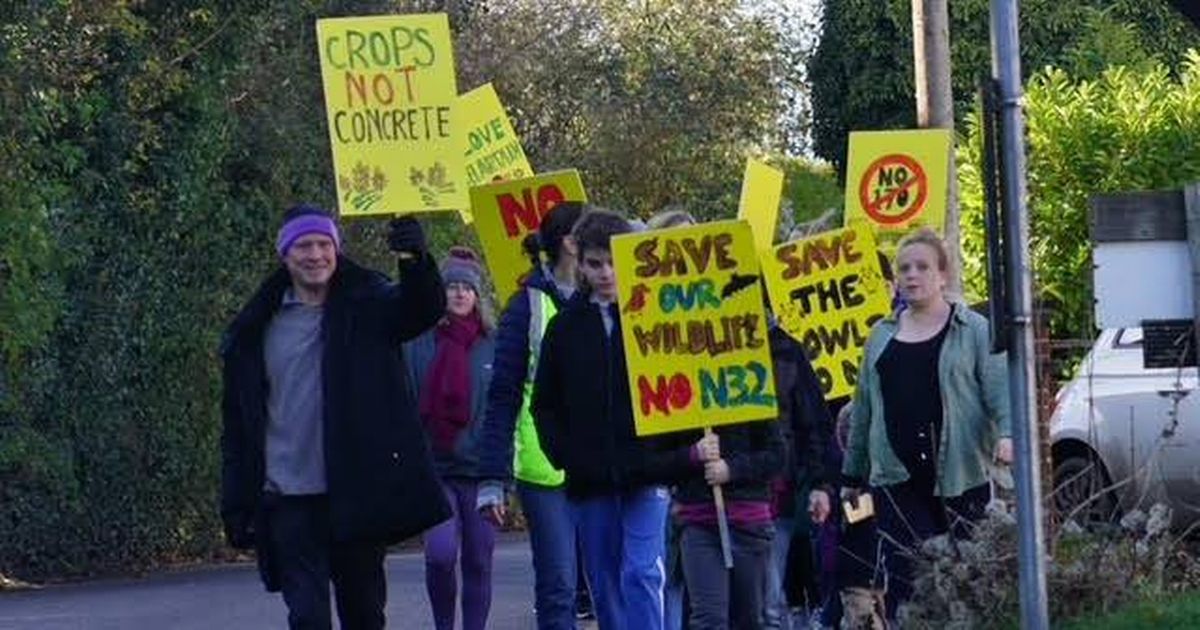
Residents claim the village’s infrastructure won’t be able to cope with the new homes

Almost 800 residents are calling for “crops not concrete” after a field on the edge of their village was earmarked for 170 homes.
Environmental groups are also opposing plans for that number of new properties on the plot just off Rattington Street in Chartham, near Canterbury.
Residents say the village’s infrastructure is “not working as it should do” and cannot handle a new estate at that site.
The land is included in Canterbury City Council’s draft local plan – the housing blueprint for the district which covers the period up to 2040. But Chartham Parish Council’s neighbourhood plan says there should be only 13 properties built there.
People backing the Crops not Concrete movement have even marched through the village in opposition to the proposals.
Alison Jackson, a villager involved with the campaign who has lived in Chartham for 40 years, said: “Infrastructure in the village is not working as it should – so additional houses and cars are the issue.
“We’ve raised nearly 1,000 signatures on our petition. Members of the group have been going out and knocking on doors and speaking to people directly. There’s a strong feeling in the village supporting our action and there are a lot of people in the village saying this.”
As well as the Rattington Street site on the edge of the village, the local plan also proposes up to 165 homes on the site of the Chartham Paper Mill, which closed down in 2022.
“Everyone I’ve spoken to in the village is supportive of the 165 homes proposed there,” said campaigner Hannah Downs. “It’s not us saying that we don’t want any new homes in Chartham; it’s about being careful as to where they are put.”
The former mill sits right in the centre of the village, near the railway station.
Ms Downs added: “There are also concerns about the services within the village and their ability to support a significant number of extra houses.
“The GP surgery is pretty much at capacity at the moment. Putting another 335 homes in the village, including this site, would potentially put them into the dangerous levels in terms of patients they can support.”
The plans for the site have also drawn criticism from environmental bodies. The Kent branch of the Campaign to Protect Rural England (CPRE) says development on the site is “wholly inappropriate.”
The group instead endorses the parish council’s “neighbourhood-scale approach”, saying it “represents the right balance between meeting local housing needs and safeguarding environmental and heritage assets”.
The Woodland Trust has also objected to the proposals as part of the city council’s local plan consultation.
If the site is included in the final version of the housing blueprint – set to be submitted to the government in the summer – it does not give permission for any homes there specifically.
Developers will still have to come forward with applications to build on the site, which the council’s planning committee will assess.
Councils must produce local plans setting out how they intend to meet targets calculated by central government – Canterbury’s is 1,216 new homes every year.
If a local authority does not have a local plan, it enters a “state of presumption in favour of sustainable development”, which effectively means it becomes harder to control the location of housing, as it must approve applications it might otherwise refuse.
A city council spokesman said: “Our most recent round of public consultation on the draft local plan ended in October and officers are currently analysing all of the feedback that was received.
“Every single one of the comments received during that consultation and the previous consultations will be taken into account as we prepare the final draft version of the local plan – known as Regulation 19 – early next year.
“All previous comments will also be forwarded to the Secretary of State for Housing, Communities and Local Government, who will appoint a planning inspector.
“They will then hold a public inquiry, known as an examination in public, into the draft plan.”
