




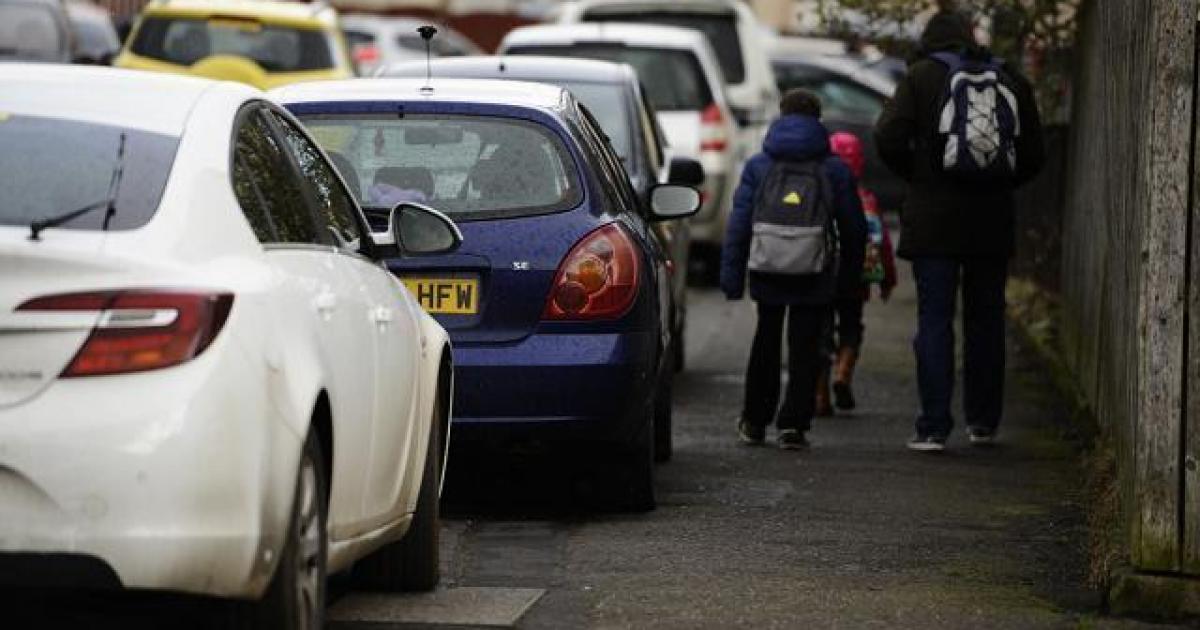

The local authority will launch the scheme on January 5, 2026, under new Scottish Government legislation that makes it illegal to park on pavements, double park, or park at dropped kerbs intended for pedestrian crossings.
The law does not apply to dropped kerbs at private driveways.
READ MORE: Questions over teacher parking discounts amid Glasgow permit rollout
READ MORE: Fears over proposed parking controls in Glasgow’s Southside
READ MORE: 24 East Renfrewshire streets to be exempt from pavement parking fines
A three-month “soft launch” period will be in place from January 5 to March 31, 2026, to allow residents, businesses and visitors time to adjust to the new rules before full enforcement begins on April 1.
Councillor Danny Devlin, convener for environment and housing at East Renfrewshire Council, said: “The new rules aim to reduce danger and inconvenience to people walking, wheeling, and cycling because of pavement parking.
“By introducing enforcement, the council hopes to make pavements and roads safer for everyone to use.
“This will prioritise the safety of people in wheelchairs, those with mobility issues, and people with buggies and prams, who will be able to walk or wheel without having to go onto the road to pass a vehicle parked on a pavement, which many have to do currently.
“As the council begins the roll-out of the pavement parking ban drivers are urged to adopt this change early to avoid being issued with a penalty charge notice.”
During the soft launch period, vehicles found parked on pavements will receive warning notices.
These will advise drivers of the new rules and inform them that repeat offences will result in a penalty charge notice once formal enforcement begins.
From April 1, 2026, offenders could face a £100 fine, reduced to £50 if paid within 14 days.
To prepare for the implementation of the ban, the council carried out a comprehensive survey of all streets in East Renfrewshire.
This assessment considered factors such as speed limits, off-street parking availability, existing restrictions, street type, road and pavement width, current parking behaviour and proximity to key facilities like schools, train stations and health centres.
The survey also identified areas that may qualify for exemptions.
The council’s approach to enforcement has been approved by elected members.
Any exemptions will be subject to a statutory process, and final approval will be required before exemption orders are put in place.
Once approved, exempted streets will be clearly signed to inform road users that pavement parking is permitted.
Transport Scotland guidance allows exemptions where 1.5 metres of pavement remains unobstructed for pedestrians or where pavement parking is necessary to allow emergency vehicles access.
The council will continue to review the ban and may update its approach and exemptions if significant issues arise, in accordance with Transport Scotland criteria.
Residents are encouraged to visit eastrenfrewshire.gov.uk/pavement-parking-ban for more information and to view exemption map.
