




NASA opens the International Space Station for scientists and researchers, inviting them to use the benefits of microgravity for private industry research, technology demonstrations, and more. Today, half of the crew’s time aboard station is devoted to these aims, including medical research that addresses complex health challenges on Earth and prepares astronauts for future deep space missions.
Supported by knowledge gained from space station experiments, researchers at Merck Research Labs received approval in September from the U.S. Food and Drug Administration for a new injectable version of a medication used to treat several types of early-stage cancers called pembrolizumab, also known by its brand name KEYTRUDA. The development of the injectable formula has been supported by research efforts aboard the space station through the ISS National Laboratory, resulting in reduced treatment times while maintaining its efficacy.
Originally, the treatment was delivered during an in-office visit via infusion therapy into the patient’s veins, a process that could take up to two hours. Initial delivery improvements reduced infusion times to less than 30 minutes every three weeks. The newly approved subcutaneous injectable form takes about one minute every three weeks, promising to reduce cost and significantly reduce treatment time for patients and healthcare providers.
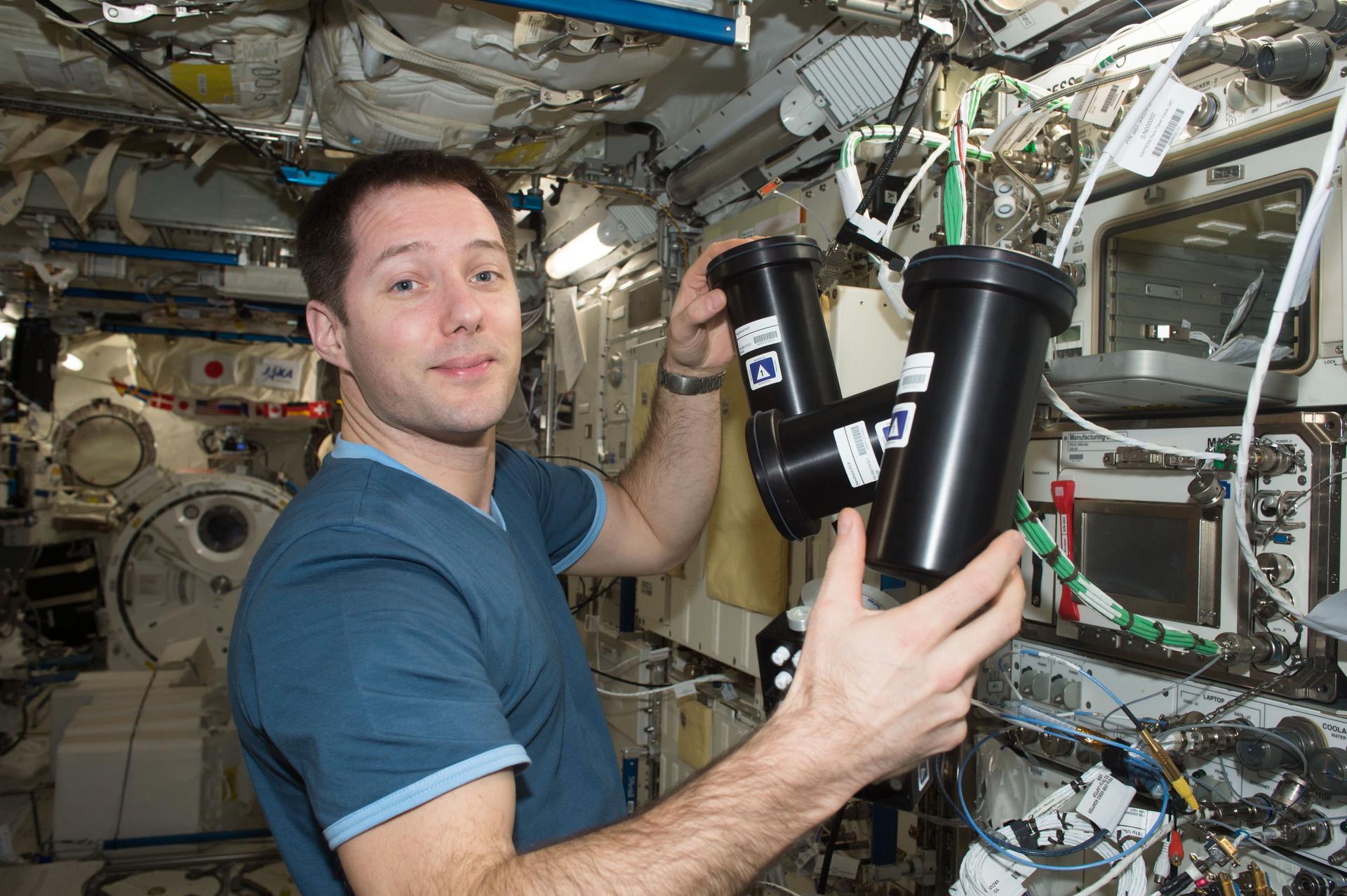
Since 2014, Merck has flown crystal growth experiments to the space station to better understand how crystals form, including the monoclonal antibody used in this cancer treatment. Monoclonal antibodies are lab-made proteins that help the body fight diseases. This research focused on producing crystalline suspensions that dissolve easily in liquid, making it possible to deliver the medication by injection. In microgravity, the absence of gravity’s physical forces allows scientists to grow larger, more uniform, and higher-quality crystals than those grown in ground-based labs, advancing medication development and structural modeling.
Research aboard the space station has provided valuable insights into how gravity influences crystallization, helping to improve drug formulations. The work of NASA and its partners aboard the space station improves lives on Earth, grows a commercial economy in low Earth orbit, and prepares for human exploration of the Moon and Mars.
